

Nimal Sanderatne.
The Sri Lankan economy achieved a 5 per cent growth last year, inflation was contained at 5 per cent and foreign reserves (including a Chinese yuan swap facility equivalent of US$ 1.5 billion) increased to US$ 6.1 billion.
Although the economy achieved a 5 per cent growth last year, this year’s growth is expected to dip to 3 per cent. Inflation that was contained at 5 per cent last year is expected to rise sharply amidst scarcities and high prices of essentials.
The year ahead is fraught with considerable uncertainties and downside risks.
Annual review
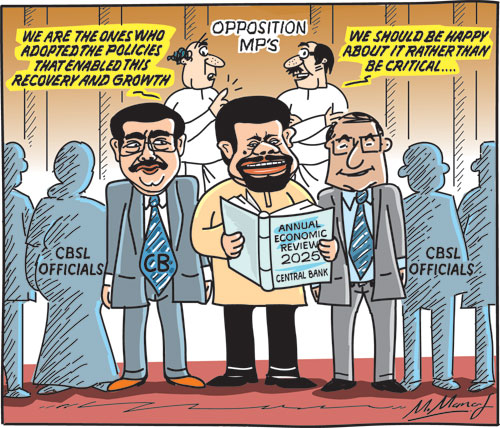
The Central Bank’s Annual Review of the economy for 2025, formerly known as the Annual Report, presents a picture of the economy stabilising and achieving an economic growth of 5 per cent last year.
Three sectors
All three sectors of the economy contributed to the growth. Agriculture grew by 1.4 per cent, manufacturing (including construction) grew by 7.8 per cent and services grew by 3.3 per cent. Inflation was contained at 5 per cent.
External Sector
The country’s gross official external reserves reached US$6.1 billion by the end of 2025 in spite of a widening trade deficit. The main contributors to the growth of external reserves were tourism and remittances from abroad.
Tourism and remittances
Earnings from tourism reached a record high of US$4 billion, and remittances increased to US$7 billion.
Undoubtedly last year was one of economic stabilisation and growth.
First year
The calendar year 2025 coincided with the NPP/JVP government’s first year in office. Consequently, last year’s economic performance is viewed through politically tinted lenses.
Government’s claim
The government would no doubt claim that the economic growth was due to its economic management, while the opposition parties say that the economic performance and the growth last year were due to the government following their policies that the JVP criticised while in opposition and said it would jettison such policies.
Objective view
The objective way of viewing this economic performance is that the government was pragmatic in its approach rather than adhered to its doctrinaire position. It is to the credit of the government that it followed a realistic policy approach rather than a doctrinaire one.
The plain truth is that there was no other option for the government. The critics of these policies, including those within the government, have not spelt out an alternate way.
President Anura Kumar Dissanaike could say, “I did it my way.”
Conclusion
The current global economic crisis caused by the West Asian war will create severe hardships and depress growth and increase inflation this year. The IMF has forecast that the Sri Lankan economy will grow at only 3 per cent and that inflation that was contained at 1.6 per cent last year is expected to rise sharply amidst scarcities and high prices of essentials.
However, this year’s growth is expected to decrease sharply amidst scarcities and high prices of essentials.
International tensions, blockades of international waterways, and destruction of economic infrastructure have reached a breaking point where there has to be an end to the current chaos. We conclude with the expectation of an early end to the current hostilities between Iran and the US-Israeli alliance, and there will be peace soon.