
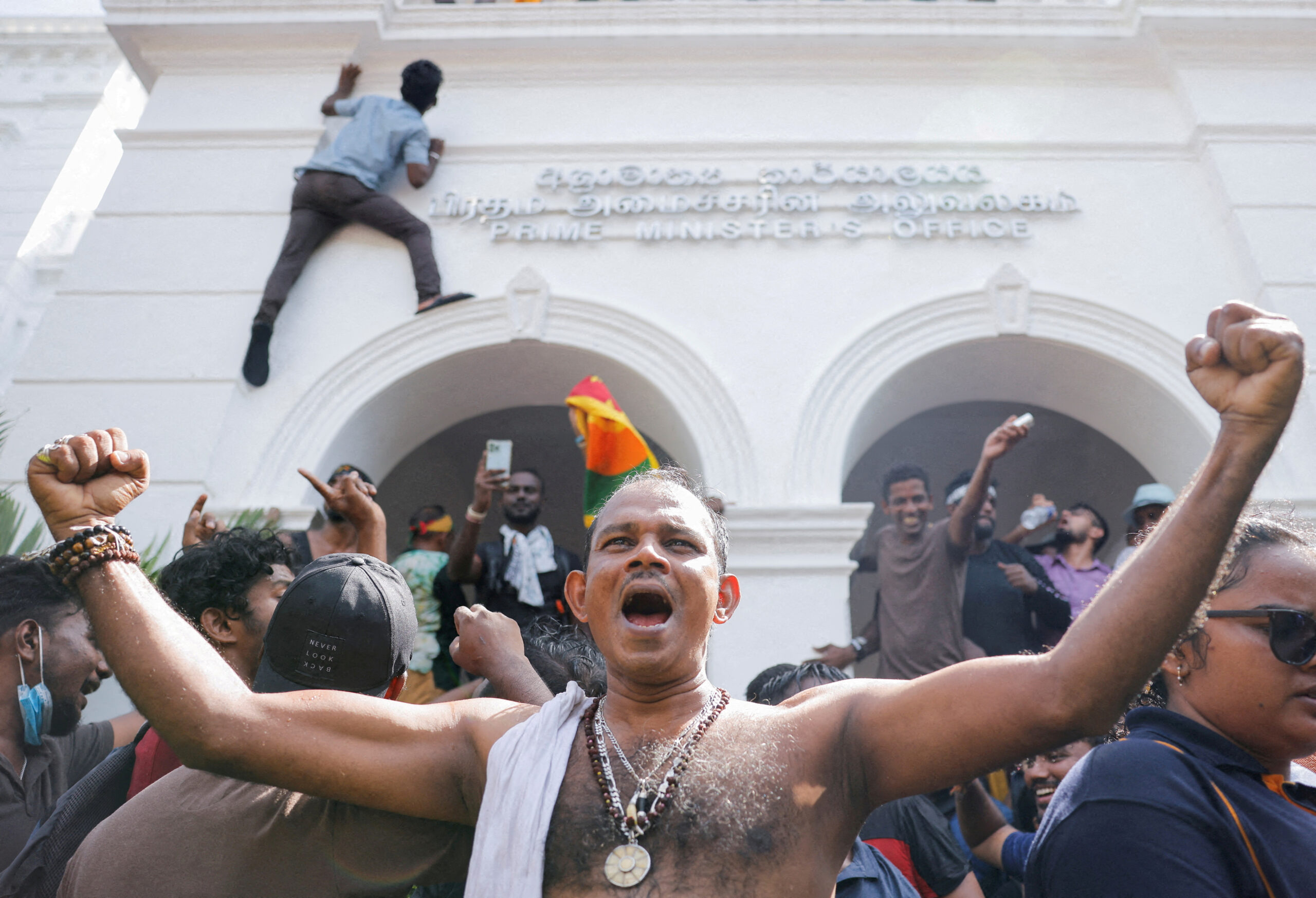

Creator: Dinuka Liyanawatte | Credit: REUTERS
Yavid Yusuf.
Sri Lanka’s political history has witnessed many dramatic changes of government, fierce electoral contests and periods of deep public dissatisfaction. Yet, until 2022, governments were removed primarily through constitutional and democratic means. Elections, parliamentary shifts and negotiated political transitions ensured that however bitter political rivalries became, the state itself retained a measure of stability. The People’s Uprising of 2022, popularly known as the aragalaya, broke fundamentally from that tradition and exposed a dangerous structural weakness in Sri Lanka’s system of governance — the excessive concentration of power in the executive presidency.
The aragalaya was unprecedented because it was not led by a political party, trade union or a single charismatic leader. It emerged spontaneously from the frustrations and suffering of ordinary citizens. Long queues for fuel, acute gas shortages, crippling inflation, medicine scarcity and the collapse of livelihoods pushed people beyond endurance. Farmers faced devastation due to ill-conceived agricultural policies, while the middle class watched its savings and economic security evaporate. For many citizens, daily life itself had become unbearable.
People from all communities, professions and age groups gathered at Galle Face and established the now historic Gotagogama. What united them was not ideology but a shared sense that the country’s leadership had failed catastrophically. The slogan Gota Go Home symbolised not merely personal anger against then President Gotabaya Rajapaksa, but a wider rejection of the entire governing structure that had become unresponsive to the suffering of the people.
Importantly, the aragalaya did not begin as a movement for system change. That demand emerged later through discussions among protesters, intellectuals and civic activists. In its early stages, the uprising was simply a cry of desperation from a population trapped in an economic nightmare with no constitutional mechanism to immediately replace a government that had lost public confidence.
This is the central lesson Sri Lanka must not ignore.
In functioning democracies, constitutional systems provide peaceful and orderly methods for removing governments that lose legitimacy. In parliamentary democracies, governments can be defeated through votes of no confidence, internal party revolts or parliamentary realignments. Such systems create political flexibility and allow public anger to be channelled institutionally rather than through street confrontations.
Sri Lanka’s Executive Presidential system, however, severely restricts such democratic flexibility. Once elected, an Executive President enjoys sweeping powers and remains largely insulated from direct public accountability during the term of office. Even where the people overwhelmingly lose confidence in the President, there is virtually no practical constitutional mechanism for removal except impeachment.
Under the Constitution, a President may only be removed on limited grounds such as intentional violation of the Constitution, treason, bribery, misconduct involving abuse of office, corruption, or physical or mental incapacity. The impeachment process itself is highly complex and politically cumbersome. It requires a resolution signed by not less than two-thirds of Members of Parliament, followed by investigation and determination by the Supreme Court and eventual parliamentary approval by a two-thirds majority.
In practical political terms, this process is almost impossible unless the President has already lost the support of his or her own parliamentary majority. In Sri Lanka’s political culture, where almost sycophantic loyalty to powerful leaders often overrides institutional independence, Members of Parliament are reluctant to challenge an incumbent executive president. The failed impeachment attempt against President Ranasinghe Premadasa in the early 1990s remains a classic example of how difficult it is to constitutionally remove a sitting President even amid significant political dissatisfaction.
This constitutional rigidity was starkly exposed during the aragalaya.
By mid-2022, public confidence in the government had completely collapsed. Yet the constitutional structure offered no realistic avenue for immediate democratic correction. Parliament itself could not remove the president merely because the people had lost faith in him. The government therefore continued to survive despite overwhelming public rejection.
As frustrations intensified, the people eventually took matters into their own hands. Protesters stormed key state institutions including the President’s House and the Presidential Secretariat. President Gotabaya Rajapaksa fled the country and ultimately tendered his resignation from abroad. While many celebrated this as a triumph of people’s power, the reality is that the country had come perilously close to complete breakdown.
No democracy can safely depend on mass uprisings as a mechanism for political transition.
The aragalaya may have remained largely peaceful for much of its duration, but future uprisings may not. Economic collapse, political instability and institutional paralysis create fertile ground for violence and anarchy. Once constitutional pathways fail, extra-constitutional methods inevitably emerge. This is the danger Sri Lanka faces if meaningful constitutional reform is delayed further.
Some political observers argue that the events of 2022 were unique and unlikely to recur. That assumption is dangerously complacent. The underlying structural conditions remain unresolved. Economic recovery remains fragile, public distrust in political institutions persists, and frustration with governance continues across many sectors of society. If another severe economic or political crisis emerges while the executive presidency remains intact, citizens may once again feel trapped in a system incapable of responding to their suffering.
The next uprising could be far more destructive.
Sri Lanka was fortunate in 2022 that despite isolated incidents of violence, the state did not descend fully into chaos. But examples across the world demonstrate that when public anger erupts outside constitutional boundaries, outcomes can become unpredictable and catastrophic. Social unrest can quickly spiral into prolonged instability, communal tensions, economic paralysis and the collapse of democratic institutions themselves.
The abolition of the executive presidency is therefore not merely a political slogan. It is a democratic necessity.
Critics of abolition often argue that Sri Lanka needs a strong executive president to ensure stability and decisive governance. Yet the events of 2022 demonstrated precisely the opposite. Excessive concentration of power can produce arrogance, policy blunders and institutional paralysis because decision-making becomes insulated from accountability. When such leadership fails, the entire state structure becomes vulnerable because there are insufficient constitutional safeguards to correct the situation peacefully.
A return to a stronger parliamentary system would restore collective responsibility and democratic responsiveness. Governments that lose public confidence could be changed through Parliament without threatening the stability of the state itself. Political crises would remain within constitutional boundaries instead of spilling onto the streets.
Abolishing the executive presidency alone will not solve all of Sri Lanka’s problems. Broader reforms relating to corruption, judicial independence, electoral accountability and public administration are also essential. But removing the excessive concentration of executive power is the first and most fundamental step toward meaningful democratic reform.
It is therefore deeply disappointing that the National People’s Power government, now approaching two years in office, has yet to take concrete steps toward abolishing the Executive Presidency despite repeated public expectations and longstanding promises. It is equally or more disappointing that the Opposition parties are not raising the issue and seem to have pushed it to the back burner. The delay in the NPP Government addressing this isssue raises legitimate concerns about whether political parties, once in power, become reluctant to surrender the enormous authority that the office provides.
Sri Lanka cannot afford another constitutional failure of the kind witnessed in 2022. The aragalaya was not simply an economic protest. It was a warning from the people that democratic systems which deny peaceful mechanisms for accountability will eventually face explosive public backlash.
If that warning is ignored, the country risks repeating history under even more dangerous circumstances.
The choice before Sri Lanka is therefore clear. Either meaningful constitutional reform with the abolishing of the executive presidency taking precedence is undertaken now through democratic consensus, or future generations may once again be forced onto the streets to demand change outside constitutional structures. The consequences next time may not end with a resignation and transition of power. They could instead push the nation toward prolonged instability and anarchy far worse than the economic crisis the country is struggling to recover from.
Courtesy of Sunday Times