

“I DIED MANY TIMES”
Issued pursuant to the mandate of the United Nations High Commissioner for Human Rights under General Assembly resolution 48/141 and Human Rights Council resolutions 46/1, 51/1, 57/1 and 60/1, this Brief documents the pattern of attacks against humanitarian personnel, medical and humanitarian infrastructure, and relief operations during Sri Lanka’s armed conflict, particularly between 2006 and May 2009.
Drawing on information and evidence compiled in OHCHR’s repository and consultations with 16 individuals engaged in humanitarian operations and medical service provision in conflict-affected areas between 2005 and 2009, the Brief finds that attacks on humanitarian actors and objects, restrictions on humanitarian access and the denial of essential assistance were neither isolated incidents nor incidental consequences of hostilities. Rather, they formed part of a sustained pattern that progressively dismantled humanitarian capacity, deepened civilian suffering and deprived affected populations of life-saving assistance and protection. This contributed to one of the most severe collapses of humanitarian protection recorded in a contemporary armed conflict. Two decades later, accountability for these serious violations of international law remains largely absent. This impunity continues to weigh on the families of those killed and injured and on their surviving colleagues, who remain without recognition or redress.
The Sri Lankan record acquires particular salience in the present moment. Attacks against humanitarian personnel, infrastructure and operations, alongside the denial or restriction of humanitarian access, have become defining features of contemporary armed conflicts. More than 1,010 humanitarian workers were killed between 2023 and 2025, almost three times the figure recorded in the preceding three years. The Inter-Agency Standing Committee has described the present period as an “era of impunity”. Many of those consulted for this Brief drew the parallel with other contemporary conflicts unprompted and in strikingly similar terms, describing the impunity that followed Sri Lanka’s war as a precedent that emboldened perpetrators elsewhere.
Contextual Background
Restrictions on humanitarian access predated the final phase of the conflict and were imposed by all parties, albeit in different forms. Successive Governments restricted the movement of essential goods and humanitarian operations in areas controlled by the Liberation Tigers of Tamil Eelam (LTTE), while humanitarian organisations faced surveillance, arbitrary searches, checkpoint delays and restrictions on supplies. The LTTE also imposed restrictions on civilian movement and humanitarian personnel, including through its pass system. These measures progressively weakened humanitarian capacity and increased civilian vulnerability. United Nations assessments warned, even before 2006, that the humanitarian response was ill-equipped to withstand a major military offensive.
From 2006 onwards, these restrictions escalated into direct attacks on humanitarian personnel and infrastructure. Local organisations, particularly in Tamil-majority areas, also faced surveillance, asset freezes and proscription, while official narratives portraying humanitarian personnel as LTTE sympathisers further undermined their security. A decisive turning point came in September 2008, when the Government ordered United Nations agencies and international NGOs to withdraw from the Vanni. The subsequent departure of international personnel, followed by the withdrawal of the International Committee of the Red Cross (ICRC) from land-based operations in February 2009, severely reduced humanitarian access and removed a critical protection and monitoring presence.
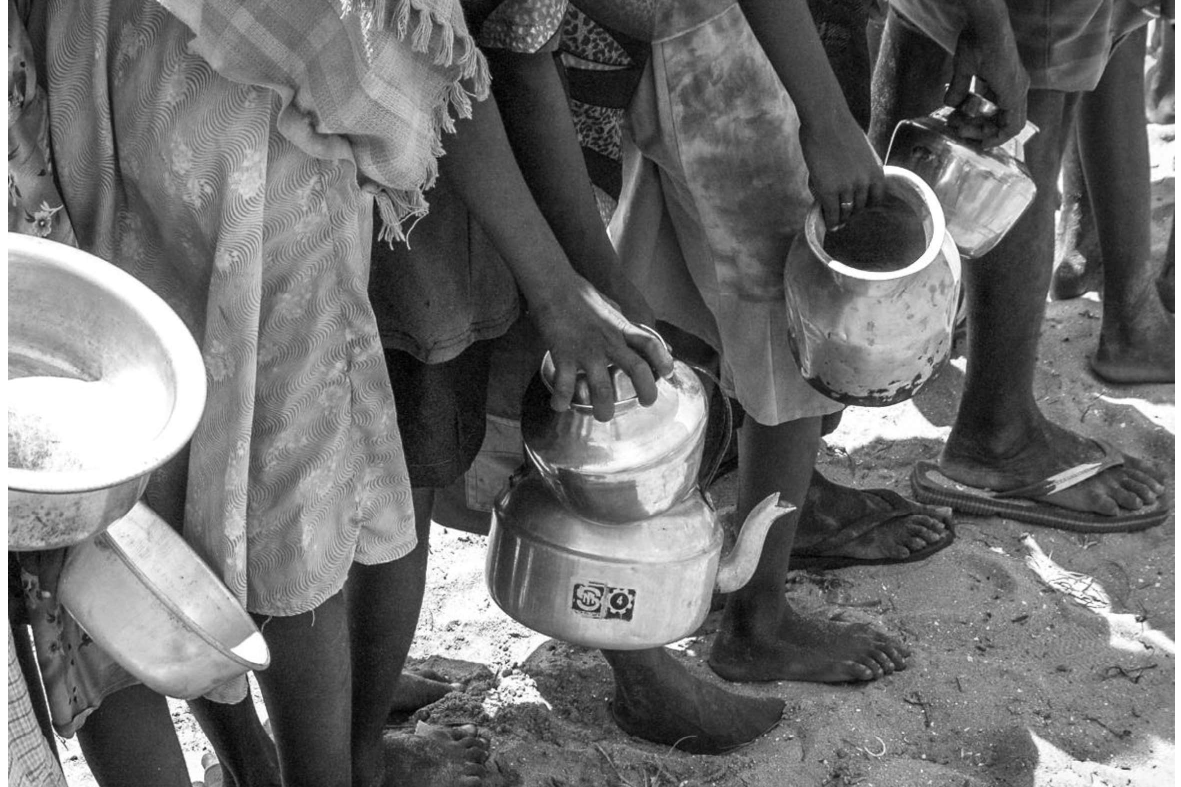
During the final offensive, attacks on medical facilities escalated. Restrictions on food and medical supplies also intensified, with deliveries falling far below assessed requirements. Severe shortages of essential medicines and surgical equipment compromised medical treatment, while malnutrition and hunger reached critical levels. By the final weeks, civilians trapped in a narrow coastal strip under continuous shelling had virtually no access to humanitarian assistance, and the last functioning hospital had ceased operating.
The Brief examines four emblematic incidents: the disappearance of staff members of the Tamil Rehabilitation Organisation on 29 and 30 January 2006; the killing of 17 Action Contre la Faim (ACF) staff in Muttur in August 2006; the shelling and obstruction of United Nations “Convoy 11” in January 2009; and the shelling of Puthukkudiyiruppu (PTK) Hospital between January and February 2009. In none of them has any individual been held criminally responsible. The available evidence suggests that attacks, restrictions and deprivations affecting civilians and humanitarian relief occurred despite the Government’s knowledge of civilian locations and humanitarian needs. The Secretary-General’s Panel of Experts found credible allegations that Government forces had committed war crimes, including attacks on medical and humanitarian objects and the starvation of civilians through the denial of humanitarian relief, while the OHCHR Investigation on Sri Lanka (OISL) report found reasonable grounds to believe that numerous serious violations by all parties may amount to war crimes.
However, despite extensive documentation gathered over the years, meaningful accountability has yet to ensue, with the cases examined in this Brief exposing persistent drivers of impunity, including denial of State responsibility, ineffective investigations and prosecutions, inadequate protection of victims and witnesses, and reliance on commissions of inquiry in place of criminal accountability.
The Brief also examines the United Nations’ own response. It recalls the finding of the Secretary-General’s Internal Review Panel that, despite the courage shown by individual staff members, the United Nations failed to meet its responsibilities to protect civilians, respond to early warnings and ensure principled humanitarian and human rights action. These failures do not diminish the State’s primary responsibility to investigate and prosecute serious violations.
Voices of Humanitarians
The consultations carried out revealed strikingly consistent accounts of the final phase of the conflict and its enduring consequences. Consultees described how humanitarian work itself became grounds for suspicion and intimidation, with national staff particularly exposed. They identified the withdrawal of international organisations in September 2008 as a decisive turning point that deprived civilians not only of humanitarian assistance but also of an international presence capable of witnessing and documenting violations.
Many described the progressive restriction and manipulation of humanitarian assistance as contributing to increasingly unbearable conditions for civilians trapped in the conflict area. Medical personnel recalled working with overwhelming numbers of wounded and critically ill patients while lacking essential supplies, often unable to provide life-saving treatment. Humanitarian workers spoke of profound powerlessness, but also of a lasting sense of responsibility to bear witness to what they had experienced. For many, trauma and distress have persisted, compounded by years of unsuccessful efforts to obtain truth, recognition and accountability. The continued impunity leaves those affected without recognition, truth, or redress, while reinforcing concerns that failure to address such violations risks their recurrence elsewhere.
Conclusion and Recommendations
The report was shared with the Government of Sri Lanka in advance of its publication, providing an opportunity to comment, but no reply had been received by the time of publication.
OHCHR calls for a clear commitment to truth, accountability and non-recurrence, beginning with the State’s formal acknowledgement of attacks against humanitarian and medical personnel, facilities and operations, including those involving State security forces, and a public apology, together with adequate and comprehensive reparations for the families of those killed or disappeared and for surviving colleagues.
Prompt, independent and impartial investigations should address not only individual incidents but also whether attacks against humanitarian actors and restrictions on humanitarian assistance formed part of a broader policy or plan. This requires strengthening the independence and capacity of prosecutorial institutions, establishing an independent prosecutorial mechanism, incorporating war crimes and crimes against humanity into domestic legislation, and acceding to relevant international instruments, including the Rome Statute.
The Government should also take concrete measures to prevent recurrence by reforming the security sector, ensuring appropriate vetting of personnel implicated in serious violations, strengthening effective and independent victim and witness protection, and ending surveillance, intimidation and reprisals against victims, their families, human rights defenders and journalists.
OHCHR also recommends sustained international scrutiny and, where domestic efforts remain inadequate, support for accountability through international investigations, prosecutions, targeted sanctions, and rigorous human rights vetting of Sri Lankan security personnel. Accountability for attacks against humanitarian action in Sri Lanka should form part of the broader international response to such violations, including efforts under Security Council resolution 2730 (2024) and the 2025 Declaration for the Protection of Humanitarian Personnel, helping ensure that the impunity witnessed in Sri Lanka does not become a precedent for other conflicts.
– OHCHR Sri Lanka accountability project
This is an Executive Summary of the report 2026-report-attacks-against-humanitarian-assistance-in-sri-lanka