
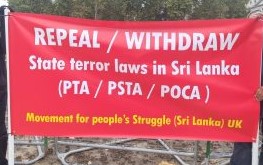

In the space of a week, the Supreme Court determined that both the Protection of the State from Terrorism (PSTA) Bill and the Prevention of Organised Crimes (POC) Bill can pass with a simple majority once amended, with the speaker announcing the second determination on November 21. Neither set of amendments touches the powers that bear most on freedom of expression, privacy and encrypted communication from compelled decryption and access to call and location data without a court order to offences that turn witnessing, reporting and silence into crimes. The president has promised public consultation before either Bill passes and a Cybersecurity Bill nobody outside government has seen is expected to become law in early 2027, which leaves Sri Lanka’s partners a short window to press for change.
In August, in a report titled A perfect storm: Digitalisation, new laws, draft bills, and threats to civic space in Sri Lanka, I mapped at least seven laws and draft laws since 2023 that bear on what citizens and organisations may say, publish, fund and organise and warned that the gravest danger lay in what I called interaction design, since a power dropped from one law turns up in another, while the digital state being built underneath strips away the friction that once limited what any of them could do. The POC Bill is the eighth and it brings back the decryption power the revised PSTA dropped. Because the court reviews each Bill’s text rather than how it combines with other laws, the November determinations make those warnings more prescient and pertinent, not less.
Neither determination deals with how these laws combine, which leaves that question with parliament, the president and, in practice, Sri Lanka’s international partners who are actively funding digitalisation, and AI architectures that must be seen as dual use technologies affording unprecedented repression, surveillance, discrimination and targeted violence against dissent.
Key findings
-
- Both Bills cleared constitutional review in November 2026 with amendments that leave their powers over speech, phones, data and disclosure largely intact
- The POC Bill lets a Superintendent of Police, with a Magistrate’s order, compel any provider of “locking or encryption services” to open what it holds, a power I warned in August would expose users of end-to-end encryption (E2EE)
- A Deputy Inspector General can obtain subscriber details, call records and phone tower locations under the POC Bill without any court order, which is enough to identify a journalist’s source without reading a single story
- The revised PSTA punishes gathering or sharing information about police or military activity with up to 15 years with no test of secrecy or harm so that filming an arrest or posting about a raid could qualify
- Both Bills punish failing to report others to the police with up to seven years and the POC Bill exempts only lawyers, the court holding that the duty falls on every citizen alike, which reaches journalists and WhatsApp group administrators
- The Online Safety Act (OSA) remains in force, unamended, and has already been used by a private bank against people discussing its own data breach
- A third draft Cybersecurity Bill went to the Attorney General in October 2026 unpublished, and the last public version allowed warrantless searches, put the defence establishment on the regulator’s board and required anyone offering cybersecurity advice to be approved
- The Personal Data Protection Act (PDPA) offers little refuge, since the order bringing it into greater force on 1 January 2027 leaves out the rights to see, correct or erase personal data
- The POC Bill revives executive detention for ordinary crime, with a Ministry Secretary issuing orders of up to one year and every power surveyed here ends at the executive presidency
- Once enacted, neither Bill can be challenged for constitutionality in any Sri Lankan court so the window for change is the promised consultation and the committee stage, where partners’ GSP+, FATF, UN and development finance relationships give them standing
Key recommendations
-
- Press for a consultation that is real, with consolidated amended texts of both Bills published in Sinhala, Tamil and English and enough time for comment before any committee stage
- Remove the decryption obligation on providers of E2EE services from the POC Bill and say plainly that partners will not support measures that weaken encryption for everyone
- Put a judge in front of every device search and data request, including the call, subscriber and location data a Deputy Inspector General can now obtain without one
- Narrow the PSTA’s offence on information about police and military activity to genuinely secret material whose disclosure causes demonstrable harm and add a saving clause for journalism, research, protest and advocacy to both Bills
- Limit the duty to report to serious violent offences and carry the PSTA’s exclusions for protected, professionally secret and self-incriminating information into the POC Bill
- Ask that the third draft of the Cybersecurity Bill be published for consultation before it is gazetted with civilian control, judicial warrants for searches and protection for independent security research
- Seek repeal of the OSA’s false statement offence now rather than await a replacement that has yet to appear
- Bring the PDPA fully into force, including the rights to see, correct and erase personal data before any new interception, data-sharing or database powers take effect
- Drop executive detention from the POC Bill, keeping the magistrate as the authority on liberty and make PSTA proscription orders expire unless renewed with judicial review
- Tie support for digital public infrastructure (DPI) and engagement through the FATF process to published rules on who may query a national data exchange and to NGO regulation that is proportionate and risk-based, as Recommendation 8 requires
General statements of concern about civic space have been met for years with general assurances whereas a request tied to a specific power, a specific safeguard and a specific point in the legislative process gives the government something it can agree to, and Parliament something it can be held to. Safeguards that arrive after systems connect cannot undo what has already been collected, shared or used and partners will carry more weight if they build on the concerns civil society, journalists’ associations and the Human Rights Commission of Sri Lanka have already set out in all three languages. If the Bills pass in their present form, monitoring how they are used becomes the only remedy left, allowing for unprecedented (algorithmic, AI-enabled, structural) online, and offline harms against already vulnerable identities and communities who have been historically discriminated against.
Where things stand
The revised PSTA Bill, published in a Gazette supplement dated September 18, 2026 and released on September 22 supersedes a widely criticised December 2025 draft and is meant to replace the Prevention of Terrorism Act (PTA) and the court’s determination requires four amendments, each about how and where the courts hear challenges to decisions taken under the Bill, leaving everything else as drafted. The POC Bill, placed on parliament’s Order Paper on 20 October 2026, drew 26 petitions, and the determination read into parliament’s record on November 21 is that it may pass by a simple majority once the amendments the Acting Attorney General offered and those the Court directed are made at the committee stage.
Four official commitments are pertinent in this regard. The president said on November 7 that neither Bill would pass without public consultation with those who have genuine concerns. A senior government source told the Sunday Times on November 15 that the POC Bill would be substantially amended with additional police powers removed before being brought to parliament within next year. The government has signalled it will drop the draft NGO law’s requirement that organisations align their work with government policy after a review held ahead of Sri Lanka’s Asia/Pacific Group mutual evaluation from October 26 to November 6. The Deputy Minister of Digital Economy has told parliament that a third draft of a single Cybersecurity Bill went to the Attorney General in October and should become law in early 2027 although no one outside government (and very likely, few within it) has seen it.
A perfect storm revisited
Three warnings in a perfect storm bear directly on what the Supreme Court has now cleared. The first was that the December 2025 PSTA draft’s treatment of information about officials and security operations rendered witnessing itself, by anyone, anywhere and in any language, a plausible offence and the revised PSTA keeps an offence of that kind. The second was that its decryption power could not be obeyed by providers who hold no keys so that it would instead expose the people who use encryption and treat privacy as evidence of something to hide, and that power, dropped from the revised PSTA, now sits in the POC Bill. The third was that a cybersecurity law modelled on the 2023 draft and hurried through after the Treasury’s losses would wire the defence establishment into a civilian regulator and the government now holds a third draft no one outside it can read. Underneath all three sits the digital state (or put another way a state undergirded by digitalisation and official AI systems).
In July 1983, mobs used voter registration lists to find Tamil homes street by street, turning a paper register compiled for an unrelated purpose into a targeting tool within days and my argument in August was that digitalisation doesn’t create the intent to harm so much as remove the friction that once held it back. The Sri Lanka Unique Digital Identity (SL-UDI), funded by a Rs. 10.4 billion Indian grant and built on face, fingerprint and iris biometrics, is due to issue its first identities by the end of 2026 alongside a national data exchange meant to let one agency see what another holds, which I called surveillance by default, if not by design. To uphold several POC provisions, the court relied on its own PSTA determination and on similar powers already in the PTA and other laws. What one law is allowed to do becomes the reason to allow the next. That is the interaction design I warned of in August, cleared one Bill at a time, while no one, including Sri Lanka’s bilateral and multilateral partners, examines the whole.
Threats to freedom of expression
The Online Safety Act, No. 9 of 2024 is still law despite repeated promises to replace it with up to five years in prison for a “false statement” and a Commission the president appoints and its use so far has run to dissent and media disputes, including the orders Cargills Bank obtained in April 2025 against people discussing the bank’s own data breach. The revised PSTA adds up to 15 years for gathering or sharing information about police or military activity where there is reason to believe it will be used for an offence under the Act with no test of whether the information was secret or whether sharing it did any harm and lets the officer in charge of a police station ban a gathering before a magistrate has seen the order so that a video of an arrest, a post about a raid or a message telling friends where a police cordon is could each qualify.
The POC Bill reaches speech through silence. Its tipping off offence, which covers telling anyone that the police are investigating a group, carries up to 10 years and exempts only lawyers while its duty to report carries up to seven years with the same single exemption, and when petitioners raised the example of a priest hearing confession, the court held that the obligation falls on every citizen alike whereas the PSTA’s equivalent duty at least exempts protected information, professional confidences and self-incrimination. So a journalist protecting a source, a doctor or the administrator of a WhatsApp group must inform or risk prison. The amendments strike out dress, tattoos and language as signs of membership of a criminal group and delete the ban on reporting court proceedings without permission, both real improvements, although an undefined suspicious association still counts. As I wrote in August, this architecture results in an unprecedented chilling effect long before it coerces.
Threats to privacy and encrypted communications
Under the PSTA police, soldiers and coast guard officers can seize a phone or laptop without a warrant if they suspect an offence, and send it to any other local or foreign expert while a soldier may hold someone for up to 24 hours before handing them to the police with nothing in the Bill to stop a demand for a passcode or a thumb pressed to the screen in that time. The POC Bill lets a Superintendent of Police, with a magistrate’s order, force any person who provides locking or encryption services to unlock what it holds and hand it over, which is for all practical purposes the decryption power in the December 2025 PSTA draft and the only change the determination records is that communications between lawyers and their clients are now protected.
WhatsApp and Signal use E2EE and, by virtue of how the technology is designed, hold no encryption keys, so the decryption order is either impossible for them to obey or a demand for a backdoor that weakens security for every user. Faced with comparable demands, Apple withdrew encrypted iCloud backups from UK users in 2025 and WhatsApp told the Delhi High Court in 2024 that it would leave India rather than break encryption, and since Sri Lanka has far less leverage than either market, the likelier result is pressure on providers and, failing that, platform blocks of the kind imposed in 2018 and 2019. The greater exposure lies outside the encrypted channel in cloud backups, seized handsets and metadata since the POC Bill also lets a Deputy Inspector General get a person’s subscriber details, call records and the location of the phone towers their calls went through without any court order, telling a magistrate in writing only after the fact.
What’s taken can end up in a new PSTA database of every arrest, detention, acquittal and conviction with no rule on who may see it or how anyone acquitted gets their name removed and can be shared with foreign governments. In August I wrote that a data protection regime arriving in 2027 to discipline systems built from 2023 is not a safeguard but an epitaph and the order bringing the PDPA into greater force on January 1, 2027 leaves out the rights to see, correct or erase personal data while neither determination mentions the Act at all. Once call records and tower locations can be had without a court, software can go looking for a suspicious association mapping who was near whom and machine translating Tamil posts with errors no one checks while nothing in either Bill limits what an algorithm may infer or how long its outputs are kept.
Old wine in new bottle? The third draft of the Cybersecurity Bill
Sri Lanka has no cybersecurity law and the state’s own record shows why it needs one. Between October 22 and 24 I found 80 state websites running versions of PHP exposed to flaws that let anyone take control of the server behind them, 61 of them on versions no longer receiving security patches, and the Deputy Minister of Digital Economy has since told parliament that 156 institutions were notified and that only 17 of the 37 critical institutions told to join the national monitoring centre by December 31 have done so. SL-CERT has no legal power to make government bodies follow the state’s own cybersecurity policy and the circular sent to every ministry sets no deadline, asks for no report back and names no official answerable for each system, three years after ransomware destroyed three months of government email on servers whose upgrade had been put off since 2021.
The government’s answer is a third draft of a single Cybersecurity Bill, which would create a Cybersecurity Authority able to make rules for compulsory audits, the reporting of attacks and enforced remediation although parliament was not told whether civilian or military control prevailed. The last public version from July 2023 put the authority’s members under a president who could remove them, gave the head of the Defence Cyber Command a seat on its board and absorbed SL-CERT so that an organisation reporting an attack would report to a body that could also investigate it. It let officials search premises and copy records without a warrant whenever the authority decided a matter was urgent, let it order internet providers to remove programmes from subscribers’ own computers without consent or court oversight and required anyone offering cybersecurity advice to be approved, a rule that could severely affect the independent research that found the 80 websites. If the third draft keeps these powers, then read with the POC Bill’s decryption and data powers it would complete the state’s reach into the devices encryption is meant to protect, and, as with the OSA, citizens may first read it only once it is gazetted with a very short window left to challenge it in the Supreme Court.
As I wrote recently, “There’s no debate around the fact that Sri Lanka needs a cybersecurity law, and an authority able to make institutions fix what they are told to fix. However, a law drafted out of public sight risks handing the state new powers over citizens’ premises, programs and professions while leaving its own neglect unchecked. Warnings sent are not websites fixed, any more than a bill nobody outside government has read can claim public consent. Until the state publishes both the third draft and the list of institutions that have fixed their websites, citizens have no way of judging either the problem or the proposed cure.”
The executive presidency and its ills
Every power in this brief ends at a single office. The president appoints the Online Safety Commission in the OSA, signs the PSTA orders banning organisations, which never expire and, as Minister of Defence, oversees the Secretary who issues PSTA detention orders and the Defence Cyber Command the 2023 Cybersecurity Bill would have seated on the regulator’s board while the POC Bill adds detention orders of up to one year signed by a Ministry Secretary and the draft NGO law’s Competent Authority answers to a minister who answers, in turn, to the president. The NPP was elected in 2024 promising to abolish that office and its ministers now call abolition a promise that cannot be prioritised, which the Centre for Policy Alternatives (CPA) described as a cavalier attitude bordering on contempt for the Sri Lankan electorate. The safeguards these laws lack were meant to come from the very reform that would have removed the office in which all of them end. That reform isn’t coming.
What’s left is the good faith of whoever holds the office, now and after 2029, which is no way to make law. Laws aren’t written for leaders we trust and in Sri Lanka they’ve never been used only against those they were sold as targeting. Think of the aragalaya in 2022 and what decryption orders, warrantless access to call and location data, a duty to inform on others and executive detention would have done to its organisers in Rajapaksa hands. The JVP, at the core of this government, knows better than any party what emergency and counter-terror powers did to its own members in 1971 and between 1987 and 1989 and yet it now presides over laws that go further.
A government produced by a mass movement that removed an executive president also understands better than any before it what a digitally coordinated protest can do to a president. Under a successor more inclined to autocracy, these laws would give that office the means to make sure it never happens again and that future is extremely bleak.
What the SC determinations do not decide
The Supreme Court’s review is confined to whether each Bill’s text as written is consistent with the constitution so the determinations are not findings that the powers they leave in place are necessary, proportionate or wise. Neither determination mentions the PDPA and the PSTA determination does not mention encryption while describing arguments about possible misuse as surmise and conjecture.
That leaves open the questions that matter most to Sri Lanka’s partners from how the Bills will work with the OSA, a Cybersecurity Bill no one has read and the digital state to whether their data and device powers meet the tests of necessity and proportionality under the International Covenant on Civil and Political Rights (ICCPR). The UN Office on Drugs and Crime’s 2022 issue paper on the Convention against Transnational Organized Crime, which Sri Lanka ratified in 2006, warns against the convention being used “as a pretext to eliminate political rivals, criminalize protest and advocacy or outlaw social groups” whereas the POC Bill has no protection for protest or advocacy, no notice after surveillance and no bar on undercover agents inciting offences. Time matters, since the constitution bars any court from questioning a law’s validity once it is enacted, so whatever passes in this form can only be challenged case by case, after the harm is done.
Implications for international partners
Sri Lanka’s GSP+ trade preferences with the European Union rest on effective implementation of the ICCPR and other core conventions and repeal of the PTA has been a standing expectation of that relationship for years. A replacement that extends counter-terrorism powers into phones and data risks being read in Brussels as repeal in title rather than substance, a concern sharpened by Human Rights Watch’s warning on November 2 that the POC Bill weakens Sri Lanka’s compliance with its GSP+ commitments while the OSA, which the government has presented to the EU as a law under reform, remains in force unchanged. The NGO Bill and much of the financial supervision around it is justified in the name of the Financial Action Task Force (FATF) yet Recommendation 8 requires focused, proportionate and risk-based measures and four UN Special Rapporteurs have said blanket supervision contradicts it so partners can press for safeguards through the very standards the government invokes.
Partners funding Sri Lanka’s digital public infrastructure, including the World Bank, whose $50 million Digital Transformation Project rated its environmental and social risk as low and whose project documents make no mention of rights, and the Government of India through its grant for SL-UDI, are paying for the systems through which these powers would be exercised. Once the PSTA and POC Bill pass in the form the court has cleared, a national data exchange built for efficient services will sit alongside powers to compel decryption, to take call records and tower locations without a court order and to share seized material with foreign governments so partners should ask who may query it, under what legal authority and with what oversight, before those systems connect rather than after.
Sri Lanka’s own credibility is also at stake since a government elected in 2024 on a promise of system change, including repeal of the PTA, now risks handing every successor a legal architecture by order of magnitude more capable of surveillance and control than anything the Rajapaksas had.
I’ve argued since August that the gravest risk lies not in any single provision but in how these laws combine with each other and with the digital state and that risk falls hardest on Tamils in the North and East, Muslims, journalists, trade unions and civil society organisations, who already carry the heaviest burden of surveillance. Partners should make rights a condition of the digital systems they help finance and the reasons are written into their own commitments.
The ICCPR, which Sri Lanka has ratified, protects privacy and expression and the UN Charter commits the organisation itself to promoting respect for human rights. The World Bank’s Environmental and Social Framework says its work supports the realisation of the rights in the Universal Declaration of Human Rights, and the Principles on Identification for Sustainable Development, which the Bank helped draft and endorsed, call for identity systems that protect privacy and personal data. UNDP’s Social and Environmental Standards make human rights an overarching principle of its programming and the Asian Development Bank’s safeguards require it to assess and manage risks to the people its projects affect. The Treaty on European Union binds the EU’s external action to democracy, the rule of law and human rights and India’s own Supreme Court has held privacy to be a fundamental right and limited the uses of Aadhaar.
No partner would accept at home or under its own charter an identity and data system built without the rules Sri Lanka’s is being built without and the consultation the president has promised and the committee stage still leave time to say so.
( Courtesy of Groundviews)