
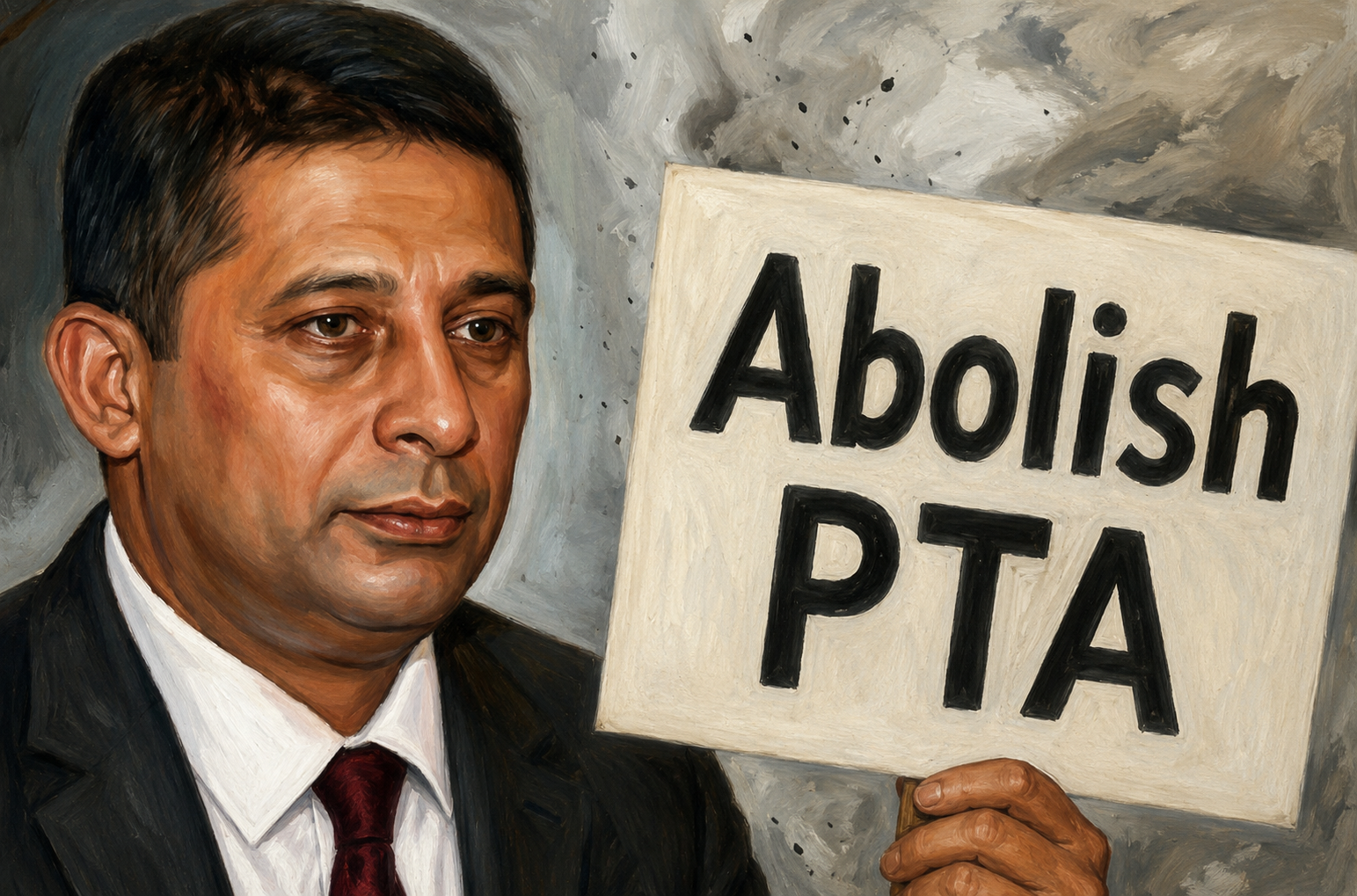

Image: Sallay, who used PTA against political opponents, now calls for abolishing the PTA.
Four United Nations human rights mandates have expressed serious concern over the detention of former State Intelligence Service chief Suresh Sallay under Sri Lanka’s Prevention of Terrorism Act, citing allegations of arbitrary detention, torture and ill-treatment, interference with access to lawyers, serious deterioration of his physical and mental health, and the risk of further harm if he is returned to Criminal Investigation Department custody.
In an urgent communication dated 20 July 2026, the UN experts called on the Sri Lankan Government to take immediate measures to protect Suresh Sallay’s life and physical and mental integrity and sought detailed answers concerning the legal basis for his detention, his treatment in custody, access to medical care and lawyers, and whether independent investigations have been launched into allegations of torture and ill-treatment.
The communication was issued by Ben Saul, UN Special Rapporteur on human rights and counter-terrorism; Ganna Yudkivska, Vice-Chair on Communications of the Working Group on Arbitrary Detention; Tlaleng Mofokeng, Special Rapporteur on the right to health; and Margaret Satterthwaite, Special Rapporteur on the independence of judges and lawyers.
Arrest under PTA linked to Easter Sunday attacks
According to the UN communication, Suresh Sallay, a retired Major General who formerly headed both the State Intelligence Service and Military Intelligence, was arrested on 25 February 2026 in connection with investigations into the 2019 Easter Sunday bombings. Three days later, the Ministry of Defence issued a 90-day detention order under the PTA, subsequently extended for another 90 days.
The detention order allegedly accuses him of having had prior knowledge of the Easter attacks and intentionally failing to disclose it, thereby conspiring in, aiding and abetting the crimes and concealing the perpetrators’ identities.
The UN experts emphasised, however, that the information before them raised questions about the basis and legality of his continued detention. They noted allegations that he was questioned only on a limited number of occasions during approximately 103 days following his arrest, including only twice for brief periods between April and June 2026.
The communication also records an apparent date inconsistency, stating that defence counsel filed a motion on 4 March 2025, although Suresh Sallay is stated elsewhere in the communication to have been arrested on 25 February 2026. The same passage says the Magistrate’s Court had not formally been informed of his detention and that a CID officer said authorities were still considering under which case to name him as a suspect.
Allegations of torture and degrading detention conditions
The most serious concerns raised by the four UN mandates relate to Suresh Sallay’s treatment in CID custody.
According to information received by the experts, he was at times held incommunicado, while access to family members and lawyers was obstructed or restricted. Meetings with lawyers were initially held in the presence of CID officers who allegedly recorded the conversations. On 26 March, the Magistrate’s Court ordered that lawyer-client consultations be facilitated without interference.
The communication alleges that Suresh Sallay was detained in a cell measuring approximately 6.5 feet by 4.4 feet, infested with rats and continuously illuminated day and night. He was reportedly permitted to leave the cell only for family and legal visits and questioning, and the continuous lighting allegedly caused severe sleep deprivation and migraines. He was also allegedly denied case-related reading materials and prevented from taking notes.
More seriously, the UN communication says it was reported that several days after his arrest a group of officers entered his cell, stripped him naked in the presence of officers and other detainees, handcuffed him and subjected him to humiliating and degrading treatment. It also alleges that he was pressured to confess.
The experts stressed that they were not prejudging the accuracy of the allegations, but said that, if substantiated, the conduct could amount to violations of Sri Lanka’s obligations under international human rights law.
Medical findings and serious deterioration in health
The communication describes a significant deterioration in Suresh Sallay’s physical and psychological condition while in detention.
On 22 April 2026, the Magistrate ordered that he be examined by a Judicial Medical Officer and a judicial psychiatrist. According to the UN communication, a medical report received by his lawyers on 20 May stated that he was suffering from post-traumatic stress disorder and contained findings consistent with torture and ill-treatment. Recommendations from a consultant nutritionist were reportedly not implemented.
On 6 June, Suresh Sallay began a hunger strike and stopped taking food and water. After a family member found his physical condition significantly deteriorated the following day, he was admitted to the National Hospital of Sri Lanka.
On 27 June he was transferred to the hospital’s Cardiac Coronary Care Unit following severe chest pain. The UN communication states that he was classified as a high-risk cardiac patient and that cardiologists informed his family that surgical intervention and a cardiac implant might be necessary to preserve his life. According to the communication, they also indicated that his condition made him unsuitable for detention. He ended his hunger strike on 1 July.
The experts nevertheless received reports that restrictions on confidential legal access continued in hospital. On 8 July, his lawyer was allegedly informed by CID officers that he would not be permitted to meet his client without their supervision.
UN raises questions over independence of investigation
The communication also raises concerns about the integrity and impartiality of the investigation.
According to information presented to the UN experts, two officials currently involved in steering the investigation against Suresh Sallay were themselves the subject of adverse findings and recommendations for prosecution by a Presidential Commission of Inquiry in 2024 in connection with the Easter Sunday attacks. The communication further records allegations that exculpatory evidence, including evidence that Suresh Sallay was stationed abroad at the relevant time, was ignored.
The experts also cited claims of evidence tampering involving CCTV footage and allegations that personal vendettas were influencing the investigation. These remain allegations presented to the UN mandate holders, rather than findings established by the communication.
They expressed particular concern about reports that the Magistrate who had ordered safeguards relating to Suresh Sallay’s treatment and legal rights was subsequently transferred and replaced. The experts said the replacement raised concerns about possible undue interference with the administration of justice and the fairness of the investigation.
Possible violations of multiple international human rights obligations
The four UN mandates said the allegations potentially engage several of Sri Lanka’s international human rights obligations, including the right to life, prohibition of torture and cruel, inhuman or degrading treatment, right to liberty and security, right of detainees to humane treatment and dignity, right to health, and right to an effective remedy.
They referred specifically to Articles 6, 7, 9 and 10 of the International Covenant on Civil and Political Rights, Articles 2 and 16 of the Convention against Torture, Article 12 of the International Covenant on Economic, Social and Cultural Rights, as well as the UN Standard Minimum Rules for the Treatment of Prisoners, known as the Nelson Mandela Rules.
The experts said the allegations of torture and ill-treatment did not appear to have been promptly, independently and effectively investigated despite complaints from Suresh Sallay’s family and counsel and the reported findings of court-ordered medical examinations.
UN renews call for moratorium on PTA
Going beyond the individual case, the experts again challenged the compatibility of Sri Lanka’s Prevention of Terrorism Act with international human rights law.
They recalled repeated previous interventions concerning the PTA, warning that its vague and overly broad definition of terrorism and extensive detention powers risk arbitrary and prolonged deprivation of liberty.
While welcoming the Government’s commitment to review and replace the PTA, the UN mandate holders renewed their call for “an immediate moratorium on the continued use of the PTA until the necessary amendments have been made.”
Eight sets of questions for Sri Lankan Government
The experts have asked the Government to respond to eight areas of concern, including the factual and legal basis for Suresh Sallay’s arrest and continued PTA detention; the status of investigations, charges or proceedings; safeguards against arbitrary detention; confidential access to legal counsel; his reported incommunicado detention; his physical and psychological health and medical care; allegations of torture and degrading treatment; the status of any independent investigation into those allegations; and measures to prevent his return to CID custody while complaints against CID officers remain under consideration.
They specifically asked whether Suresh Sallay would be promptly released if his detention were found to be arbitrary, and sought an explanation of how the involvement of two officials alleged to have been implicated in matters connected with the Easter Sunday attacks was compatible with an independent and impartial administration of justice.
The Government was also asked to explain whether recommendations made by the Judicial Medical Officer, judicial psychiatrist and other medical professionals had been implemented and whether prompt, independent and impartial investigations had been initiated into the torture and ill-treatment allegations.
Experts urge immediate protection against “irreparable harm”
Pending a Government response, the four UN mandates urged Sri Lanka to adopt all necessary interim measures to prevent irreparable harm to Suresh Sallay’s life and physical and mental integrity, halt the alleged violations and prevent their recurrence. If investigations support the allegations, they said the Government should ensure accountability for those responsible.
The communication further states that it and any Government response will be made public through the UN communications reporting website at the 60-day mark. If the Government responds within 60 days, both documents may be published earlier.
The Working Group on Arbitrary Detention may additionally take up Suresh Sallay’s case through its regular procedure to determine whether his deprivation of liberty was arbitrary. The experts stressed that the urgent communication itself does not prejudge any opinion the Working Group may ultimately reach.
The UN communication repeatedly frames the underlying claims as allegations or information received by the mandate holders and states expressly that the experts do not prejudge their accuracy.
Source: DownLoadPublicCommunicationFile (1), UN Special Procedures communication UA LKA 2/2026, 20 July 2026.