
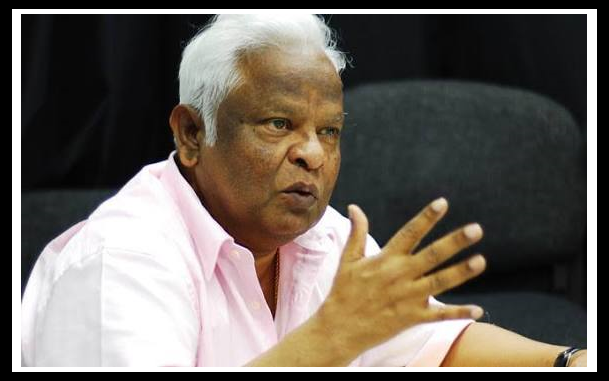

Lionel Bopage.
We have lost a dear friend and comrade. Basil Fernando died in Hong Kong on 30 September, aged 81. He was a lawyer, jurist, poet, philosopher and Marxist, and he never made peace with injustice. Asia has lost one of its bravest defenders of human dignity. Those of us who knew him have lost a man of rare warmth, wit, and moral courage.
Roots
Basil was born in Wattala, Sri Lanka, on 14 October 1944. He came from a poor fishing village and overcame the barriers of caste and class to become a firebrand human rights lawyer. These beginnings stayed with him for life. He understood injustice from the inside, as the experience of real people, long before he wrote about it as a lawyer.
The young Marxist
Basil’s politics began on the left. As a young man he joined the circle around Kamkaru Mawatha (The Workers’ Path), the weekly paper of the Revolutionary Communist League. A contemporary later recalled him leading a Kamkaru Mawatha protest march on the Colombo University grounds. That Marxist formation shaped everything that followed. For Basil, human rights were never just abstract principles. They were about power, class and the conditions under which ordinary working people live and die. He never lost that analysis, even as his work took him into courtrooms, UN missions and the international human rights movement.
He graduated in law from the University of Ceylon in 1972. After his degree he first taught English at Vidyodaya University. He was enrolled as an Attorney-at-Law of the Supreme Court in 1980 and practised in Sri Lanka until the end of 1989. He later told the story of this journey in his autobiography, A Confession of a Lawyer.
Exile
Those years were the darkest in Sri Lanka. Basil resisted the politicisation and corruption eating away at the justice system and the legal profession. In 1989, when tens of thousands of people had already been made to disappear, his own name appeared on a death list, and he was forced to flee to Hong Kong with his wife and infant daughter. He knew from his own life what it meant to be hunted by the state, and he never forgot those who could not escape.
Building justice in exile
In Hong Kong he served from 1989 to 1992 as Appeals Counsel for Vietnamese refugees in a project sponsored by UNHCR. From 1992 to 1993 he was a Senior UN Human Rights Officer in charge of the Investigation Unit of the UN Transitional Authority in Cambodia. He then led legal assistance at the Cambodia office of the UN Centre for Human Rights until 1994.
In 1994 he joined the Asian Human Rights Commission, later becoming its Executive Director. He used that role to document violations and to connect grassroots struggles with campaigns for legal and institutional reform. He pioneered the “urgent appeal” system to protect detainees from torture, unlawful detention, state abuse and possible death. For countless families, an urgent appeal from Hong Kong was the first sign that someone, somewhere, was listening.
He never stopped fighting for the disappeared. He connected the families of Sri Lanka’s disappeared with South Korea’s May 18 Movement in Gwangju, which helped inspire a national memorial to victims of enforced disappearance. With his colleagues he produced Narrative of Justice in Sri Lanka, documenting 1,500 cases of police torture between 1998 and 2011, and the quarterly journal article 2. He helped develop the Asian Human Rights Charter and the Asian Rule of Law Charter, and in 2012 he co-founded the Asian Alliance Against Torture and Ill-Treatment. Throughout, he believed a strong and independent civil society was essential to any real democracy, and he gave his time generously to young activists across Asia.
The poet
Basil was also a poet of real power. His collection Pride and Pain in Difficult Times gives a deeply human voice to Sri Lanka’s decades of conflict, part reportage and part reflection on his homeland and his exile. His poem Looking for Raju, about a parent who will never stop searching for a disappeared son, was chosen among the winning poems of Amnesty International’s Silenced Shadows competition on enforced disappearances in Sri Lanka. His work also reached Sinhala readers through translation.
Recognition
He received the Gwangju Prize for Human Rights in 2001, was named an Ashoka Fellow in 2005, and received the Right Livelihood Award, known as the “Alternative Nobel Prize,” in 2014. He wore these honours lightly. To him they belonged to the victims whose courage he documented.
Basil in Melbourne
In the early 2000s, Basil accepted our invitation to visit Australia. He addressed human rights forums in Melbourne, including gatherings of People for Human Rights and Equality (PHRE), an association I was privileged to associate with. I remember his clarity, his humour and his insistence that the rule of law must be real for the poorest person, not just words in a constitution. He reminded us that solidarity knows no borders, and that a police cell in Sri Lanka is the concern of us all.
An appeal for the disappeared
Basil spent decades standing with the families of the disappeared. Across Sri Lanka, in the North and East as well as the South, mothers, wives and children are still waiting to learn what happened to their loved ones. Many have grown old waiting, and some have died without ever receiving an answer. Like the parent in his poem Looking for Raju, they have never stopped asking.
As a measure of respect for Basil, I appeal to the Government of Sri Lanka to do justice to these families. That means telling them the truth about the fate and whereabouts of the disappeared, holding those responsible accountable through independent and credible investigations and prosecutions, providing meaningful reparations, and guaranteeing that no family in Sri Lanka will ever again have to search for a loved one taken by agents of the state. Strengthening the Office on Missing Persons and ending the long culture of impunity would be the most fitting memorial to a man who never stopped asking these questions on their behalf.
Farewell
Our deepest condolences go to his beloved wife and daughter, who shared his exile, his struggles and his long years of service. We also share this grief with his comrades and colleagues at the Asian Human Rights Commission and the Asian Legal Resource Centre, with my friends at PHRE and Australian Advocacy for Good Governance in Sri Lanka (AAGGSL) in Australia, and with the many human rights defenders across Asia whom he mentored and inspired.
Basil believed that justice is built patiently, case by case and voice by voice. The best way to honour him is to carry that work forward.
Farewell, dear comrade. Your voice will not be silenced.
1 October 2026
Melbourne, Australia