

This week’s death of a young man in the custody of the Homagama Police custody reportedly due to assault raises anew, grave fears regarding enhanced powers of arrest and custody conferred on the police by Sri Lanka’s Organised Crimes Bill (2026).
What history teaches us
Preliminary medical findings indicate that he suffered broken ribs and head injuries leading to suspected bleeding in the brain. Senior police officers have admitted that he had been assaulted while being held at the Police Crime Division prior to being placed in a cell. This is an all-too familiar tale. That tragedy is not mitigated by the arrest of the Officer-in-Charge (OIC) of that police station, let me add.
These arrests assuage public anger but torturers in police uniform are allowed to quietly reassume their posts once public memory fades. Torture routinely takes place within the first few hours of arrest. This is a documented fact, the best testimony to which is the records of the Supreme Court with judicial reprimands of ‘police torturers’ being to no effect.
A regular lament of the Human Rights Commission of Sri Lanka (HRCSL) is that directives to the police to abstain from torture as a method of interrogation are to similar effect. The HRCSL’s guidelines to the police on treatment of suspects in custody, issued by the Inspector General of Police (IGP) through a circular to all police stations, had been ignored by the Homagama Police.
Insanity to increase period of police custody
It would be safe to say that the observance of these guidelines by any police station through the length and breadth of the land would be a veritable miracle. All this is nothing new. Each time that a death in custody occurs, the media space is sensationalized for a while and then the furore dies down till the next custodial death occurs.
So, in this context, is it not sheer insanity to confer powers on the police to hold a suspect for an excruciatingly painful time of 72 hours in custody before production before a Magistrate, under Clause 20 of the Organised Crimes Bill (2026)? That is like giving the fox, the intoxicating power over the hen coop. If these brutalities can occur within the 24 hours now permitted, how much will this increase?
Technically, the Homagama victim, as the police would indisputably argue, would fall within the definition of an ‘organised criminal’ as this Bill portends. The official explanation for the arrest was that this was in connection with a drug-related investigation involving the alleged possession of narcotics (490 milligrams) or ‘ice’ as commonly known. His family may shriek to the high heavens that he was not a criminal, organized or not.
Dystopian realities of the present
But what does that matter? Who would care? ‘False cases’ filed by the police, most commonly on charges of possession of narcotics, led one magistrate to take the extraordinary step of directing the IGP to order his men and women to stop such acts. In the absence of an island wide circular issued in obedience to that order, the IGP was referred for contempt to the appellate courts.
This peculiar turn of events was discussed in these column spaces last week. Sometimes, one wonders if we have the privilege of living in the dystopian world of George Orwell’s Animal Farm, so great are the absurdities that are inflicted upon us. This impugned Clause 20 of the Organised Crimes Bill meanwhile has more wonders to offer us.
Thus, after a suspect is produced before a Magistrate and where a police officer has ‘reasonable grounds’ to believe that extended custody is required to conduct ‘further investigations, the Magistrate may, with ‘reasons to be recorded in writing’, authorise a further period of detention for twenty four hours.
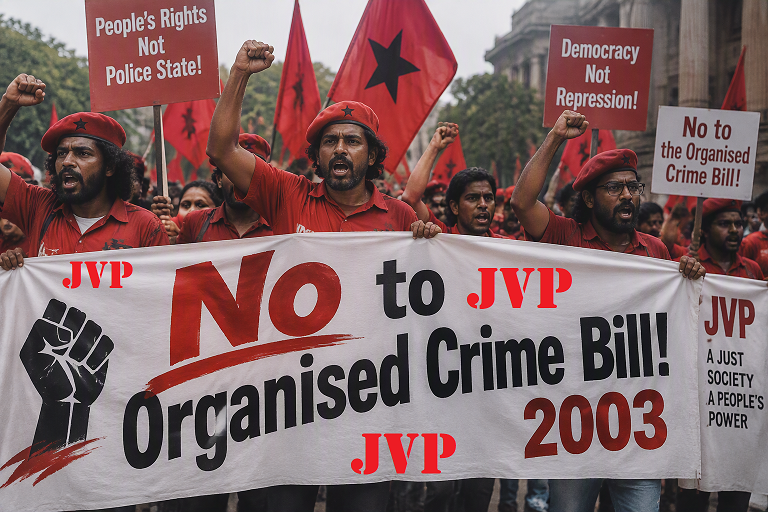
Organised Crimes Bills of 2003 and 2026
These are grotesquely well worked provisions in Sri Lanka’s anti-terrorism regime. Mechanical magisterial orders of detention are very much part of the coercive and torture–inducing architecture of national security laws that will, in consequence of the 2026 Organised Crimes Bill, soon be imported into the country’s general law.
In 2003, the Organised Crimes Bill of the Wickremesinghe Government which was challenged in the Supreme Court was not half as bad as this. Production before a Magistrate was within 24 hours even though Clause 11 permitted a suspect to be held for seven days upon judicial order. The Attorney General argued that, this extended custody was under judicial supervision.
It was further argued that provision to this effect already existed in the Poison, Opium and Dangerous Drugs (Amendment) Act of 1984. Needless to say, replication of existing law with the potential of enabling abuses is hardly conducive to the Rule of Law. Unsurprisingly, a conservative Bench of the Court upheld that argument, finding no inconsistency with Article 13 (2) of the Constitution.
Opposing then; proposing now?
The overall reasoning was that ‘members of an organised criminal group’ are not ‘similarly circumstanced’ as other petty criminals. Quite problematically, it was extrapolated therefore that the equal protection of the law promised by Article 12 (1) would not apply to bar minimum mandatory sentences. But now, we proceed from the legal to the political.
In that challenge to the 2003 Organised Crimes Bill, prominent politicians of the Janatha Vimukthi Peramuna (JVP) now leading the National Peoples Power Government were among its most vociferous petitioners. As in 2026, the 2003 Bill also brought back the PTA’s terrible allowance of making confessions to senior police officers admissible. In 2003, the JVP opposed this clause with might and main. Again, what occasions this change of political heart now?
Other concerns abound. In 2026, the magistrate is required to ‘personally see the suspect in camera, and look into his well-being and record any statement the suspect may provide.’ Apart from an archaic gender blind terminology that pervades this poisonous Bill, these ‘safeguards’ are purely theoretical. The 2003 Bill was a tad better.
Flimsy protections against abuse
Upon an undertaking given to Court by the Attorney General, hours of interrogation of suspects were to be specified under magisterial order. Part of that undertaking in 2003 was also to empower the magistrate to direct any suspect for a medical examination if required, not only in regard to suspects whose confessions may be admitted (2026).
Giving the police, the discretion to refer to suspects for medical examination is a cruel farce. Clause 26 of the Organized Crimes Bill (2026) meanwhile allows a ‘suspect remanded or detained’ to have access to a lawyer. A similar right is conferred in regard to ‘the right to communicate with and be visited by his relatives … or any other person of his choice’. This is subject to ‘conditions established by written law.’
But what of the period prior to being so ‘remanded or detained?’ A suspect in police custody is not allowed legal counsel at the earliest opportunity As was noted at the start of this reflection, practices of torture occur most during that period of initial police custody. The unfortunate youth in Homagama was one victim; there were thousands before him and possibly, thousands after.
Shifting winds of power
Sri Lanka’s ‘torture regime’ which has displaced the Rule of Law for decades is typically characterised by the lack of effective magisterial intervention, the inadequacy of proper medical examinations and the collusion of prisons officials and police officer who abuse with impunity. That regime will be strengthened a hundred-fold by the 2026 Organised Crimes Bill.
Those leading the Government currently in power passionately objected to its milder avatar in 2003. So what is the rationale to advance a Bill in 2026 that is infinitely more draconian under its imprimatur of ‘system change’?
Shifting winds of political power, we assume. If we are to be kind, that is. Other pejorative terms also come to mind.
Courtesy of the Sunday Times.