
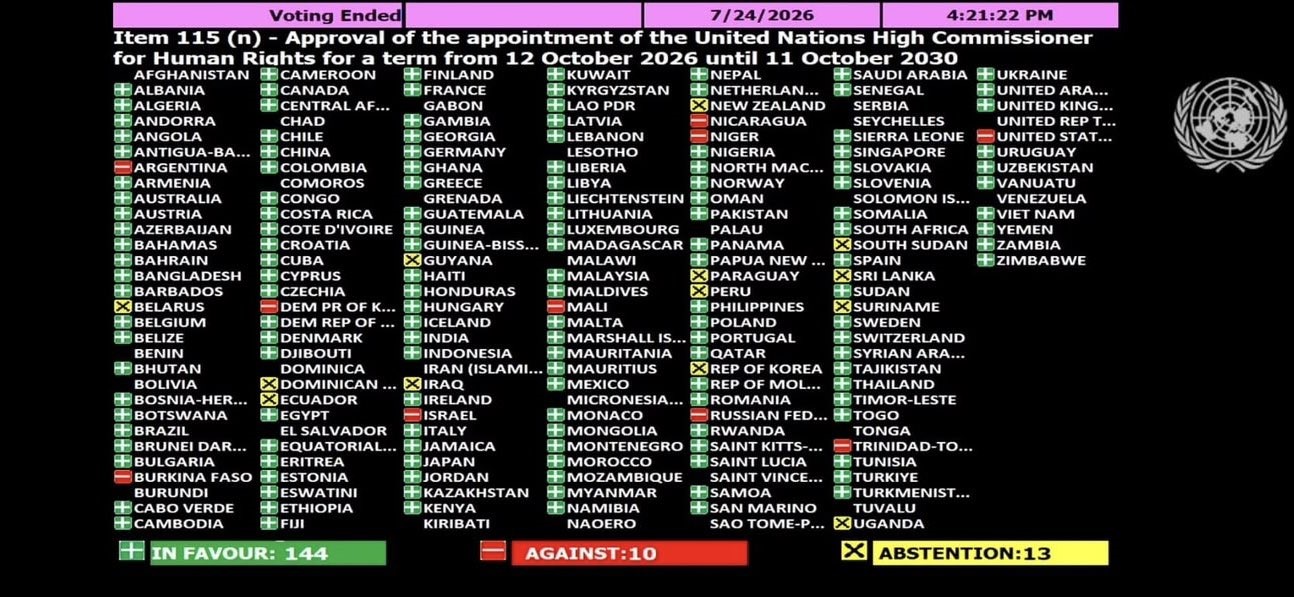

The UN General Assembly has renewed UN High Commissioner for Human Rights Volker Türk’s mandate for four more years, ensuring continuity in the UN’s global human rights monitoring at a time of rising international scrutiny and conflict‑related abuses. The resolution, tabled by Russia and backed by an unusual coalition including the United States, Israel, North Korea, and several other states, passed with a comfortable majority.
Sri Lanka was among 13 countries that abstained, choosing not to align with either supporters or opponents of the extension. Human rights observers noted that Sri Lanka’s abstention is significant given the High Commissioner’s continued reporting on accountability, enforced disappearances, and systemic human rights concerns in the country. The abstention places Sri Lanka alongside a diverse group of states that opted out of taking a position on the future direction of the UN’s human rights leadership.
The 13 abstaining countries—including Sri Lanka, India, Bangladesh, Nepal, Bhutan, Maldives, Indonesia, Thailand, Vietnam, Laos, Cambodia, Singapore, and the UAE—largely share a pattern of cautious engagement with UN human rights mechanisms.
Many of these states have historically preferred neutral positions on contentious human‑rights votes, especially when resolutions are introduced by major powers with competing geopolitical agendas. In this case, the proposal was tabled by Russia and unexpectedly supported by the United States and Israel, creating an unusual cross‑bloc alignment that made some governments reluctant to take sides. Several abstaining states also face ongoing human‑rights scrutiny or sensitive domestic issues, making them wary of appearing aligned with either camp in a vote directly affecting the leadership of the UN’s human‑rights system.
The extension secures Türk’s role through 2030, allowing the Office of the High Commissioner for Human Rights to continue its work on documenting violations, supporting victims, and advancing global human rights norms. Analysts say the cross‑bloc support for the resolution reflects shifting geopolitical dynamics within the UN system, while the abstentions highlight ongoing tensions around human rights oversight and state accountability.
If you want, I can refine this into a shorter wire‑style brief or a more formal policy‑tone version.