
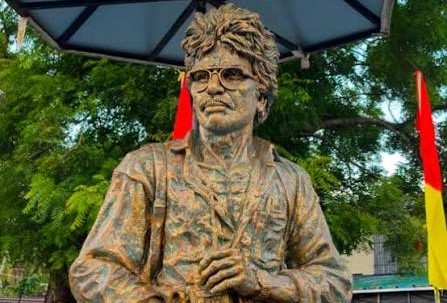

Police have removed a memorial statue of former LTTE member Rasaiah Parthipan, better known as Thileepan, from the Thileepan Memorial Square in Nallur, Jaffna, following commemorations marking the 39th anniversary of his death.
The statue was reportedly removed during the early hours of Sunday, 27 September, a day after the principal commemorative events concluded. CCTV footage from the memorial reportedly shows police officers removing the statue and transporting it away in a vehicle.
Tamil National People’s Front Secretary and MP Selvarasa Gajendran alleged that more than 15 police personnel entered the premises without prior notice and forcibly removed the statue.
As of 27 September, the authorities had not publicly explained the legal basis for the removal.
The incident raises broader human-rights questions surrounding the right to remembrance and memorialisation in post-war Sri Lanka. Tamil civil society organisations have long argued that remembering those who died during the conflict, including individuals associated with the LTTE, should not in itself be treated as endorsement of the organisation or its actions. The Adayaalam Centre for Policy Research describes remembrance and memorialisation as important elements in addressing conflict and advancing truth, justice and reconciliation.
At the same time, Thileepan’s history cannot be separated from the LTTE. Born Rasaiah Parthipan, he joined the LTTE and became a political-wing leader in Jaffna. Contemporary accounts describe him as having also participated in the organisation’s armed struggle before becoming best known for his final hunger strike.
On 15 September 1987, Thileepan began a hunger strike near the Nallur Kandaswamy Temple, directing five demands at the Indian Government following the Indo-Lanka Accord. They included the release of Tamil political prisoners, an end to Sinhala settlement in Tamil areas under the guise of rehabilitation, restrictions on new police and military facilities, and changes concerning the deployment of security forces and home guards. He died on 26 September 1987 after refusing food and water.
His legacy therefore remains deeply contested. For many Tamils he became a symbol of sacrifice and political resistance, while his membership and role in the LTTE remain an inseparable part of his history. That distinction is important in considering the present controversy: the right of individuals and communities to remember their dead does not necessarily amount to approval of the politics or violence of the organisation to which the deceased belonged.
The removal of the statue consequently raises a central post-war question for Sri Lanka: whether remembrance can be restricted solely because the person being commemorated was associated with the LTTE, or whether any state interference must instead have a clear legal basis and be compatible with fundamental freedoms.