
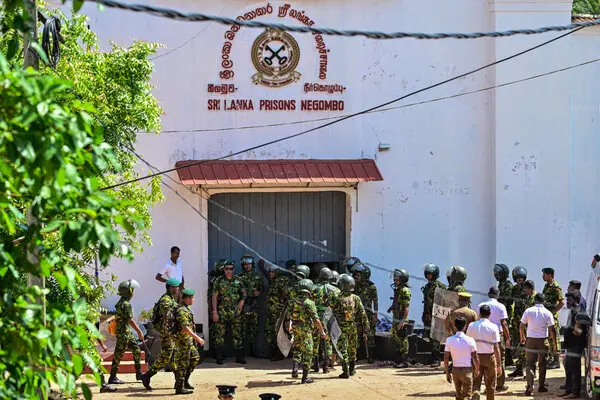

The deadly violence that erupted inside Sri Lanka’s Negombo Prison has once again exposed the country’s long-standing prison crisis, raising urgent questions about human rights, criminal justice reform, and the state’s ability to manage one of South Asia’s most overcrowded penal systems.
The clash, which reportedly began as a confrontation between rival inmate groups linked to drug trafficking, quickly escalated into one of the deadliest prison incidents in Sri Lanka in recent years. According to authorities, 26 people were killed—including 19 inmates and seven prison officers—while more than 100 others were injured before security forces regained control.
While officials have focused on the gang-related origins of the violence, legal experts and human rights advocates argue that the bloodshed was the predictable consequence of years of systemic neglect.
A Prison System Beyond Capacity
Sri Lanka’s prison network has been operating far beyond its intended capacity for years. Facilities designed to accommodate between 11,000 and 13,000 prisoners routinely hold close to 40,000 inmates—more than three times their intended population.
The country’s prison overcrowding has been driven largely by strict drug laws, lengthy pre-trial detention, and slow judicial proceedings. According to international human rights organizations, a substantial proportion of those behind bars have never been convicted of a crime and remain in custody while awaiting trial.
In prisons such as Negombo, severe overcrowding has created conditions widely criticized as degrading and inhumane. Inmates often have less than 1.2 square meters of personal space, forcing many to sleep in shifts or on concrete floors beside open sanitation facilities.
These conditions fall well below the standards outlined in the United Nations Standard Minimum Rules for the Treatment of Prisoners, better known as the Nelson Mandela Rules, which require adequate living space, sanitation, healthcare, and humane treatment for all detainees.
Violence Born from Desperation
Criminologists have long warned that overcrowded prisons become breeding grounds for violence.
Limited access to basic necessities, poor sanitation, inadequate medical care, and constant tension create an environment where even minor disputes can rapidly escalate into deadly confrontations. When organized criminal groups operate inside already overcrowded facilities, the risks increase dramatically.
The Negombo riot illustrates how prison authorities can quickly lose control once violence begins. Narrow corridors, overcrowded cells, and limited staffing make emergency responses exceptionally difficult, while separating rival groups becomes nearly impossible.
Human rights organizations have repeatedly argued that prison violence is rarely the result of a single incident. Instead, it reflects accumulated institutional failures that eventually reach a breaking point.
Prison Officers Also Pay the Price
The deaths of seven prison officers underscore another often-overlooked aspect of Sri Lanka’s prison crisis.
Correctional officers routinely work in dangerous conditions, supervising inmate populations that vastly exceed safe staffing ratios. Many officers reportedly face long working hours, limited equipment, insufficient training, and significant psychological stress.
As prison populations continue to grow without corresponding investment in staffing or infrastructure, officers increasingly find themselves responsible for managing volatile environments with few resources.
From both a labor rights and public safety perspective, experts argue that governments have a duty to ensure prison staff can perform their work without facing unacceptable levels of risk.
The Judicial Bottleneck
One of the principal drivers of overcrowding is Sri Lanka’s large remand population.
Thousands of detainees spend months—or even years—in custody before their cases reach trial. Many remain incarcerated because they cannot afford bail or because court proceedings move slowly through an already burdened judicial system.
International legal standards emphasize that individuals awaiting trial should generally be held separately from convicted prisoners. In practice, however, overcrowding often makes such separation impossible, exposing first-time offenders and unconvicted detainees to hardened criminal networks inside prison walls.
Legal reform advocates argue that accelerating court proceedings and expanding the use of bail could significantly reduce prison populations without compromising public safety.
Calls for Structural Reform
Following the violence, Justice Minister Harshana Nanayakkara acknowledged the seriousness of the crisis and accepted responsibility on behalf of the government. Authorities subsequently transferred approximately 700 inmates from Negombo Prison to other correctional facilities in an effort to restore order.
However, prison experts caution that simply redistributing inmates shifts the problem rather than solving it. Without reducing the overall prison population, overcrowding is merely transferred from one institution to another.
Human rights organizations and criminal justice specialists have repeatedly recommended a series of structural reforms, including:
- Expanding alternatives to imprisonment for non-violent and low-level drug offences.
- Accelerating criminal proceedings to reduce lengthy pre-trial detention.
- Increasing investment in prison infrastructure and modern correctional facilities.
- Recruiting and training additional prison officers while improving working conditions.
- Expanding rehabilitation, education, and drug treatment programs aimed at reducing reoffending rather than relying solely on incarceration.
An International Human Rights Concern
Sri Lanka has faced repeated criticism from international bodies, including the UN Human Rights Council, over conditions within its detention facilities. Domestic watchdog groups have also documented recurring concerns about overcrowding, inadequate healthcare, limited mental health services, and poor sanitation.
The Negombo tragedy is unlikely to be viewed as an isolated security failure. Rather, it reflects broader structural problems that have accumulated over decades.
Without meaningful reform of both the criminal justice system and prison administration, analysts warn that similar incidents remain a significant risk.
The events at Negombo Prison serve as a stark reminder that prisons are not merely places of punishment—they are institutions where governments remain responsible for protecting the lives, dignity, and rights of every person in custody, as well as the officers charged with maintaining order. Until Sri Lanka addresses the systemic causes of overcrowding and institutional neglect, the conditions that led to one of the country’s deadliest prison riots are likely to persist.