
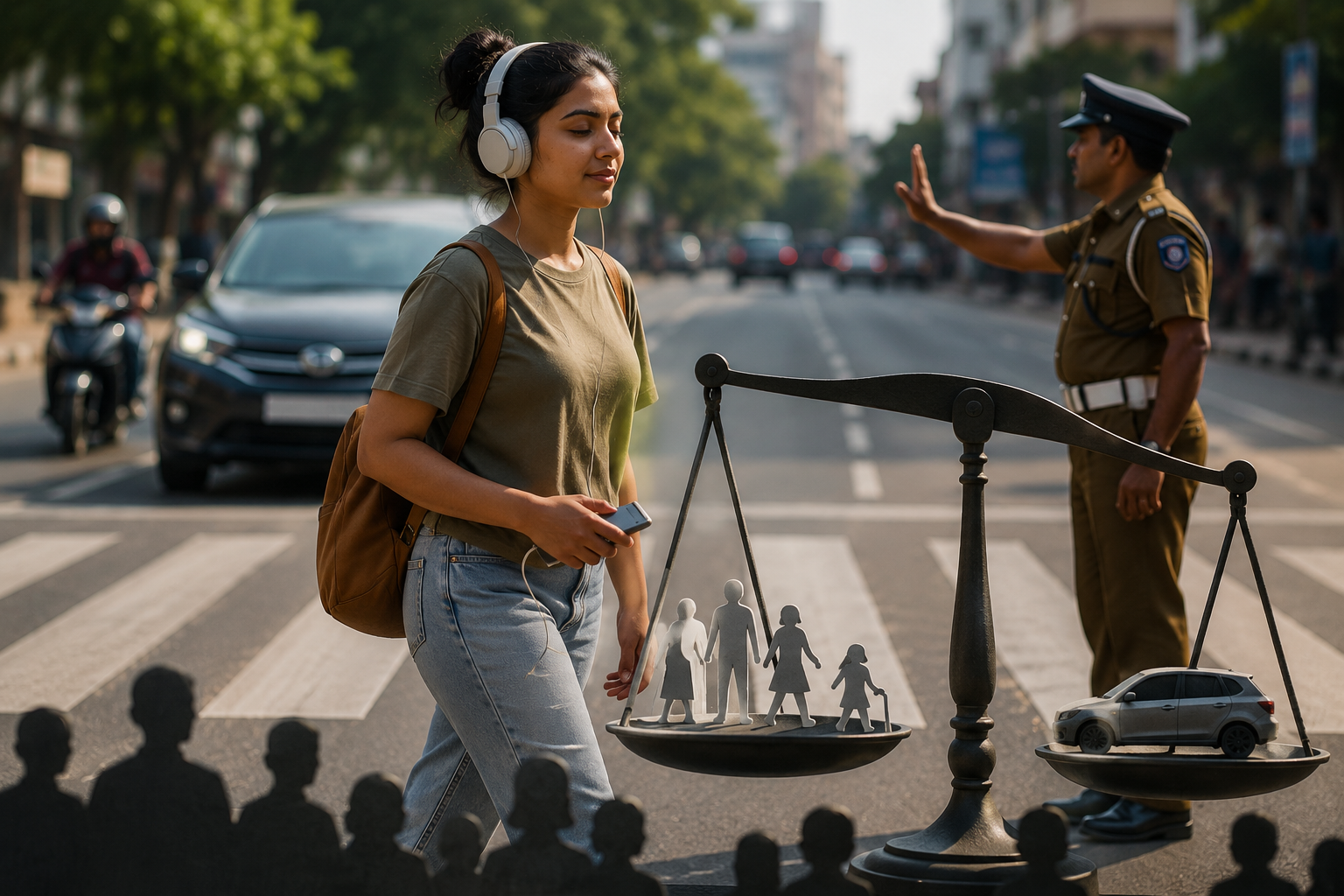

The announcement by Sri Lanka Police that pedestrians may soon face legal action for wearing headphones while walking raises an important question: Are we solving the real problem, or simply shifting the blame onto the most vulnerable users of our roads?
Road safety is undoubtedly a national concern. The statistics presented by the police are alarming. More than 1,300 people have lost their lives in road accidents during the first half of 2026 alone. Every life lost is a tragedy, and authorities have a duty to reduce these numbers.
Police to take legal action against pedestrians using headphones while walking https://t.co/V10QB7TX9H
— NewsWire 🇱🇰 (@NewsWireLK) July 3, 2026
But public safety should not come at the expense of fundamental freedoms without clear evidence that such restrictions are necessary, proportionate, and effective.
Listening to music while walking is not, in itself, dangerous. Millions of people across democratic societies—including the United Kingdom, Germany, France, Japan, Australia, Canada, New Zealand, Singapore, and most European countries—walk daily while listening to music, podcasts, audiobooks, or navigation instructions through headphones. None of these countries criminalises the simple act of wearing headphones while walking on public roads.
Instead, they focus on the actual causes of pedestrian deaths.
The overwhelming majority of successful road safety programmes around the world concentrate on speeding, dangerous driving, drunk driving, distracted driving, poor road engineering, inadequate pedestrian crossings, vehicle safety standards, and effective traffic enforcement. Where concerns exist about pedestrian distraction, governments typically respond with public awareness campaigns rather than criminal sanctions.
The difference is significant.
A person wearing headphones is not necessarily distracted. Many people use only one earbud, keep the volume low, or use modern headphones with transparency or ambient sound modes that allow environmental sounds to be heard clearly. Others may be listening to turn-by-turn navigation, language lessons, or work-related audio while commuting.
Making all such behaviour a legal offence assumes guilt without considering individual circumstances.
The proposal also risks setting a troubling precedent.
If wearing headphones becomes punishable because it may reduce awareness, what comes next? Will people talking on phones while walking face prosecution? What about those reading text messages? People engaged in animated conversations? Tourists looking at maps? Children playing? Elderly people with hearing impairments? Every pedestrian experiences varying degrees of distraction.
The law cannot realistically criminalise every possible reduction in attention.
More importantly, pedestrians are not the ones operating machines capable of causing fatal injuries.
Road safety policy around the world is built on a simple principle: those controlling the greatest source of danger carry the greatest responsibility.
A motor vehicle weighing over a tonne travelling at speed poses exponentially greater risks than a pedestrian listening to music. That is why virtually every developed road safety framework places its strongest legal obligations on drivers rather than on pedestrians.
Several countries have gone even further by adopting the “Safe System” or “Vision Zero” approach, which accepts that human beings will inevitably make mistakes. The role of government is therefore to design roads, vehicles, speed limits, crossings, and enforcement systems that prevent those mistakes from becoming fatal.
This philosophy recognises that people will sometimes be distracted, tired, elderly, disabled, or unfamiliar with an area. Safe roads are designed with these realities in mind.
Sri Lanka would benefit far more from investing in safer pedestrian crossings, better street lighting, traffic calming measures, functioning sidewalks, strict action against speeding, and improved road maintenance than from prosecuting citizens for listening to music.
There is also the question of proportionality.
Criminal law should generally be reserved for conduct that clearly endangers others or causes demonstrable harm. Wearing headphones while walking is a personal choice that primarily affects the individual making it. Governments routinely educate citizens about risks associated with such behaviour, just as they advise cyclists to wear helmets or encourage reflective clothing at night. Education empowers people to make informed decisions without unnecessarily expanding the reach of criminal law.
None of this diminishes the importance of personal responsibility. Pedestrians should remain alert, avoid stepping into traffic without looking, and exercise caution when crossing roads. Listening to loud music that completely blocks surrounding sounds can certainly increase risk.
But increased risk does not automatically justify criminalisation.
The police have correctly identified the urgent need to reduce road deaths. However, success will come from addressing the principal causes of those deaths—not by penalising ordinary citizens engaged in everyday activities that remain perfectly lawful in most of the democratic world.
Sri Lanka deserves safer roads. It also deserves policies that respect individual liberty, are supported by evidence, and focus enforcement where it will save the greatest number of lives.
Protecting public safety and protecting personal freedom are not opposing goals. Wise public policy achieves both.
If you’d like, I can also rewrite this in the style of a newspaper editorial, a sharper op-ed, or a constitutional/legal analysis referencing the rights to personal liberty and freedom of movement under the Sri Lankan Constitution.