
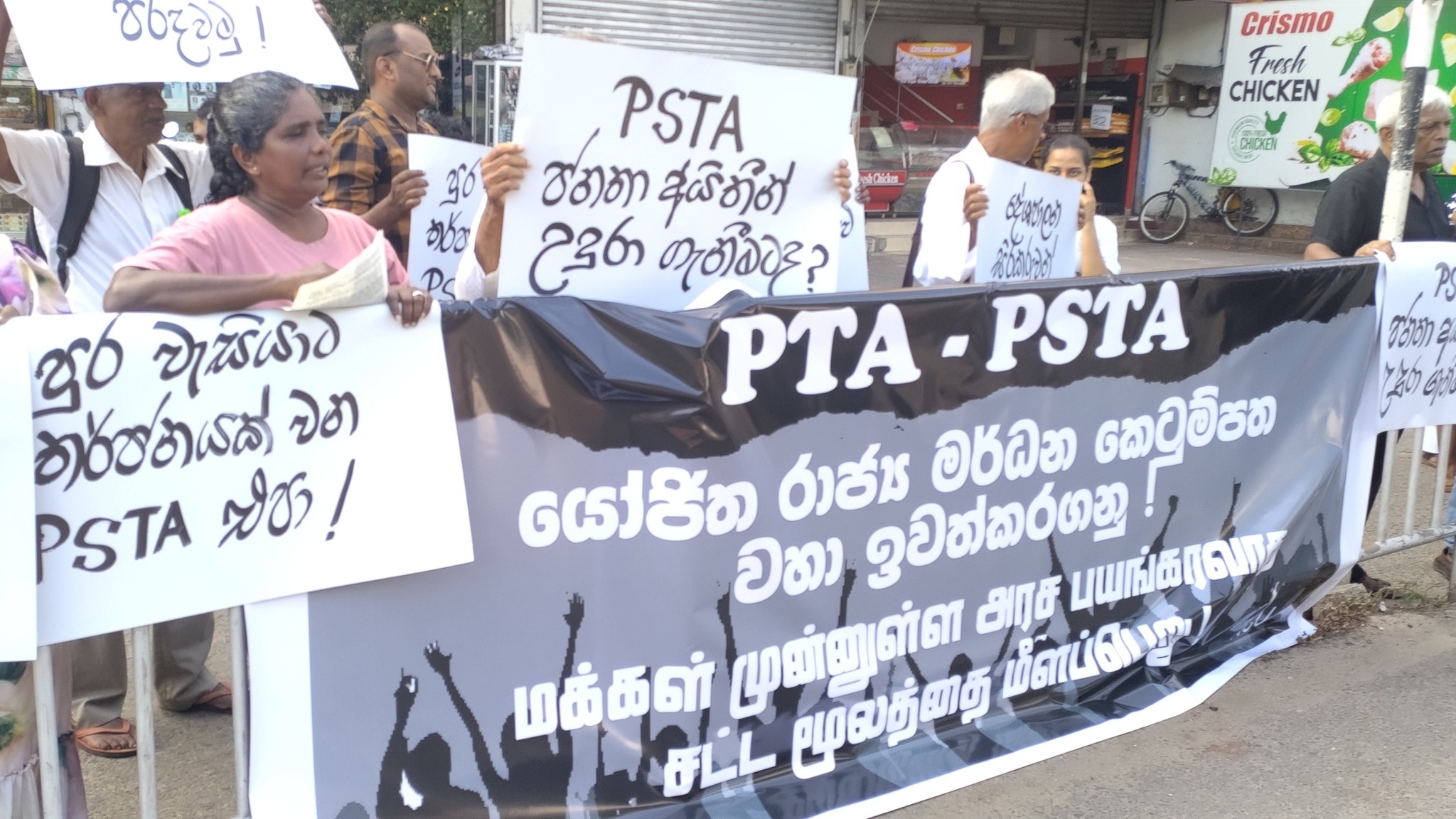

The UN Special Rapporteurs and Working Groups welcome Sri Lanka’s effort to replace the problematic Prevention of Terrorism Act (PTA). Despite some safeguards, the draft PSTA is assessed as still fundamentally incompatible with international human rights law, falling short of the five benchmarks set in communication LKA 4/2023. The concerns cover overbroad definitions, expanded security powers, intrusive surveillance, weak safeguards against arbitrary detention and torture, undue criminalization of expression, and lack of oversight and accountability.
The analysis focuses on key sections rather than an exhaustive review.
1. Definition of Terrorism (Section 3)
Main Concerns
- Remains vague, overbroad and open to arbitrary use.
- Fails to reflect international “best practice” standards and legality principles under ICCPR Article 15.
- Specific intent elements are duplicative or excessively broad (e.g., “propagating war”, “violating territorial integrity”).
- Physical elements include conduct that is not genuinely terrorist, such as property damage, theft, weapons offences, cyber interference, etc.
- Mental element wrongly includes knowledge and even recklessness, rather than requiring intent.
- Exclusion clause for protest, dissent, industrial action is too weak and vaguely qualified.
Implications; An ill‑defined offence risks misuse against dissenters, journalists, civil society, or political actors.
2. Penalties and Offence Structure
Main Concerns
- Mandatory life sentences breach proportionality and judicial discretion.
- Preparatory offences carry the same penalties as principal offences.
- Offences connected to proscribed organisations (Section 6) are unclear, repetitive, and expansive, risking unjustified criminalization of association or expression.
Implications; Risk of disproportionate punishment and arbitrary enforcement.
3. Expression and Media Freedom (Sections 8–11, 75, 78)
Main Concerns
- Offences related to “confidential information”, “encouragement”, or “terrorist publications” are vague, overbroad, and inconsistent with ICCPR Article 19.
- Definition of “confidential information” could criminalize reporting on:
- Militarization,
- Troop movements and checkpoints,
- Police misconduct,
- Human rights violations,
- Detention sites.
- Criminalization extends extraterritorially, affecting diaspora speech.
- Lack of clear, narrow exemptions for journalists, researchers, academics, and civil society.
Implications: Severe chilling effect on press freedom, academic analysis, human rights documentation, and legitimate political discourse.
4. Arrest, Detention, and Military Powers (Sections 19–30)
Main Concerns
- Police powers extended significantly to the military and coast guard, normalising militarised internal security.
- Military may detain individuals for 24+ hours (plus unlimited “travel time”) without judicial oversight.
- Delay in producing detainees before a magistrate undermines protections against torture and enforced disappearance.
- Section 28 permits up to two years of detention, including one year before charges.
- Administrative detention orders issued by the Secretary (Executive) are not subject to real judicial review (Sections 26, 29).
Implications: High risk of arbitrary detention, torture, enforced disappearance, and denial of judicial protection.
5. Access to Lawyers and Fair Trial (Article 14 ICCPR)
Main Concerns
- Lack of guaranteed immediate access to legal counsel.
- No guarantee of a lawyer who speaks the same language.
- Recorded interviews are recommended but not mandatory—problematic given past torture during interrogations.
- Attorney-General may suspend or defer proceedings for up to 20 years, imposing rehabilitation-like measures without conviction.
Implications: Risk of coerced confessions, pressure to accept “rehabilitation”, and erosion of presumption of innocence.
6. Surveillance, Search, Seizure, and Privacy (Section 20, 55)
Main Concerns
- Warrantless search powers with low thresholds.
- Broad stop-and-search powers for military and police.
- Interception powers apply to persons “likely” to commit an offence – a vague standard violating legality.
- Expanded decryption powers risk undermining encryption.
Implications: Unrestricted surveillance, privacy violations, potential for abuse, and weakening of cybersecurity and freedom of expression.
7. Use of Force (Section 45)
- Insufficient safeguards governing lethal force.
- Must be strictly tied to imminent threat of death or serious injury.
8. Proscription of Organisations (Section 63)
Main Concerns
- Executive has extremely broad discretion to proscribe groups.
- Conduct related to proscribed groups is vaguely defined (“any other activity”).
- No periodic review; proscription lasts until rescinded.
- No independent judicial oversight or appeal.
Implications: Arbitrary/unreviewable executive control over civil society, minority groups, and political organisations.
9. Restriction Orders, Curfews, and Movement Controls (Sections 64–66)
Concerns
- Restrictions on movement, communication, association can be imposed without necessity or proportionality tests.
- President may impose nationwide curfews on broad grounds with no judicial review.
- Section 66 can prohibit entering or photographing locations, creating risks for journalists, monitors, and researchers.
10. Accountability, Oversight, and Immunity (Section 70)
Concerns
- Overbroad immunity for officials acting “in good faith”.
- No explicit right to remedy for violations (ICCPR Article 2).
- Lack of strong, independent oversight bodies with clear powers.
11. Victims of Terrorism
- No framework for assistance, reparations, or protection of victims.
- Title focuses on protecting the “State”, not people.
Key Recommendations
A. Definition & Offences
- Redraft terrorism definition to meet legality, precision, and international standards.
- Remove vague intent elements and conduct elements that are not genuinely terrorist.
- Strengthen exclusion clauses for protest, dissent, humanitarian work, and armed conflict.
- Reduce penalties for preparatory crimes and ensure proportionality.
B. Expression & Information
- Narrow offences concerning confidential information, incitement, and publications.
- Add robust, specific exemptions for:
- Journalists,
- Researchers,
- Academics,
- Human rights defenders,
- Civil society actors.
C. Arrest, Detention & Military Powers
- Limit military involvement; strengthen civilian oversight.
- Require judicial review within 48 hours without exception.
- Eliminate one-year pre-charge detention & Executive detention orders.
- Ensure immediate access to counsel and mandatory audio/video recording of interviews.
D. Surveillance & Privacy
- Raise thresholds for interception orders.
- Restrict applications to senior officers.
- Prohibit weakening encryption or mandating backdoors.
- Establish independent oversight and notification mechanisms.
E. Proscription of Organisations
- Require:
- Clear nexus to terrorism,
- Time-limited listings,
- Independent judicial review,
- Transparent grounds for designation.
F. Restriction Orders & Curfews
- Introduce strict necessity and proportionality tests.
- Require judicial authorisation and periodic review.
G. Accountability & Remedies
- Remove overbroad immunity clause.
- Provide explicit right to effective remedy and compensation.
- Strengthen independent oversight mechanisms for security agencies.
H. Victims’ Rights
- Include comprehensive provisions on victim protection, assistance, and rehabilitation.
- Rename the Act to reflect protection of the people, not just the State.
The letter is signed by Mandates of the Special Rapporteur on the promotion and protection of human rights and fundamental freedoms while countering terrorism; the Working Group on Arbitrary Detention; the Working Group on Enforced or Involuntary Disappearances; the Special Rapporteur on extrajudicial, summary or arbitrary executions; the Special Rapporteur on the situation of human rights defenders; the Special Rapporteur on the right to privacy and the Special Rapporteur on torture and other cruel, inhuman or degrading treatment or punishment
09 February 2026.
The letter: UN SPs on PSTA