
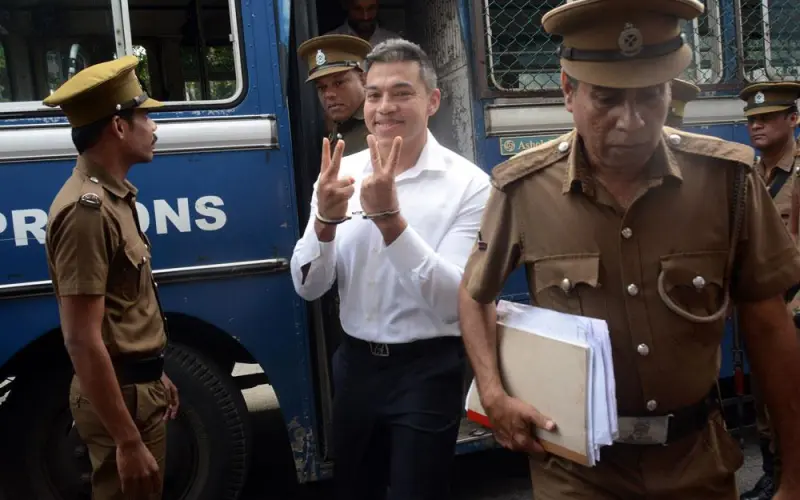

In Sri Lanka’s slow‑moving justice system, major financial crimes often unfold like prolonged political sagas—years of investigation, intermittent courtroom appearances, and a trail of documents that grows thicker than the public’s patience. The money‑laundering case involving former Navy Lieutenant Yoshitha Kanishka Rajapaksa and his 98‑year‑old grandmother Daisy Forrest is one such story: a case that began with a simple question—how did a young naval officer accumulate Rs. 596 lakh?—and evolved into a sprawling legal battle that has taken nearly a decade to reach trial.
The Colombo High Court’s latest hearing on 16 July 2026 marked a turning point. The prosecution announced its intention to amend and maintain the charge sheet, signalling that the state is prepared to push forward despite years of procedural delays, appeals, and shifting legal strategies by the defence.
A Case Years in the Making
The indictment, filed under the Prevention of Money Laundering Act, alleges that between 2009 and 2013, Yoshitha Rajapaksa and Daisy Forrest failed to disclose the source of Rs. 596,79,900, deposited into multiple bank accounts and fixed deposits. The prosecution argues that the funds were knowingly handled despite being derived—directly or indirectly—from illegal activities.
The timeline itself raises questions. The investigation file reached the Attorney General’s Department in 2018, but charges were filed only in April 2026, a seven‑year gap that reflects the chronic delays in Sri Lanka’s justice system. These delays are not unusual: financial crimes, especially those involving politically exposed persons, often languish in bureaucratic limbo.
The High Court’s decision to proceed with the amended charge sheet came after the Court of Appeal dismissed a defence argument claiming that only one accused could be charged under conspiracy. The appellate judges disagreed, allowing the prosecution to pursue both defendants under the conspiracy provision.
The Evidence Trail: Bank Accounts, Investments, and Real Estate
The prosecution’s case is built on a substantial documentary foundation:
- Four joint bank accounts held by the accused
- Seven additional accounts linked to Yoshitha Rajapaksa
- Stock market investments across multiple companies
- Assets and liabilities declarations submitted to the Navy from 2009–2015
- Property documents for a house in Ratmalana
- Records of the purchase of the Newburgh Estate in Ella
These documents paint a picture of financial activity that far exceeds the accused’s official income. The Attorney General’s Department previously disclosed that:
- Yoshitha earned Rs. 73,000 per month as a naval officer
- Daisy Forrest earned approximately Rs. 300 per month as a hostel warden at St. Thomas’ College
Neither income source could reasonably explain the accumulation of nearly Rs. 6 crore.
The prosecution has also lined up 103 witnesses, including senior Navy officers, former heads of the Securities and Exchange Commission, and former Inland Revenue officials. Their testimony is expected to shed light on the financial transactions, the origins of the funds, and the alleged concealment.
A Life Abroad and a Career at Sea
During the period under investigation, Yoshitha Rajapaksa was not always in Sri Lanka. He attended a course at the National University of Defence Academy in Ukraine from 2009 to 2010, later extended until March 2014. His naval career began in December 2006, and his overseas training coincided with the years during which the alleged financial irregularities occurred.
This overlap raises questions about who managed the accounts, how the funds were deposited, and whether the transactions were structured to avoid scrutiny.
The Legal Landscape: Money Laundering and Conspiracy
The charges fall under:
- Section 35 of the Prevention of Money Laundering Act, No. 5 of 2006
- Amendment Act No. 40 of 2011
- Section 113A of the Penal Code (conspiracy)
These provisions allow the state to prosecute not only the act of laundering money but also the facilitation, abetment, and conspiracy behind it. The inclusion of conspiracy is significant: it suggests the prosecution believes the financial activities were coordinated, not incidental.
A Justice System Under Strain
The case highlights a broader issue: Sri Lanka’s justice system is struggling under the weight of delays, political interference, and administrative bottlenecks. Financial crime cases often take years to investigate, and even longer to prosecute. The seven‑year gap between investigation and indictment is emblematic of a system where complex cases move at a glacial pace.
These delays erode public confidence, especially when politically connected individuals are involved. They also weaken the deterrent effect of financial crime laws, allowing illicit financial networks to operate with relative impunity.
What Comes Next
With the case now moving to a pre‑trial conference, the High Court will determine the admissibility of evidence, the scope of witness testimony, and the structure of the trial. The prosecution appears determined to proceed, armed with a substantial documentary record and a long list of witnesses.
For the public, the case is more than a legal battle—it is a test of whether Sri Lanka’s justice system can effectively prosecute financial crimes involving powerful families. For the courts, it is an opportunity to demonstrate independence and resolve.
And for the accused, it is a reminder that even in a slow system, accountability can eventually catch up.