
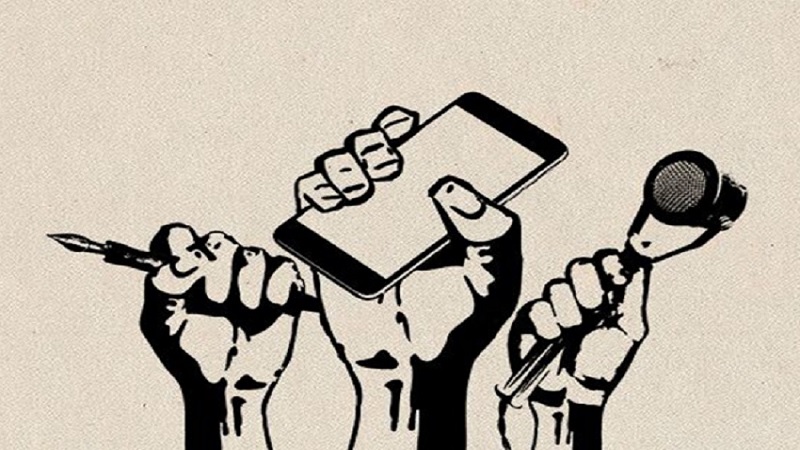

Image Courtesy of sabrangindia.in/
The Proposed CHARTERED INSTITUTE OF MEDIA PROFESSIONALS OF SRI LANKA’ (BILL) and Triple Legal Repression: Digital Civil Space and Freedom of Expression Under Threat
The ‘Collective for Social Media Declaration'(CSMD) hereby expresses its grave concern regarding the. “CHARTERED INSTITUTE OF MEDIA PROFESSIONALS OF SRI LANKAl” gazetted by the government in June 2026, which poses a serious risk of severely restricting the digital civil space and the freedom of expression of independent voices in this country. While this bill presents itself as introducing and maintaining professional standards in the media sector, it carries a high potential of becoming a repressive tool that directly silences independent journalism and professional criticism in practice.
It is factually clear that the very initial operation of this bill, upon enactment, opens the door to direct political interference. Under Clause 5(4) of the bill, the “Interim Council” appointed for the first year of the act’s operation falls entirely under the influence of the Minister in charge of the subject. This council, composed of members nominated with the consent of the Ministry Secretary and the Minister, is empowered to determine the foundational criteria for selecting members of the permanent council – paving the way for the institution’s very foundation to be shaped according to political will, devoid of any independent professional basis.
In this context, the three primary threats posed by this bill – particularly to the digital space, social media activists, and content creators – can be identified as follows:
- Entrapping Digital Creators Through the Definition of “Media Professional”
This bill directly includes not only traditional journalists but also “content creators” and “content editors” operating on online platforms such as YouTube, Facebook, and TikTok within the legal scope of “media professional.” While on the surface this may appear to be professional recognition or appreciation extended to them, its true underlying intention is to bring independent citizens under an institutional and state regulatory framework.
2.The Risk of Vague “Misconduct” Rules and Disciplinary Control
The governing council established by the bill is granted full authority to impose a professional code of ethics and exercise disciplinary control over members. The most serious legal gap therein is that “professional misconduct” is not specifically defined within the bill itself. Leaving this to be determined by rules subsequently formulated by the governing council creates a broad political opening to persecute independent journalists by labeling any content critical of the government or corrupt officials as “unethical” or “misconduct.”
3. The ‘Triple Legal Threat’ Converging with Other Repressive Legislation
If a social media activist’s professional registration is revoked through disciplinary proceedings under this bill, the impact is not limited to mere institutional punishment. A deadly ‘triple legal trap’ is activated here, where this bill converges with the already-enforced Online Safety Act (OSA) and the proposed Protection of the State from Terrorism Act (PSTA).
As a practical illustration, an independent social media activist (YouTuber) who exposes large-scale government corruption could have their professional registration revoked under this bill on grounds of “ethical violation.” They could then be reduced to the status of an ordinary unofficial citizen, after which the content could be removed from the internet under the Online Safety Act(OSA) on claims of spreading misinformation, and punishment imposed. Furthermore, if the exposure triggers public outrage, it could be framed as inciting anti-state sentiment, and if the proposed PSTAl is passed, the mechanism would be in place to arrest the individual without a warrant.
Our Request and Emphasis
As a collective that stands for and operates with socially responsible, human rights-based ethical social media activism, we make our emphasis on that ethical foundation.
The combination of these laws has the full capacity to directly or indirectly threaten the freedom of speech and expression guaranteed under Article 14(1)(a) of the Constitution, and to create a dark era of “self-censorship” in this country’s digital space – where media personnel, especially social media activists, censor themselves out of fear of legal punishment.
Therefore, we strongly urge the National People’s Power (NPP) government to immediately withdraw this bill, which suppresses civil space and the right to criticize under the guise of professionalism. We, as the ‘Collective for Social Media Declaration (CSMD),’ also earnestly call upon all civil society organizations, media professionals, and citizens who respect democracy to immediately unite in defense of both media freedom and democratic rights in this country.
Faithfully yours,
Sampath Samarakoon,
Convener | Collective for Social Media Declaration (CSMD)
+94 777 248304
MEDIA RELEASE | June 24, 2026