

The economic fallout from the escalating conflict in the Middle East is threatening to deepen food insecurity in Sri Lanka, with a new analysis by the United Nations World Food Programme (WFP) warning that up to 1.3 million additional people could struggle to meet their basic food needs.
According to the report, rising global food, fuel and fertilizer prices triggered by the crisis are placing renewed pressure on Sri Lankan households that are still recovering from the country’s recent economic downturn. The findings underscore Sri Lanka’s vulnerability to external shocks due to its heavy dependence on Middle Eastern energy imports, remittance inflows and export markets.
In March, WFP warned that as many as 45 million people worldwide could fall into acute food insecurity if the conflict persisted and oil prices remained around US$100 per barrel through the end of June. The agency now says that scenario is becoming a reality.
The latest analysis identifies Sri Lanka among the countries most exposed to the economic ripple effects of the conflict. WFP estimates that up to 1.3 million additional Sri Lankans could be unable to meet their minimum food requirements, adding to a baseline of 4.7 million people already projected to face food insecurity in 2026.
“Early warnings only matter if the world acts on them,” said Jean-Martin Bauer, Director of WFP’s Food Security and Nutrition Analysis Service. “We warned that this crisis could push millions more people into hunger; now we are watching it happen in real time. In many cases, the poorest families around the world, far from the center of the crisis, are being hit the hardest.”
Sri Lanka’s exposure is particularly significant because 63 percent of its energy imports originate from the Middle East, while 44 percent of remittances come from Gulf countries and 45 percent of the nation’s tea exports are destined for Gulf markets. Any disruption to energy supplies, labour markets or trade flows in the region therefore has direct consequences for Sri Lankan households and the wider economy.
The report notes that wages are increasingly being stretched as the costs of food, fuel and agricultural inputs continue to rise. As a result, many families are finding it harder to afford both the quantity and quality of food they need, increasing the risk of malnutrition and hunger among vulnerable groups.
WFP warned that countries already grappling with conflict, climate shocks, economic instability or a heavy reliance on imports are among the most vulnerable to the crisis. While food remains available in many markets, rising prices mean that millions of families can no longer afford essential items.
The analysis also highlights concerns that the worst impacts may still lie ahead. Farmers in many countries are entering key planting seasons while facing severe fertilizer shortages and elevated fuel costs, conditions that could reduce crop yields and drive food prices even higher in the months to come.
“One of the biggest concerns is that the full impact of this crisis has yet to be felt,” Bauer said. “Even if the conflict were to end today, irreversible damage has been done and the impact on prices, livelihoods and humanitarian operations will continue to be felt for a long time.”
Beyond its impact on households, the crisis is also placing additional strain on the global humanitarian system. WFP says it is facing a “triple squeeze” of rising humanitarian needs, increasing delivery costs and shrinking donor funding. As a result, the agency estimates it will be able to assist 1.5 million fewer people than originally planned in 2026.
If the conflict continues in the coming months, WFP warns that more than 9 million people globally could lose access to humanitarian assistance. The agency has called for urgent additional resources, warning that without swift action, vulnerable populations could face a worsening hunger emergency.
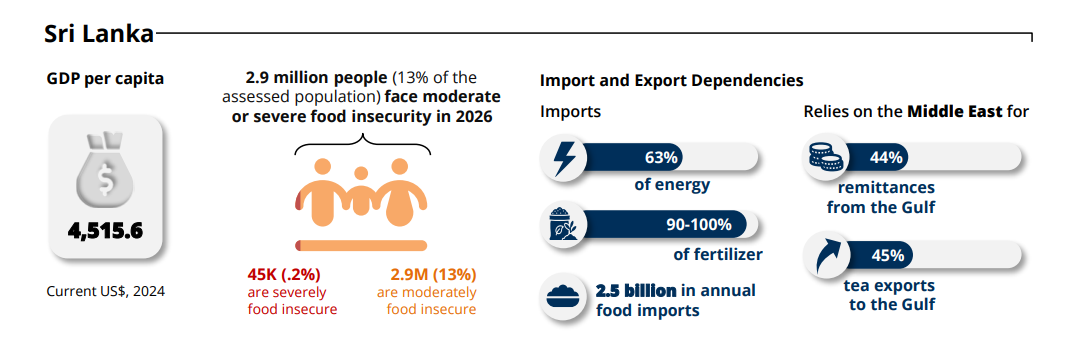
Alongside Sri Lanka, the report profiles Somalia and Afghanistan as examples of countries facing different but equally serious risks from the Middle East crisis, illustrating how economic shocks linked to the conflict are spreading far beyond the region itself.