
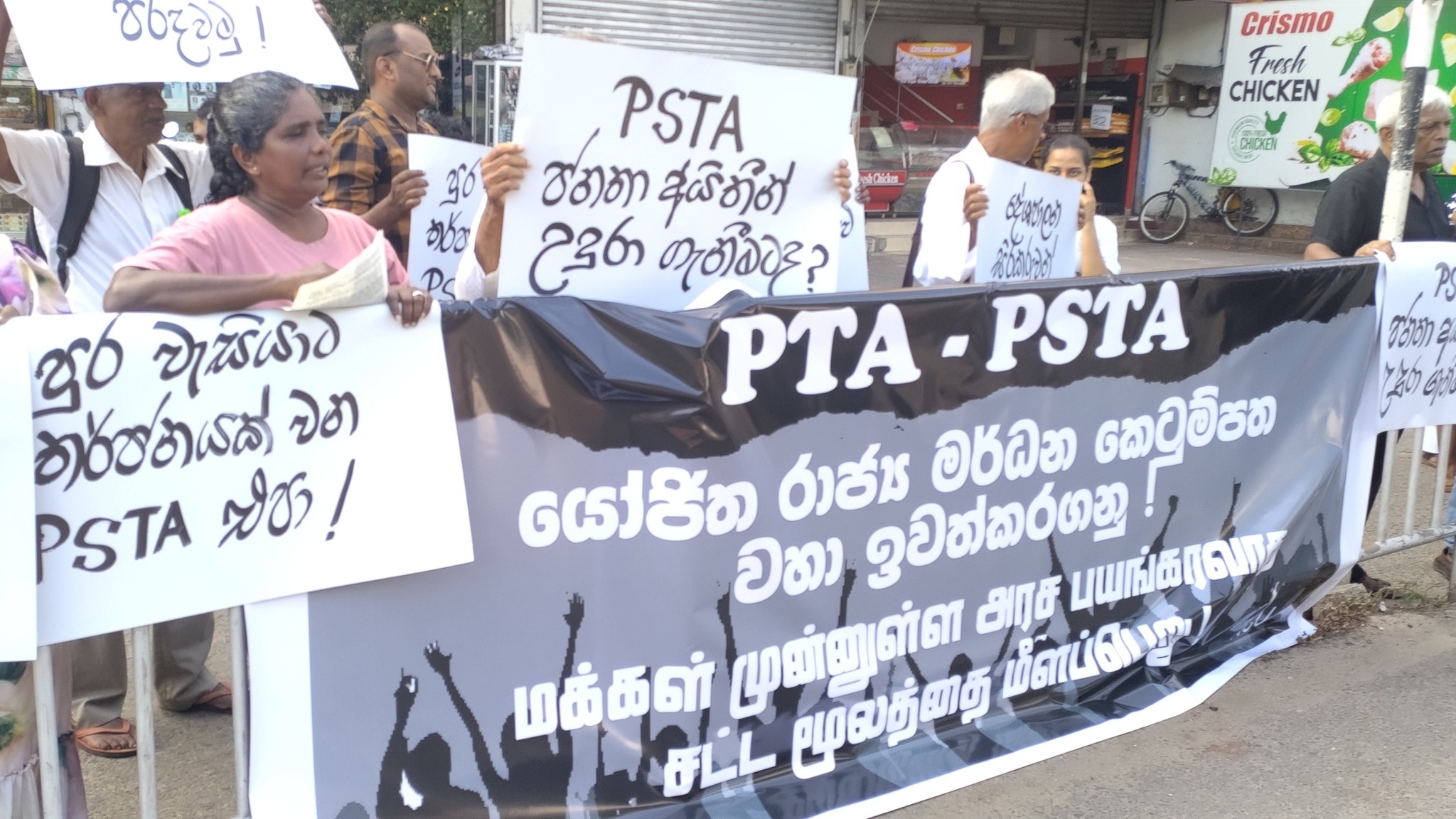

The publication of the Janatha Vimukthi Peramuna (JVP) led National Peoples’s Power (NPP) Government’s draft ‘Protection of the State from Terrorism Act’ (PSTA) in the gazette is awaited by Sri Lankans with bated breath.
The present as continuation of the past
We were told this week that the Cabinet of Ministers has approved its contents. The public was assured by the Cabinet spokesman that the ‘revised’ draft rectifies strong criticisms of the way that the offence of ‘terrorism’ has been defined in its earlier version. Even so, the official release still continues to refer to the draft under the earlier preposterous title of ‘protecting the State’ from ‘terrorism.’
If so, this is little reassurance that anything startlingly new has gone into its contents. We cannot be so easily led astray by political pronouncements to that effect. The object of an anti-terrorism law is not to protect the ‘State from terrorism. That can be interpreted as latitude given to the Government to clamp down on freedoms of speech and expression that exposes its own ill doings and misdeeds.
This was the precise problem with earlier drafts, both under former President Ranil Wickremesinghe’s Presidency and the present Government which appears to be following faithfully in his footsteps. Offences relating to ‘terrorism associated acts’ and ‘encouragement of terrorism’ were defined broadly in Mr Wickremesinghe’s draft Counter Terrorism Act (CTA) and the Anti-Terrorism Bill (ATB).
NPP’s earlier draft PSTA more anti-democratic than the PTA
These had the potential to ‘kill’ and not merely ‘chill’ dissent. Their implications for the media were particularly consequential. Those drafts were, with great difficulty, prevented from being enacted after public concern, if not outrage, was manifested. The NPP’s draft PSTA, in terms of what was presented to the public in earlier versions some months ago, were to like effect.
That was perhaps even more seriously anti-democratic in certain of its clauses than the Prevention of Terrorism Act (PTA) which it seeks to replace or the CTA and the ATB. In fact, Mr Wickremesinghe’s anti-terrorism drafts boasted proper titles as contrasted to its present NPP avatar. Certainly there is more to a ‘title’ of a law that what meets the eye as any student of statutory interpretation would be quick to remind.
For those inclined to dismiss the ‘title’ as being of no consequence, they must be educated that this is both unwise and legally unsound. Referencing the long title of a statute or its preamble is a standard procedure for any court called upon to interpret a problematic or unclear provision. The purpose of an anti-terrorism law must be to protect the ‘People’, not the State, from terrorism.
More to the title than meets the eye
To maintain that there is no distinction between the two is absurd in the extreme. If that fundamental distinction has yet not been appreciated by those drafting this document, Technical Committee of ‘experts’ or not as the case may be, the rest of its contents are liable to be looked at with a jaundiced eye and justifiably so.
In fact, the significant over-breadth of the definition of what amounts to ‘terrorism’ was just one of many other serious concerns. These concerns have been analysed previously in these column spaces. The progressive decline of rights protections in the draft PSTA as compared to the CTA and ATB was of specific interest. A good example is the way that Restriction Orders were treated.
Mr Wickremesinghe’s CTA (2018) empowered the Minister to issue ‘Restriction Orders’ upon a recommendation made by the Inspector General of Police (IGP). An appeal could be lodged to the Court of Appeal by an individual aggrieved as a result of such an Order being issued. In the wake of criticisms of the extensive power given to the executive in that regard, the later ATB (2023) vested the power of issuing such Orders with the President upon the recommendation of the IGP.
Lowering the bar of rights protections further
But the NPP’s draft PSTA (2026) lowered the bar even further by giving ‘a police officer not below the rank of Deputy Inspector General of Police (DIG)’ the power to apply for ‘Restriction Orders’ against any person by approaching the Magistrate’s Court. Restriction Orders’ under Clause 64 (3) encompassed a full range of prohibitions.
These including ordering any individual to curtail (a) movement outside the place of residence, (b) travelling within Sri Lanka, (c) travelling overseas and (d) travelling outside the normal route between the place of residence and a place of employment. In addition, restrictions may be placed on (e) the communication or association, or both, with ‘particular persons’ as specified in the Order.
Also included was (f) engaging in certain specified activities that may facilitate the commission of an offence under this Act. Expanding on the list in the ATB, the draft PSTA adds that restrictions may be imposed on (g) visiting any place specified in the Order. Such Orders may include requiring the affected person to report to a police station. Initially issued for one month, the Orders can be extended upon magisterial scrutiny to a maximum of six months.
Impact of oppressive powers
It does not need a genius to figure out the oppressive implications of such powers. Does the ‘new draft’ that the Cabinet spokesman talked about, continues to allow an unacceptable laxity in permitting ‘Restriction Orders’ to be imposed? This is just one example, singled out due to the lack of space to refer to many other problems with the NPP’s draft PSTA.
These go counter to its campaign promise to replace the PTA with a law securing civil freedoms of Sri Lankans. We look forward to the ‘new’ PSTA draft not only framing offences narrowly but also ensuring that law enforcement officers are not enabled to misuse their authority.
There is also a reference to ‘organised crimes’ in the Cabinet spokesman’s statement on the draft PSTA that is puzzling. It is said that the ‘new draft’ will ‘…protect the democratic freedoms and fundamental human rights of the people, as well as prevent terrorism including organized crimes.’ That is, of course, a veritable legal mouthful, so to speak.
Why the EU GSP Plus was denied then
Earlier statements made by President Anura Kumara Dissanayake seemed to imply that a separate law with deterrents to organized crimes was being formulated. We are yet to be enlightened in that respect. But if the purpose of this replacement law is to offset criticisms emanating from the ‘international community’, that is hardly the point.
This is of immediate concern also in regard to the potential loss of the EU GSP Plus preferential trade facility to Sri Lanka. EU GSP Plus benefits were denied to Sri Lanka in 2010, causing the ‘closure of 25 apparel factories, forcing almost 10,000 people out of work, with the total loss to the country exceeding Rs. 782 million from apparel exports’ (Financial Times, 24th October 2013).
In 2010, the EU listed several reasons for its decision to deny the trade facility. Among these was the failure to effectively implement the 17th Amendment to the Constitution and the non-legitimacy of a politicised Constitutional Council (CC). In addition, the demonstrated ineffectiveness of the criminal justice system and the rampant politicisation of the police investigative function were singled out.
What has changed now?
An EU experts panel observed that the police were unable or unwilling to investigate human rights violations. Meanwhile a law prohibiting torture was glaringly non-effective and politically driven Commissions of Inquiry do not paper over the widening tears in the fabric of justice, the expert mission said.
What exactly has changed now in a ‘system change’ Government, we may well ask? That is, apart from putting politicians of previous regimes behind bars, that is. This is richly deserved, no doubt.
But it is not the ‘be all and the end all’ of governance,’ let it be said bluntly.
(Courtesy of The Sunday Times)