
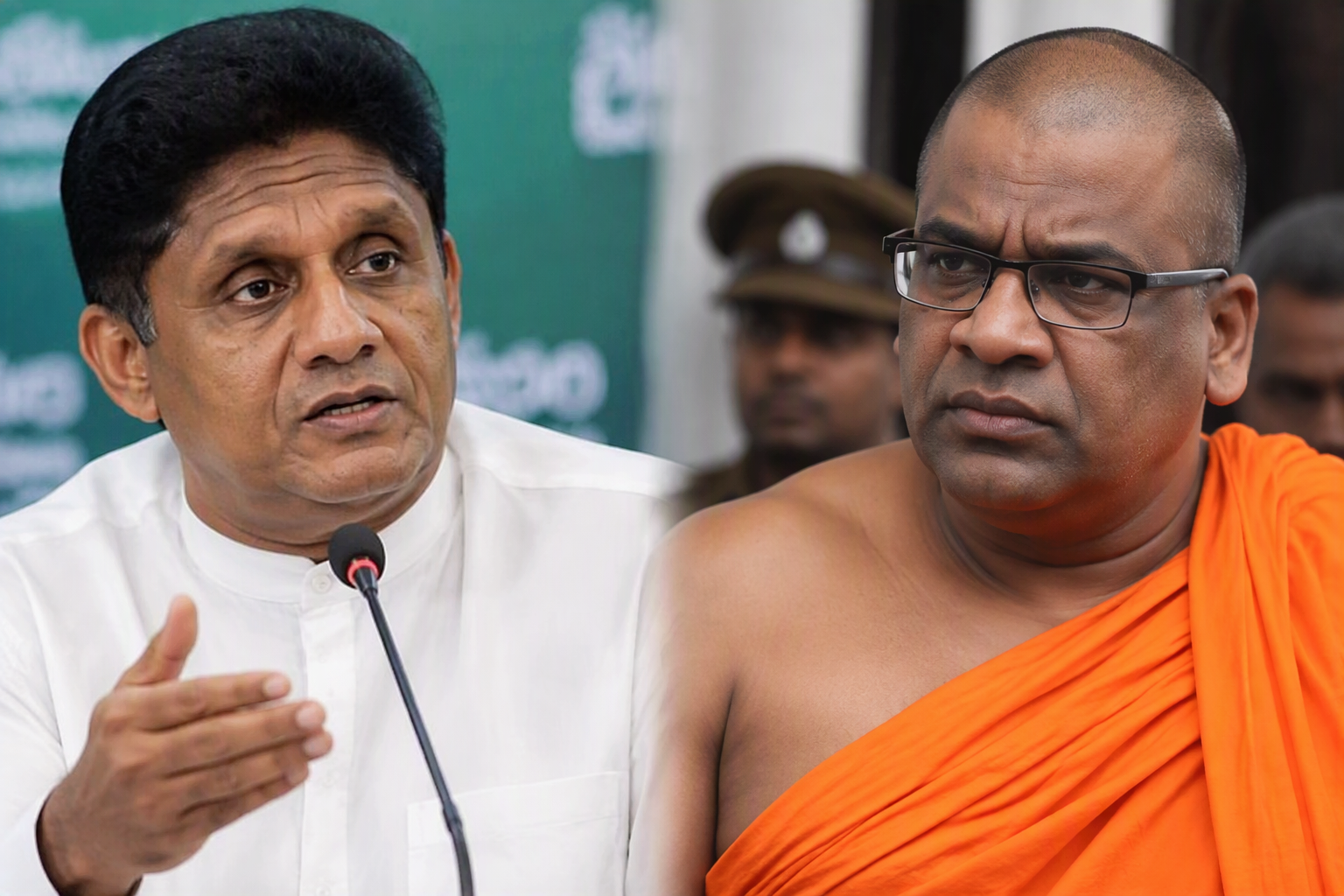

Prisons Department says rules apply to all convicted prisoners as Sajith Premadasa questions treatment of controversial BBS monk.
The re-imprisonment of Bodu Bala Sena General Secretary Galagoda Aththe Gnanasara Thero following the invalidation of his presidential pardon has developed into a political and religious controversy, after he was produced before the Colombo High Court without his Buddhist robes.
Gnanasara Thero, who was convicted of contempt of court and sentenced to six years’ rigorous imprisonment in 2018, had been released in May 2019 after receiving a presidential pardon from then President Maithripala Sirisena. The Supreme Court subsequently ruled the pardon unconstitutional and invalid.
The original conviction arose from Gnanasara Thero’s conduct at the Homagama Magistrate’s Court during proceedings connected to the disappearance of journalist Prageeth Eknaligoda. He was convicted on four charges of contempt of court and sentenced to 19 years’ rigorous imprisonment to run concurrently over six years.
Following the Supreme Court decision, the Attorney General moved the Court of Appeal to enforce the outstanding sentence. When Gnanasara Thero failed to appear before court, the Court of Appeal issued a warrant for his arrest on 29 September. His lawyer said he was ill, but the court noted that medical documentation had not been produced at that stage.
The Court of Appeal subsequently directed authorities to enforce the remainder of the sentence, and Gnanasara Thero is now back in prison. When prison officials produced him before the Colombo High Court on 6 October in connection with another case, he appeared not in his familiar saffron robes but in civilian/prison clothing.
It was that change of clothing, rather than the judicial decision returning him to prison, that quickly became the centre of political controversy.
Sajith Premadasa enters the controversy
Opposition Leader Sajith Premadasa questioned the decision to produce the monk in court without his religious robes, arguing that the Government should respect religious traditions and the dignity attached to the Buddhist robe.
In his statement, Premadasa accepted that courts operate within the legal framework, but argued that governments must also be sensitive to social traditions, conventions and religious and cultural identities.
He maintained that decisions concerning whether someone continues to hold the status of a Buddhist monk should properly belong to the relevant religious institution, and called for sensitive cases involving Buddhist clergy to be dealt with in consultation with the Mahanayake Theras.
The intervention, however, shifts what is essentially a question about the treatment of a convicted prisoner into the political arena.
The key issue is whether Gnanasara Thero was singled out because of his identity or religious status, or whether prison authorities merely applied an existing rule governing convicted prisoners.
The explanations subsequently provided by both the Prisons Department and the Government support the latter position.
Prisons Department: sentence determines clothing
Commissioner of Prisons (Operations) and Prisons Media Spokesman Senaka Pallethenna said the clothing worn by prisoners when produced before court is governed by prison regulations rather than an ad hoc decision concerning Gnanasara Thero.
According to Pallethenna, a Buddhist monk sentenced to simple imprisonment may remain in robes while serving the sentence. But where a sentence involves rigorous imprisonment, the prisoner is required to wear prison attire.
He also drew a distinction based on the length of a sentence when convicted prisoners are taken to court.
For sentences of less than three years, the prison superintendent may permit a prisoner to wear the civilian clothing worn before imprisonment. But a person serving a sentence exceeding three years must be produced in clothing issued by the prison, according to the Department’s explanation.
That distinction is significant because Gnanasara Thero’s original contempt-of-court sentence was six years’ rigorous imprisonment.
The Prisons spokesman further said that religious clergy have previously served prison sentences under established administrative and legal procedures.
Government rejects allegation of special treatment
Cabinet Spokesman and Minister Nalinda Jayatissa went further, rejecting suggestions that prison authorities had taken a special or punitive decision against Gnanasara Thero.
Jayatissa said the procedures governing Gnanasara Thero’s prison and court attire were implemented under the Prisons Ordinance and prison regulations, and that no special procedure had been devised for him.
According to the Minister, the same procedure is being applied to 63 Buddhist monks currently serving prison sentences. He said Gnanasara Thero would receive neither exceptional treatment nor special privileges.
The Government’s position therefore directly challenges the implication that the removal of Gnanasara Thero’s robe represents political interference with his religious status.
There is nevertheless a separate dispute over the issue within the Buddhist clergy. The Kotte Sri Kalyani Samagri Dharma Maha Sangha Sabha has argued that decisions concerning whether a monk should retain or remove his robes as an ecclesiastical matter fall within the authority of the Sangha Sabha.
That argument, however, raises a distinction which has become blurred in the political controversy: being required to wear prison clothing while serving a sentence is not necessarily the same thing as being formally expelled or disrobed from the Buddhist monastic order.
The Prisons Department is explaining its action as an application of rules governing the clothing of prisoners. The monastic authorities are asserting their authority over ecclesiastical status. And Premadasa has chosen to intervene on the question of religious tradition.
Against that background, the controversy is no longer simply about what Gnanasara Thero wore to court.
It has become a broader test of whether an ultra-Sinhala-nationalist religious figure convicted and imprisoned under the ordinary law should be treated differently from other convicted prisoners because of his religious status, and where the boundary should lie between the authority of the State over a prisoner and the authority of a religious institution over one of its clergy.