
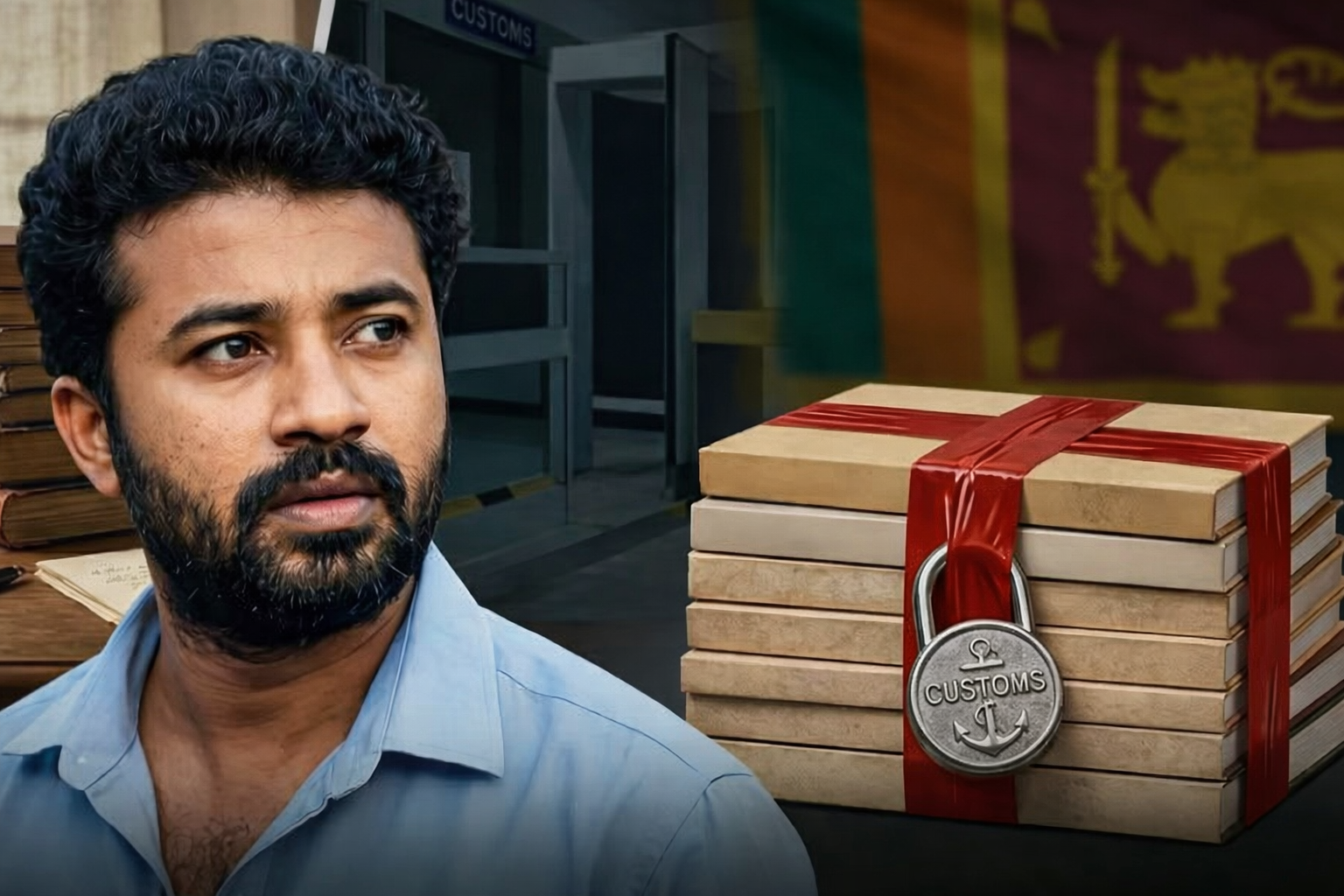

On the 10th, the writer informed us that he had been summoned to Colombo for a discussion scheduled for the 17th. This was not a legal summons, nor was he under any obligation to attend. Nevertheless, the Minister of Buddhist and Cultural Affairs of the Democratic Socialist Republic of Sri Lanka personally contacted him and requested his presence.
A committee had already investigated the matter and indicated that Theepachelvan’s literary works—currently held by Customs—would be released provided they posed no threat to national security. Despite raising several basic and legitimate questions arising from this decision, the so-called Literary Council, representing Amatha and former JVP militants, failed to respond to any of them.
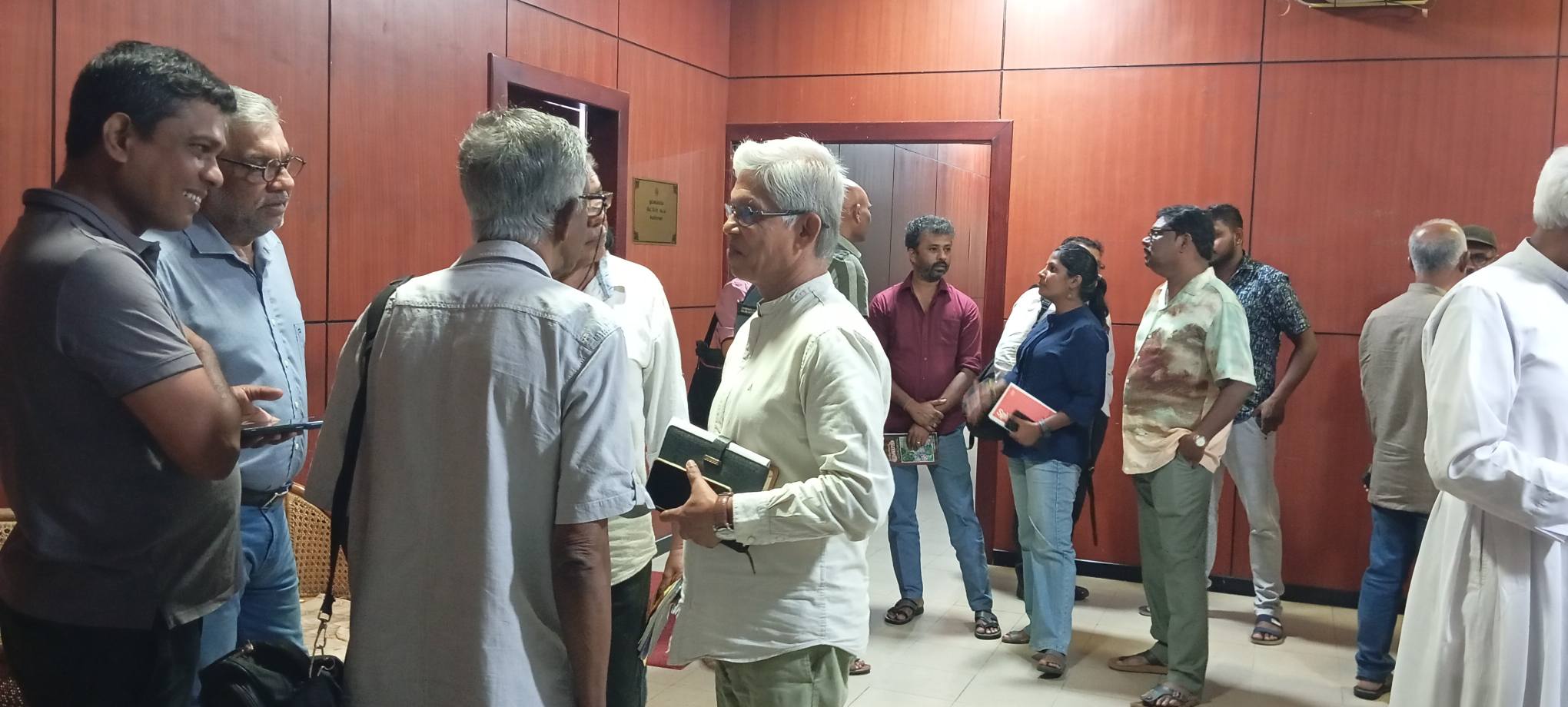
On the 17th, TheepaChelvan, who travelled from Kilinochchi to Colombo, was sent back empty-handed. He was informed that the release of his works would now depend on the Ministry of Defence’s permission. Shockingly, the Minister who personally summoned him left midway through the discussion. The Minister owes the public an explanation as to why a writer was summoned from Kilinochchi for a discussion that yielded nothing.
Meanwhile, individuals such as Kamal Perera, once celebrated as great fighters, have expressed anger on social media merely for writing about this issue. It is also reported that a so-called romantic literary critic has issued an audacious statement.
We see no need to revisit the JVP’s past interventions on freedom of expression. When Shakthika Sathkumara was imprisoned over a short story, he displayed a generosity in Parliament that defied measure.
Yet, when observing the conduct of the so-called progressive front that claims to be a National People’s Power, one is reminded of Julien Benda’s The Treason of the Intellectuals. Long before the election, we repeatedly warned about the damage political allegiance inflicts on artists—foremost among them, the loss of critical independence.
Is this not exactly what we are witnessing now?
These figures have not only abandoned criticism but have also chosen political loyalty over moral responsibility. The progressive literary establishment must be told clearly: this is the time to take an uncompromising stand, not to issue hollow expressions of “disappointment.” One day, there will be a reckoning of your actions during this positional shift.
This government has no clear policy direction. While claiming to protect leftist ideology, it continues to operate along a neoliberal path—exposing even neoliberals to the consequences of a system stripped of all masks.
Labeling a literary work as a national security threat before its publication is a grave violation of freedom of expression. Previously, we have witnessed attempts at post-publication censorship. This escalation marks a dangerous precedent.
We are fully aware of the political terrain into which Deepachelvan, as a Tamil writer, carries his voice. This censorship is not merely an assault on freedom of expression; it is part of a broader structure of institutional racism imposed on the Tamil people. We can only smile bitterly at those who expected justice for Tamils from a party that promised to “fight the good fight.”
Behind the censorship of Tamil literary works lies a deeper objective: the destruction of collective memory. We have consistently argued that literature is essential to preserving and transmitting this memory. Therefore, this must not be dismissed as a mere ban on books—it is an attack on history, identity, and survival.
Article 14(1)(a) of the Constitution of Sri Lanka guarantees freedom of speech and expression. By what authority, then, do the Customs Department or the Ministry of Defence violate this guarantee? And how does the National People’s Power government justify such actions?
This is not an isolated incident. Tamil writers in Sri Lanka live under constant surveillance.Theepachelvan himself was harassed by the Terrorist Investigation Division during the writing of his works. This persecution has not ceased under the National People’s Power government.
The so-called intellectual and artistic class, having discarded moral responsibility, must share the burden of this injustice. Likewise, the National People’s Power government stands exposed for replicating the same security practices used by previous racist regimes.
A red bird has landed on freedom of expression.
Let us resist all forms of censorship.
Let us oppose the systematic attempt to erase the collective memory of the Tamil people.
( Adopted from a Sinhala FB post of well-known Sri Lanka writer Sandun Priyankara Vithanage )