

Once again, ominous sparks of religiously charged agitation are flickering across Sri Lanka—sparks capable of igniting an island-wide conflagration that could burn the nation to the ground for decades, condemning generations yet unborn to pay the price and setting the country back by at least fifty years. Tragically, the instigators of this chaos drape themselves in Buddhism—one of the world’s most peaceful, non-violent philosophies—using the sacred Dhamma as a convenient shield to justify and mask their lawlessness, ego, and political ambitions.
What are being staged as desperate movements to “save Buddhism” have nothing to do with protecting the Sasana. At their core, these spectacles are orchestrated bids for public attention, political leverage, and chaos. Look closely at the two demands around which a group of saffron-robed agitators launched a hunger strike near the sacred Ruwanweli Maha Seya in Anuradhapura on November 7: first, that the Mahanayake Theros intervene to secure the release of a senior extremist monk currently serving a prison sentence; and second, that the government immediately revoke the gazette notification for the Anuradhapura Sacred Area Development Plan, which protesters allege threatens the sacred landscape and invites foreign commercialisation.
Neither demand holds water upon basic scrutiny. The Mahanayake Theros had already addressed the issue of the imprisoned monk and engaged in discussions with the President regarding matters concerning the clergy. Equally telling is the timing of the second demand: the updated Anuradhapura Sacred Area Development Plan—which updates the original 1984 framework to expand the protected sacred zone from 28 to 38 square kilometres alongside improvements to infrastructure, pilgrim facilities, and archaeological conservation—was officially issued via Gazette Extraordinary No. 2477/44 as far back as February 27, 2026. Why, after eight months of silence, has it suddenly become an existential threat to Buddhism in October and November? The answer is obvious: this is manufactured outrage serving a narrow political agenda. Wherever communal friction or religious provocation flares up—from Trincomalee to Anuradhapura—the same familiar faces appear at the center of the storm.
The Gnanasara saga
We have seen this exact script play out before. The imprisoned ringleader who played a central role in stoking communal hatred and inciting major racial and religious violence—most notably targeting Muslims and Islam—operated for years as though he were untouchable. He barged into peaceful gatherings to sabotage them, spewed hate speech, threatened individuals in public and inside courtrooms, and openly defamed the judiciary. Ultimately, the law caught up with him; convicted of contempt of court in 2018 and sentenced to six years in prison, his subsequent presidential pardon was ruled unconstitutional by the Supreme Court in September 2026, returning him to prison to serve the remainder of his sentence. He claimed he was “saving Buddhism,” when in reality he was weaponizing the religion as a front for ethno-religious extremism.
Now, stepping into his shoes, a new cast of saffron-robed agitators has revived the same destructive drama, pushing defiance of the state to brazen new extremes. The chief instigator of the Anuradhapura protest has publicly and insolently declared that he fears neither the Executive, the Legislature, nor the Judiciary, asserting that the laws of Sri Lanka do not apply to him and that courts established under the Constitution have no jurisdiction over him, claiming instead that only a monastic Sangha Adhikarana holds authority over him. Lawful police directives and summonses from the Colombo Crimes Division are treated like dust beneath their feet, while Magistrates and judicial orders—including orders, summonses and warrants issued in Trincomalee and the Anuradhapura Chief Magistrate’s Court—are dismissed with vulgar contempt. This figure has gone so far as to claim that sitting Magistrates—and even the Chief Justice himself—are ignorant of the law and the Constitution which he himself had to teach them, boasting that he had to teach the Chief Justice the law.
Street thuggery of opposing monks
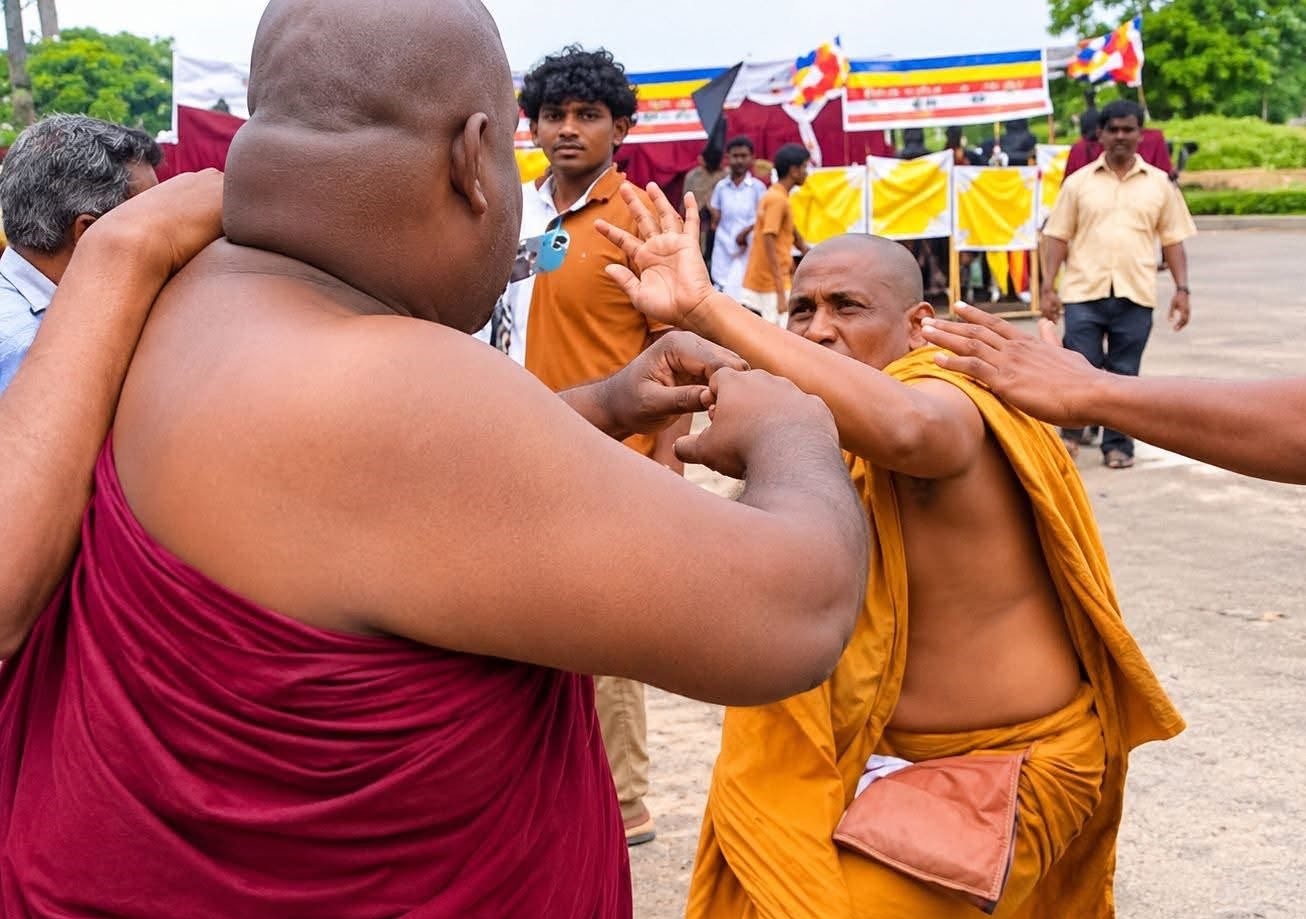
The spectacle degenerated from verbal sedition into outright street thuggery on November 12, 2026, in Anuradhapura. Another controversial figure—who was formally expelled from his own religious Chapter, the Sri Lanka Ramanna Maha Nikaya, in April 2025 over his conduct—descended upon the protest site with a gang of followers, triggering a violent brawl between rival factions of robed agitators and laypeople. Protest huts were demolished, blows were traded, the visiting agitator sustained a bleeding head wound after being struck with a wooden pole, and the protest’s ringleader was captured spinning a club and challenging rivals to a fight. Worse still, during the melee, robed men physically grappled with one another until their robes came undone—one forcibly undressing another in full view of the public and cameras.
There is also a profound spiritual tragedy unfolding in plain sight. Every element of that brawl is an abomination to Buddhist philosophy—a direct violation of both the Vinaya Pitaka, the strict monastic code of discipline, and the core principle of non-violence deeply rooted in Buddhist teachings and values. By turning sacred ground near the Ruwanweli Maha Seya into a battleground—and carrying away a Buddha statue amid a violent street brawl—these agitators broadcast a distorted, violent caricature of Buddhism to the entire world. How does Sri Lanka face the international community when global headlines associate the serene teachings of the Buddha with club-wielding brawls? Devout Buddhists at home are left heartbroken and disillusioned, watching their faith desecrated from within. Worse yet, just as decades of political corruption bred the cynical generalisation that “all politicians are corrupt,” the unchecked antics of these impostors threaten to poison public reverence toward the entire Sangha, leading people to tar all monks with the same brush. Anyone who genuinely wishes to protect Buddhism must first rid the Sasana of political opportunists hiding behind yellow robes.
A direct assault on the rule of law
The immediate peril of this behaviour extends far beyond monastic indiscipline; it is a direct assault on the rule of law. When individuals openly mock the police, flout court injunctions, and ridicule judges without swift consequences, public faith in the justice system erodes. If citizens see that wearing a robe grants immunity from the Penal Code, society risks descending into anarchy, where mobs take the law into their own hands. For a nation still working to stabilize its economy, another wave of communal instability would be devastating. Foreign investors will retreat, tourism—a vital lifeline for millions of Sri Lankan families—will evaporate overnight, international standing will collapse, and the resulting economic and diplomatic losses will be almost impossible to recover within our lifetimes.
History warns us in blood never to dismiss extremist fringe actors as mere clowns or harmless nuisances. Every major catastrophe that tore Sri Lanka apart began with fanatics whom society initially failed to stop. In Black July 1983, a wave of state-condoned, severe anti-Tamil riots and pogroms swept across Sinhalese-majority areas, leaving over 3,000 people dead, thousands injured, and more than 150,000 made homeless and displaced. Shortly thereafter, the bloodthirsty extremist Velupillai Prabhakaran built a terrorist organisation that plunged the nation into a thirty-year separatist war. That same cycle of mutual devastation defined the thirty-year separatist war, where the LTTE’s ruthless campaign of suicide bombings at sacred sites like the Dalada Maligawa and Sri Maha Bodhi, ethnic cleansing, and forced conscription of child soldiers was met with relentless military campaigns, aerial bombardments, and civilian casualties in the North and East—culminating in the immense human suffering of the final stages at Mullivaikkal, where hundreds of thousands of trapped civilians bore the brunt of the crossfire. The war ended in 2009 resulting in an estimated 100,000 total deaths, over 111,655 wounded and permanently disabled, and roughly 800,000 displaced within those blood-soaked three decades.
History of violence
We saw this same merciless reality during the 1988–1989 JVP insurrection and the state’s ferocious counter-insurgency, which turned the South into a landscape of terror. The JVP paralyzed the country through forced hartals, political assassinations, public executions of dissenting civilians and officials, and the destruction of public infrastructure, while the state responded with sweeping emergency powers, unofficial death squads, torture chambers, mass graves like Suriyakanda, and tens of thousands of enforced disappearances. An entire generation of rural youth—university students, schoolboys, and young soldiers—was wiped out, leaving burning tires on roadsides and grief-stricken mothers searching endlessly for their missing vanished sons and daughters.
That tragic pattern repeated itself in the post-war era whenever communal bigots were left unchecked. In June 2014, hate speech and mob agitation ignited the Aluthgama and Dharga Town riots, killing 4 people, injuring over 80, and displacing approximately 10,000 residents. Four years later, in March 2018, anti-Muslim violence erupted in Digana and Kandy, leaving 3 dead, between 10 and 20 injured, and roughly 300 homes, shops, and mosques damaged or destroyed. Just over a year later, on Easter Sunday in April 2019, Islamist extremists masterminded by Naufer Mawulavi and Zahran Hashim carried out coordinated suicide bombings that slaughtered 279 people, injured over 500—leaving dozens permanently disabled—and temporarily displaced more than 1,000 refugees. The economic loss reached billions; the social and cultural loss, immeasurable.
Every single one of these tragedies was ignited by deranged racists, politicians, bureaucrats and religious bigots who were once brushed aside as loudmouths or treated as a joke. Yet when the fires they lit began to rage, no man, woman, or innocent child could escape the flames. Ordinary citizens paid with their lives, their livelihoods, and their children’s futures, while many of the real masterminds and their families insulated themselves abroad, untouched by the misery they engineered at home.
Not a passing circus
The state cannot afford to treat this latest provocation as a passing circus. What begins with two or three agitators quickly draws a flock of opportunists capable of inflicting irreversible damage. Nobody—regardless of status, political backing, or religious attire—can be permitted to stand above the law. Statutes such as the ICCPR Act, the Penal Code, and the Contempt of a Court, Tribunal or Institution Act were not enacted to gather dust on shelves, nor to enable the police to arrest a poet, novelist, or stand-up comedian; they exist precisely to halt incitement, hate speech, and judicial defiance before blood is spilled. Had law enforcement applied these laws firmly and without hesitation during the 2014 Aluthgama riots, the 2018 Digana violence, and the 2018 Mawanella Buddha statue vandalism, countless lives, properties, billions in economic output, and Sri Lanka’s international dignity could have been spared.
The police arrest of the protest ringleader and two associates in Anuradhapura on November 12 must not end as another hollow procedural gesture. The law must take its full, uncompromising course. Sri Lanka has burned enough times to know how quickly a match becomes an inferno—the state must act decisively now to save the country.
(Niroshan Pathberiya is an Attorney-at-Law)