
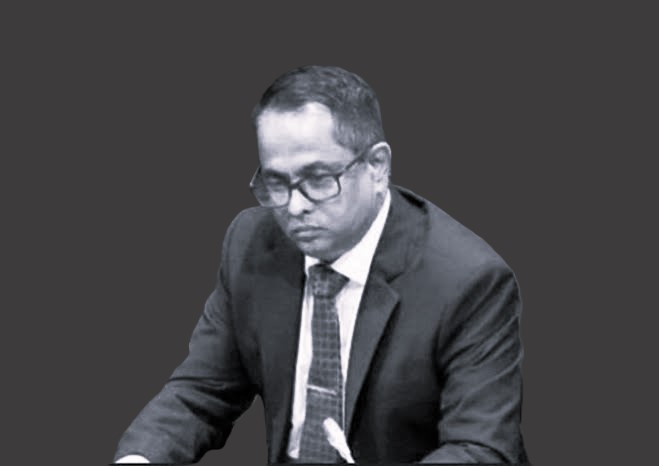

The investigation by Sri Lanka’s Commission to Investigate Allegations of Bribery or Corruption (CIABOC) into Speaker Dr. Jagath Wickramaratne has entered a fresh phase, with two drivers attached to the Speaker’s office summoned to provide evidence this week. The inquiry is significant not only because it involves the country’s third-highest constitutional office, but also because it is believed to be the first corruption investigation conducted into a sitting Speaker of Parliament.
According to notices issued by the Commission’s Special Investigation Unit, the drivers have been directed to appear before investigators with records relating to a parliamentary vehicle allegedly assigned to an unofficial media unit operating under the Speaker’s office. Investigators have requested details of the vehicle’s usage, duty logs since September 2025, and documentation relating to a traffic accident involving the vehicle in January this year.
The investigation stems from a complaint lodged by former Deputy Secretary-General and Chief of Staff of Parliament, Attorney-at-Law Chaminda Kularatne, who alleges that a media unit was established without the required authorisation and that a parliamentary vehicle was unlawfully allocated for its use.
The complaint further claims that the vehicle was involved in an accident while being used for activities unrelated to official parliamentary duties and that public funds were subsequently utilised for repairs in addition to the insurance compensation received.
Sources familiar with the inquiry say investigators have questioned several senior officials attached to Parliament’s transport division and are seeking to establish whether public resources were diverted for personal or politically related purposes. Officials close to the investigation indicate that evidence-gathering is nearing completion and that legal officers are being consulted throughout the process to ensure any eventual prosecution can withstand judicial scrutiny.
The case presents an early and potentially embarrassing test for the National People’s Power (NPP) administration, which came to power promising a decisive break from the corruption, misuse of state resources and lack of accountability that characterised previous governments. While the NPP has repeatedly pledged zero tolerance for corruption and has sought to portray itself as the ethical alternative to Sri Lanka’s traditional political parties, a growing number of allegations involving individuals associated with the administration have raised questions about whether those standards are being applied consistently.
Government representatives insist that the Bribery Commission is operating independently and emphasise that neither ministers nor the President would be shielded from investigation. If true, the continuing probe into the Speaker could be cited by the administration as evidence that law enforcement institutions are being allowed to function without political interference. Critics, however, argue that the ultimate measure of independence will not be the commencement of investigations, but whether they are permitted to proceed to their logical conclusion regardless of the political status of those involved.
For the NPP, the political stakes extend beyond the allegations against a single official. The party’s claim to moral and political legitimacy rests heavily on its promise to establish a cleaner and more accountable system of governance. As a result, corruption allegations involving senior state officials inevitably attract heightened scrutiny, not merely because of the individuals concerned, but because they are viewed as a test of whether the government’s anti-corruption rhetoric can survive encounters with allegations within its own ranks.
With investigators now gathering operational records and witness testimony, attention is likely to focus on whether sufficient evidence exists to establish criminal liability under the Anti-Corruption Act No. 9 of 2023. Whatever the outcome, the investigation has already become a politically sensitive case, touching both on the management of public resources within Parliament and the credibility of a government elected on a promise to clean up Sri Lankan politics.