
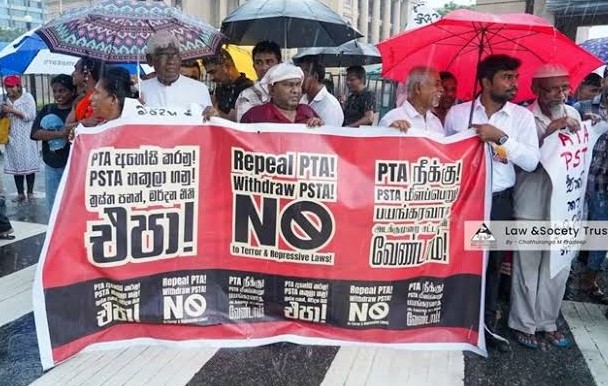

Sri Lanka stands at a perilous legal threshold. Gazetted within weeks of each other—the Protection of the State from Terrorism Act (PSTA) on September 22, 2026, and the Prevention of Organised Crimes Act (POCA) on October 2, 2026—these twin legislative proposals are framed by the government as modern frameworks to safeguard national security and combat organized crime. Yet, beneath their public relations veneer lies an autocratic blueprint. Legal experts, civil society organizations, and international watchdogs, have raised concerns, pointing out that these laws dismantle the foundational checks and balances of a democratic society. Crucially, as these bills face intense public backlash and constitutional challenges, they are now under legal review in the Supreme Court, while the President has publicly stated that the administration is open to amendments. Nevertheless, let us not be fooled by political assurances. Although the government insists these measures are not intended to suppress anyone, in the wrong hands or corrupted hands, what is the absolute guarantee?
Furthermore, Clause 66 of POCA defines an “organised criminal group” as requiring as few as three persons acting in concert, with no requirement for a formal structure, defined roles, or continuous membership. This vague threshold can easily be weaponized to label loose groups of citizens, pressure groups, or dissenting protesters as criminal syndicates.
The primary structural danger of both Bills lies in how they construct criminal definitions so broadly that ordinary citizens, trade unionists, journalists, and political activists can be easily ensnared. Under Clause 3 of POCA, a “serious crime” is defined as any offense carrying a prison sentence of four years or more, coupled with a massive schedule of diverse offenses ranging from major crimes to minor copyright infringements, forest offenses, and unlicensed gambling. This subjects everyday regulatory or economic infractions to the draconian penalties and parallel detention rules designed for violent syndicates. Furthermore, Clause 66 of POCA defines an “organised criminal group” as requiring as few as three persons acting in concert, with no requirement for a formal structure, defined roles, or continuous membership. This vague threshold can easily be weaponized to label loose groups of citizens, pressure groups, or dissenting protesters as criminal syndicates. Similarly, while the PSTA narrows certain definitions of terrorism compared to previous drafts, it retains dangerous ambiguities. Acts resulting in “substantial economic loss” or disruptions to electronic and communication networks are equated with violent harms, and Section 3(4) treats strikes, advocacy, and protests merely as an evidential caution rather than an explicit, ironclad exclusion, leaving peaceful civic dissent vulnerable to executive overreach.
“In an extraordinary leap toward totalitarian control, the legislation criminalizes personal identity, lifestyle, and public transparency. Clause 4(2) of POCA empowers courts and law enforcement to infer gang membership based on subjective, non-criminal lifestyle markers such as clothing style, hand signs, vocabulary, tattoos, specific places visited, and social associations.”
In an extraordinary leap toward totalitarian control, the legislation criminalizes personal identity, lifestyle, and public transparency. Clause 4(2) of POCA empowers courts and law enforcement to infer gang membership based on subjective, non-criminal lifestyle markers such as clothing style, hand signs, vocabulary, tattoos, specific places visited, and social associations. This effectively criminalizes youth culture and personal appearance—regardless of whether the wearer knows their alleged significance, regardless of whether such features have any proper definition or sociological research linking them to actual criminality in Sri Lanka—focusing on superficial traits rather than overt criminal conduct. Concurrently, the Bills launch a direct assault on media freedom and public transparency. Clause 14 of POCA criminalizes reporting court proceedings without prior permission and imposes strict publication bans on victim identities under threat of two years in prison, creating an atmosphere of self-censorship that shields state actions from public scrutiny. This is compounded by PSTA Section 74, which defines “confidential information” so broadly—encompassing military and police deployments, arrest records, and routine security operations—that independent journalism and human rights documentation of state overreach could be prosecuted as terrorism-related offenses.
The most alarming structural flaw of the PSTA and POCA is the wholesale erosion of judicial oversight and the concentration of unchecked power within the executive branch and senior police hierarchy. Under POCA Clauses 20–21 and PSTA Sections 26–27, suspects can be held for up to 72 hours before being produced before a Magistrate. Following this initial window, an executive official—the Ministry Secretary—is empowered to issue Detention Orders keeping a suspect in police custody for up to two months at a time, accumulating to a full year without a formal indictment. Most egregiously, POCA Clause 20(3)(a) and PSTA Section 26(3)(a) strip Magistrates of their discretionary authority, forcing them to automatically rubber-stamp executive detention orders. Furthermore, POCA Clause 25 and PSTA Section 39 allow individuals safely held under judicial remand to be pulled back into police custody and isolated for up to six months based on new, unverified allegations, effectively circumventing judicial safeguards and reintroducing emergency-style detention mechanics. To sustain this parallel detention regime, the legislation dismantles historical evidentiary protections by nullifying sections of the Evidence Ordinance to allow confessions made directly to senior police officers (Clauses 46 and 47), shifts the burden of proof onto the accused, permits warrantless digital surveillance (POCA Clause 44(4), PSTA Sections 28 and 45), and grants sweeping immunity to shield law enforcement from accountability.
The inherent danger of these sweeping powers becomes starkly terrifying when examined against the institutional reality, capacity lapses, and documented misconduct of the Sri Lanka Police. Entrusting an institution plagued by corruption, violence, and profound legal illiteracy with expanded executive powers is a direct invitation to tyranny. Across both higher and lower ranks, corruption and abuse run deep. The public is asked to trust an agency where high-level command is frequently tainted by criminality—such as the shocking case of former Colombo North DIG Vaas Gunawardena, his son, and several police officers who were convicted and sentenced to death for the brutal 2013 abduction and contract murder of businessman Mohamed Siyam. Senior leadership rot is further evidenced by former IGP Deshabandu Tennakoon, who was dismissed by Parliament after the Supreme Court found him guilty of torturing a suspect, alongside recent high-profile arrests including Chief Inspector Varuni Bogahawatta over fraud-linked funds and OIC dismissals at the Akuressa Police Crime Division for running ties with members of drug-trafficking networks.
At the ground level, the system is routinely stained by fatal brutality and custodial torture. According to the Human Rights Commission of Sri Lanka (HRCSL), between January 2020 and March 2025 alone, there were 49 reported deaths in police custody and 30 deaths resulting from confrontations following arrest.
At the ground level, the system is routinely stained by fatal brutality and custodial torture. According to the Human Rights Commission of Sri Lanka (HRCSL), between January 2020 and March 2025 alone, there were 49 reported deaths in police custody and 30 deaths resulting from confrontations following arrest. This violent legacy is punctuated by historical atrocities: the 1988 custodial murder of Wijedasa Liyanarachchi (whose autopsy revealed 19 broken ribs and over 100 internal injuries); the 2002 torture and subsequent 2004 assassination of dock worker Gerald Mervin Perera; and the 2009 Angulana police custodial murders. Demonstrating that this crisis is ongoing, the October 2026 custodial death of 29-year-old Ishara Harshakumara at the Homagama Police Station—where investigations revealed he suffered three broken ribs and severe head trauma from assaults inside the station—proves that officers continue to operate with total impunity.
Beyond brutality, the police force frequently exhibits a profound institutional incapacity to correctly interpret and execute statutory law, regularly turning basic civic life into absurd human rights violations. In my own professional experience, I once encountered a police officer who argued with me, insisting that a domestic worker beaten by her master could easily file a Fundamental Rights case in the Supreme Court against the private employer—audaciously asking me if “the learned counsel” (myself) had even read the Fundamental Rights chapter of the Constitution and telling me to go and read it, completely oblivious to the elementary constitutional principle that FR jurisdiction applies strictly to executive and administrative action, not private disputes.
Demonstrating such a fundamental misunderstanding of statutory law constitutes an unacceptable shortcoming in a law enforcement professional. Unfortunately, this staggering legal illiteracy is mirrored in other infamous cases: Hasalaka Police arrested a woman, Abdul Rahim Masahina, because the print on her dress featured a ship’s wheel, which ignorant officers bizarrely misconstrued as a sacred Buddhist Dharma Chakra symbol, resulting in a gross FR violation condemned by the Supreme Court. Similarly, police officers demonstrated a total lack of proportionality by harassing and detaining foreign tourists, such as British visitor Naomi Michelle Coleman, simply for having innocuous Buddha tattoos on their bodies. Furthermore, officers have routinely weaponized the 2007 ICCPR Act against artists and writers. Senior officers even operate under the delusion that the ICCPR—widely recognized as one of the world’s most finely crafted human rights conventions—can be used by police to arbitrarily arrest novelists and poets on petty matters, while figures like Galagoda Aththe Gnanasara who make blatantly racist comments walk free. This is administrative absurdity I personally encountered when a police officer argued with one of my senior legal counsels, insisting that the ICCPR was merely a ‘civil’ affair statute. If an institution can look at a woman’s dress pattern of a ship’s wheel or a tourist’s tattoo and construct a criminal or sacrilegious threat, how can any citizen trust them with the sweeping, ambiguous definitions of terrorism and organized crime under the PSTA and POCA? Granting unchecked detention, warrantless surveillance, and confession-based powers to a police force with this documented history of incompetence, corruption, and brutality is not a security measure—it is the codification of a police state.
“To prevent Sri Lanka from sliding irreversibly into authoritarianism, the state must withdraw these deeply flawed texts and adhere strictly to international human rights standards. First, offenses relating to terrorism and organized crime must be tightly redefined to explicitly shield peaceful dissent, trade union activities”
To prevent Sri Lanka from sliding irreversibly into authoritarianism, the state must withdraw these deeply flawed texts and adhere strictly to international human rights standards. First, offenses relating to terrorism and organized crime must be tightly redefined to explicitly shield peaceful dissent, trade union activities, civic advocacy, and journalistic work from criminalization. Second, absolute judicial oversight must be restored by stripping executive officials and police of arbitrary detention powers, ensuring prompt judicial review, and requiring prior judicial warrants for all searches, seizures, and digital surveillance.
Third, the legal framework must enforce rigorous protections against abuse by rendering all police-extracted confessions completely inadmissible in court, outlawing custodial torture without exception, and protecting due process rights, including the presumption of innocence and access to legal counsel. Finally, the government must eliminate broad statutory immunities that shield law enforcement officers from criminal accountability, establish independent oversight bodies to investigate police misconduct, and engage in genuine, transparent public consultations with civil society and legal experts before attempting any legislative reform.
Make no mistake: if the government remains stubborn, refuses to welcome constructive criticism, and pushes these draconian frameworks through, the future of fundamental freedoms and human rights in Sri Lanka is in grave, immediate danger.
(Niroshan Pathberiya is an Attorney-at-Law)