
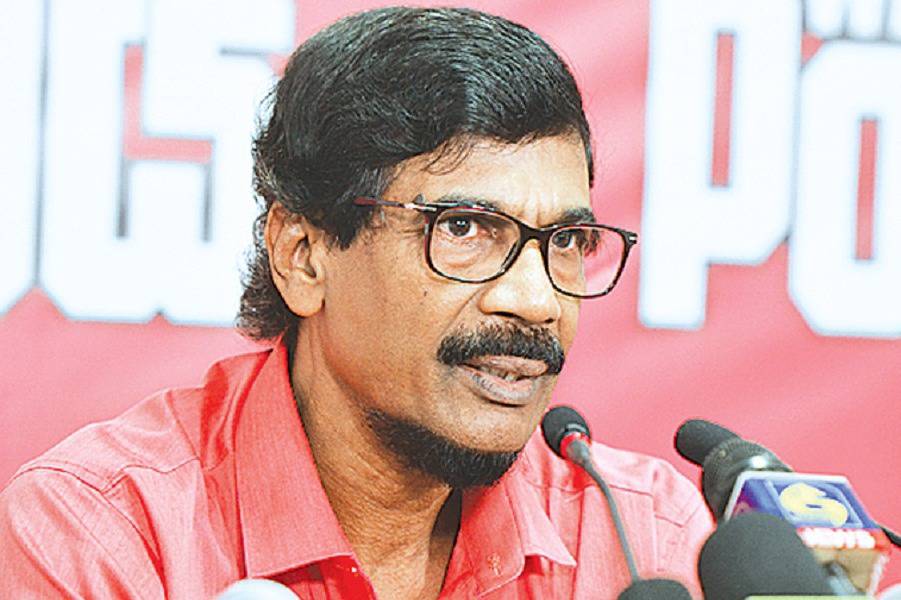

Image: JVP General Secretary Tilvin Silva makes it clear: There will be no provincial council system under a new constitution.
Lionel Bopage’s account of a conversation with Tilvin Silva raises a larger question: is the AKD administration merely delaying Provincial Council elections, or preparing to replace the entire constitutional architecture of devolution?
Sri Lanka’s political parties, particularly those representing the Tamil people, as well as much of the mainstream media, appear to have paid insufficient attention to a development with potentially far-reaching constitutional and regional consequences.
It concerns not simply the continued postponement of Provincial Council elections, but the future of the Provincial Council system itself and, behind it, the fate of the 13th Amendment.
The issue has been brought sharply into focus by Lionel Bopage, former General Secretary of the JVP and an important early theoretician of the party on the national question. In an interview with Groundviews published on 2 October 2026, Bopage recounted a discussion he had with JVP General Secretary Tilvin Silva.
What Bopage reports is politically significant:
“But at the same time it doesn’t accept the 13th Amendment… During a discussion with Comrade Tilvin Silva, I asked about the change of constitution and the 13th Amendment. His answer was that the government is still working towards a new constitution that it will adopt. It sees the 13th Amendment as a negative. It is trying to find an alternative.”
Bopage then summarises what he understood Silva’s position to be: the Government recognises that Tamil people have grievances that must be addressed, but does not intend to address them through the Indo-Lanka Accord and existing Provincial Council framework, and is developing what Bopage describes as its “own mechanisms”.
That is the heart of the matter.
Not simply another postponement
Four propositions emerge from Bopage’s account:
The Government does not accept the 13th Amendment as the appropriate framework.
It regards the existing framework negatively and is looking for an alternative.
It accepts that there are specifically Tamil grievances requiring a political response.
But, according to Bopage’s understanding, it wants that response to take a form other than the present Provincial Council system created under the Indo-Lanka Accord.
The distinction is crucial.
Until now, the public controversy has largely centred on when Provincial Council elections will be held and under which electoral system. The deeper question raised by Bopage’s disclosure is now whether the Government intends eventually to retain Provincial Councils in anything resembling their present constitutional form.
That question has become still more pertinent because the Government has already failed to fulfil its original timetable.
The NPP went to the electorate promising Provincial Council and local government elections within one year after taking office. The Centre for Policy Alternatives noted in May 2026 that Provincial Council elections still had not been held and criticised the continuing delay despite the Government’s manifesto commitment.
The electoral obstacle is real. Unresolved problems flow from the Provincial Councils Elections (Amendment) Act of 2017, including disputes surrounding the new electoral system and delimitation. But these difficulties have now existed for years. CPA’s position is that resolving them falls squarely within the responsibility of Government and Parliament.
The political story therefore can no longer be reduced to administrative delay.
The Government’s position has shifted
There have also been striking changes in the public explanation.
In August 2025, Leader of the House Bimal Rathnayake said that the Government hoped to conduct Provincial Council elections during the first half of 2026 and, significantly, that they would be held before a constitutional amendment was introduced.
That did not happen.
By September 2026 the position sounded distinctly different. NPP General Secretary Nihal Abeysinghe said that the future of the Provincial Council system would be dealt with in the proposed new Constitution. Former NPP General Secretary Laxman Nipunarachchi, responding to demands for elections under the existing electoral system, reportedly said that holding the election under the old system was not acceptable because the electoral system was being changed.
Taken together with Bopage’s account of his conversation with Silva, this suggests something more consequential than an argument about delimitation.
It suggests that the Government is reconsidering the constitutional future of Provincial Councils themselves.
But it would go beyond the available evidence to state as an established fact that the Government has already decided to abolish the 13th Amendment or Provincial Councils. Indeed, earlier statements attributed to Silva said that Provincial Councils would not be abolished until an alternative solution was available.
The more defensible conclusion is therefore this:
The NPP/JVP does not regard the 13th Amendment and present Provincial Council system as its preferred permanent solution to the national question, and important party figures have now publicly indicated that their ultimate future is to be decided through a new constitutional arrangement.
That in itself is a major political development.
What is the alternative?
Here lies the largest unanswered question.
If the 13th Amendment is “negative”, precisely what is negative about it?
Is the Government opposed to particular powers allocated to Provincial Councils? To the province as the territorial unit? To the structure of Centre-Province relations? Or is its objection to ethnicity being addressed through geographically based power-sharing?
These are fundamentally different propositions.
The 13th Amendment did not merely create another layer of administration. Constitutionally, Article 154A established a Provincial Council for every province and provided that each Council would be constituted through the election of its members.
Therefore, replacing that structure with administrative decentralisation, district-level bodies, or guarantees of individual equality would not necessarily amount to another version of the same system. It could represent a fundamental move away from territorial devolution of political power.
That distinction matters particularly to Tamil politics.
Individual equality before the State is not the same thing as collective political participation through territorially devolved institutions. A government can guarantee non-discrimination, language equality and equal access to public institutions while simultaneously maintaining an intensely centralised State.
If what replaces 13A does not contain meaningful elected territorial devolution, Sri Lanka will have moved from modifying the existing devolution settlement to abandoning its organising principle.
The contradiction with the constitutional promise
The NPP’s 2024 manifesto committed it to a new Constitution. Available versions of the manifesto describe a process in which the draft is presented to the public, discussed, revised where necessary and ultimately submitted to a referendum.
Yet the constitutional process has moved slowly.
In June 2026, Prime Minister Harini Amarasuriya acknowledged that constitutional drafting had not been given priority, although preliminary discussions and foundational work were under way.
That produces an obvious democratic problem.
If Provincial Council elections must wait for electoral reform, while the long-term future of Provincial Councils must await a new Constitution, and the constitutional process itself is not an immediate Government priority, Sri Lanka could remain indefinitely without an elected provincial tier.
This is no theoretical concern. Provincial Councils have already remained without renewed electoral mandates for years.
And then there is India
The external dimension makes the issue considerably more sensitive.
The Provincial Council structure derives from the 13th Amendment enacted following the 1987 Indo-Sri Lanka Accord. Whatever Sri Lankan governments may think of its origins, India continues publicly to treat meaningful devolution and Provincial Council elections as important elements of the political settlement.
That position has not disappeared under the AKD presidency.
During Indian Foreign Secretary Vikram Misri’s visit to Sri Lanka on 5 August 2026, India again called for Provincial Council elections to be held “at the earliest” and for Sri Lanka’s constitutional provisions to be implemented to address Tamil aspirations.
That makes the suggestion that the existing framework could be replaced much more than an internal JVP ideological question.
Any attempt to dismantle 13A without an alternative commanding substantial Tamil political consent would almost inevitably become an issue in Sri Lanka-India relations. What cannot responsibly be predicted is the form or intensity of India’s response.
That distinction matters. Diplomatic consequences are plausible; particular Indian retaliatory or strategic concessions by Colombo cannot be asserted without evidence.
Tamil nationalism does not make devolution redundant
None of this requires romanticising Tamil nationalism or ignoring its violent and separatist history.
The LTTE’s authoritarianism, its elimination of Tamil political rivals and its violent struggle for a separate state belong to the historical record. Nor does contemporary commemoration of LTTE-linked figures remove legitimate concerns about the political messages attached to such remembrance.
But the existence of maximalist Tamil nationalism is not an argument against democratic devolution. Arguably, it makes democratic and constitutional structures through which regional populations exercise political power more important, not less.
The central political insight behind devolution is straightforward: a national minority concentrated geographically in areas where it forms a substantial or majority population may seek meaningful authority over affairs directly affecting that region without demanding a separate sovereign state.
That is precisely the political territory between extreme centralisation and secession.
The Provincial Council scheme has always been imperfect. Important elements of devolution have remained contested or incompletely implemented. But it established an elected territorial level between Colombo and local government and created a constitutional mechanism through which political authority could be exercised regionally.
A replacement that provides only “equal opportunities for all communities” would answer a different question.
Equality is indispensable.
But equality is not synonymous with devolution.
The Sinhala majority also has a stake
This debate should not be presented simply as Colombo versus the North-East, or Sinhala versus Tamil.
The absence of Provincial Council elections deprives citizens throughout all nine provinces, including the overwhelmingly Sinhala provinces, of an elected intermediate tier of government.
Provincial democracy is therefore not exclusively a Tamil demand.
The constitutional issue is whether Sri Lanka wants elected government at national, provincial and local levels or whether substantial power between local authorities and Parliament should revert to an overwhelmingly centralised State bureaucracy.
That question affects the whole country.
The real questions Tilvin Silva must answer
Bopage’s disclosure should therefore trigger a serious public debate.
The Government, and particularly Silva, should clarify several matters.
Does the Government intend to hold Provincial Council elections before adopting a new Constitution?
Does it intend to retain the provincial tier as an elected tier of government?
Will its proposed alternative retain constitutionally guaranteed territorial devolution of legislative and executive power, or will it replace devolution with administrative decentralisation and guarantees of equal treatment?
Will the province remain the basic unit?
What happens to the 13th Amendment while the new Constitution is being prepared?
And most importantly, will any replacement for the existing system be designed through negotiations with Tamil, Muslim and other political representatives, or presented to them after the Government has already determined its architecture?
These questions cannot be dismissed as premature.
In September, the ruling NPP itself said the fate of Provincial Councils would be determined in its proposed Constitution.
Now Bopage reports that Silva told him the Government sees the 13th Amendment negatively and is searching for an alternative.
A constitutional warning light
It is therefore too early to declare the death of the 13th Amendment.
But it is no longer reasonable to treat the controversy merely as a technical dispute over when Provincial Council elections will be held.
The evidence now points to a much larger debate inside the ruling political movement about whether the constitutional architecture created in 1987 should survive at all in its present form.
That makes the continuing postponement of Provincial Council elections considerably more consequential.
If elections are held, Sri Lanka restores an elected provincial tier under the existing constitutional order while debating its future.
If elections remain postponed pending an undefined electoral reform, an unfinished constitutional process and an unspecified “alternative”, the Government will effectively be deciding the future of devolution while citizens remain unable to elect the institutions through which that devolution is presently exercised.
That is where Bopage’s revelation becomes important.
The fundamental question facing the AKD administration is no longer simply when will Provincial Council elections be held?
It is:
Does the Government intend to reform Sri Lanka’s existing system of devolution, or replace it with something fundamentally different?
And if it is the latter, what precisely is being offered to Sri Lanka’s Tamil people, and to the country as a whole, in place of elected Provincial Councils and constitutionally guaranteed territorial devolution?
Until the Government answers those questions clearly, suspicions that the delay in Provincial Council elections is connected to a larger project to supersede the 13th Amendment will inevitably grow.
( Complied with the inputs from Dr. Dayan Jayatilleka’s article published in Daily FT and the help of AI)