
Saliya Peiris, PC says changes were never referred back to committee and warns they reduce judicial control, expand executive power, and weaken protections for individual liberty.
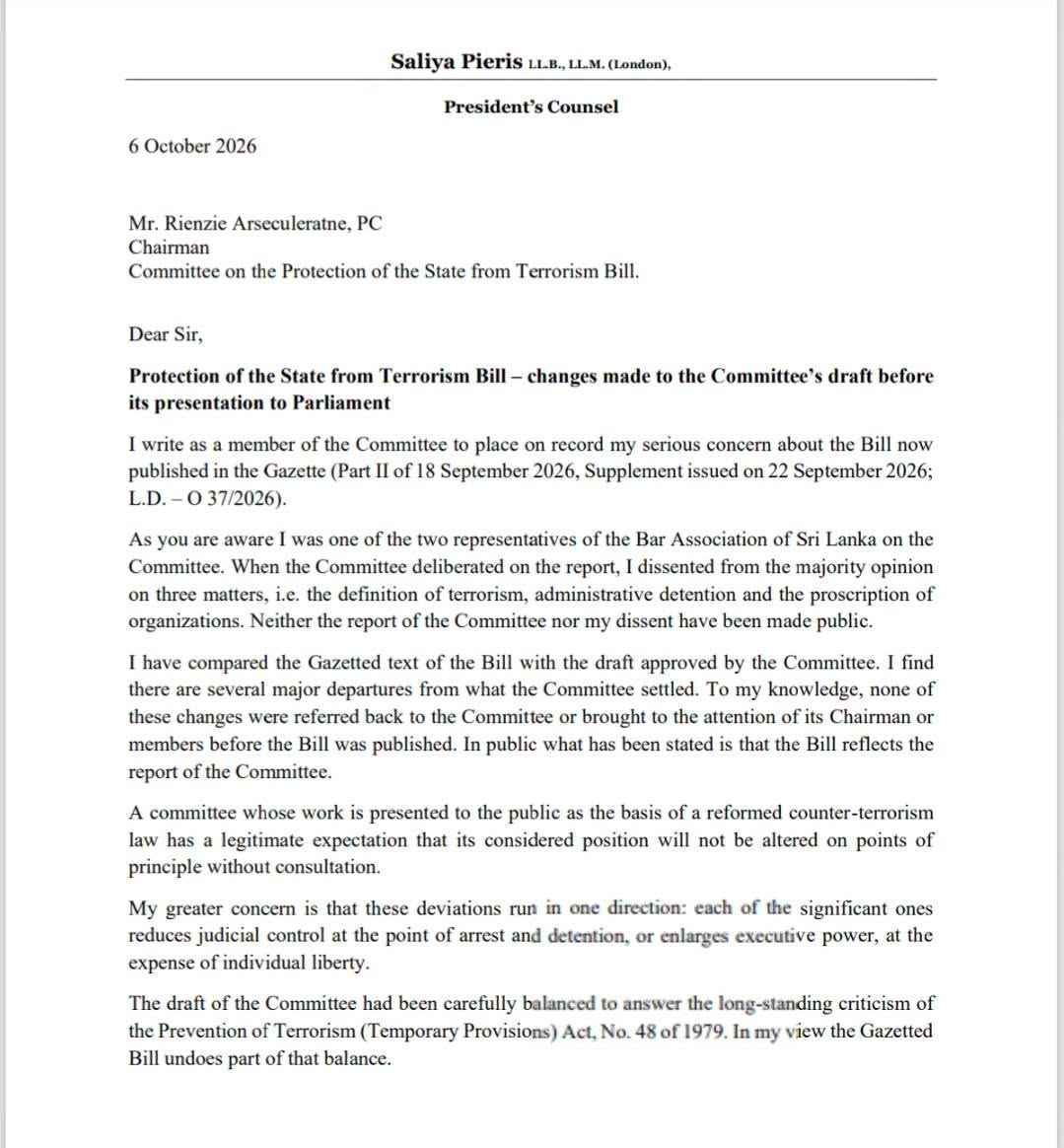
President’s Counsel Saliya Pieris has raised serious concerns over what he describes as major and undisclosed changes made to Sri Lanka’s proposed Protection of the State from Terrorism Bill after the expert committee appointed to formulate the legislation had settled its draft.
In a letter dated 6 October 2026 to Rienzie Arsecularatne PC, Chairman of the Committee on the Protection of the State from Terrorism Bill, Pieris says a comparison of the committee-approved draft with the Bill subsequently published in the Gazette reveals several major departures from what the committee had agreed.
According to Pieris, none of these changes was referred back to the committee or brought to the attention of its chairman or members before the Bill was published.
The allegation raises significant questions over how a proposed law intended to replace Sri Lanka’s long-criticised Prevention of Terrorism Act was altered between the conclusion of the expert committee process and publication of the Bill.
Pieris, who says he was one of two representatives of the Bar Association of Sri Lanka on the committee, notes that he had himself dissented from the committee’s majority on three issues: the definition of terrorism, administrative detention and the proscription of organisations.
Neither the committee’s report nor his dissent had been made public at the time of his letter, he says.
Despite those disagreements, Pieris says the committee had arrived at a carefully balanced draft designed to address longstanding criticism of the Prevention of Terrorism (Temporary Provisions) Act No. 48 of 1979.
His central allegation is that the Bill subsequently gazetted departed from that balance.
According to the letter, the changes move overwhelmingly in one direction: reducing judicial control over arrest and detention or enlarging executive power at the expense of individual liberty.
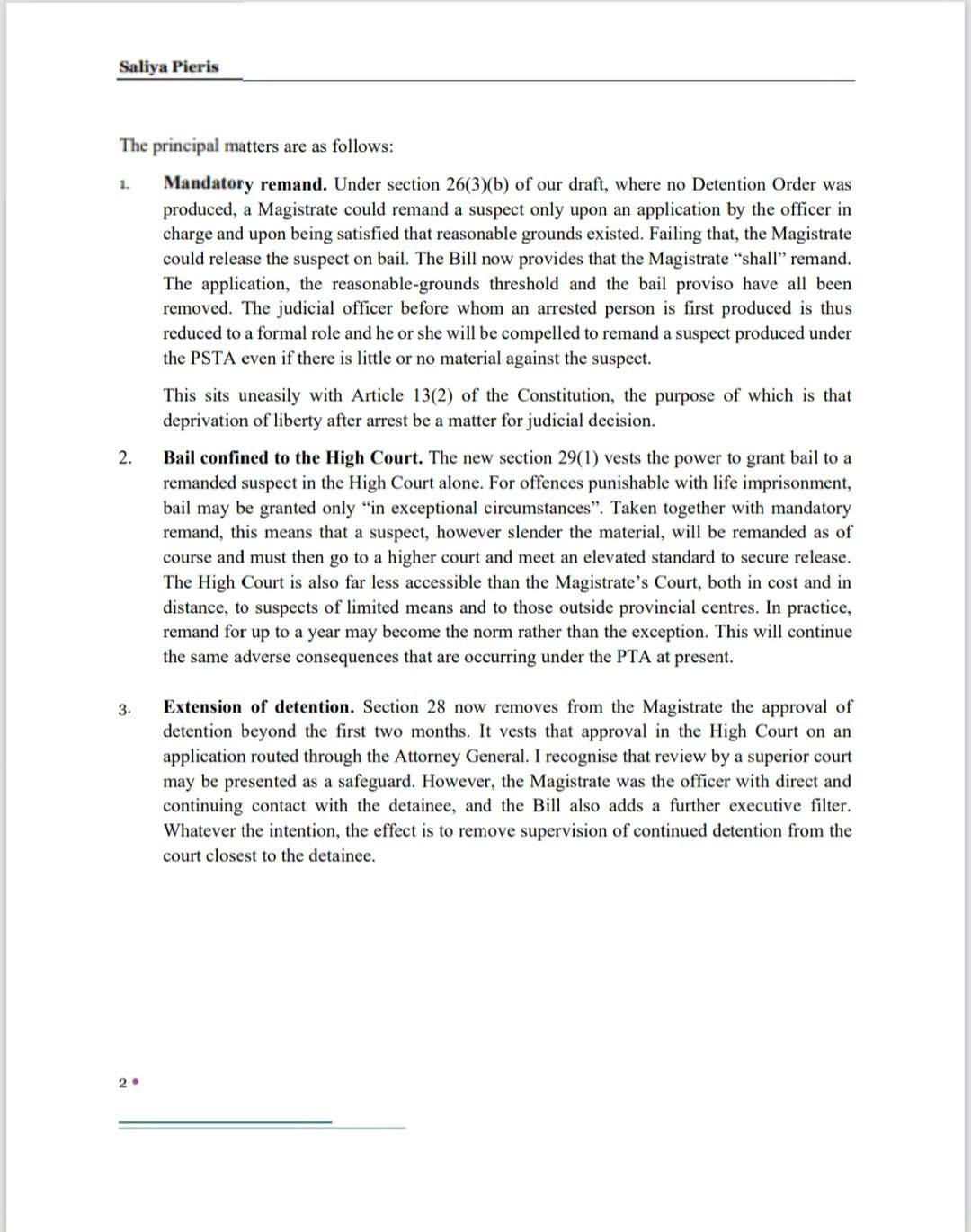
Mandatory remand replaces judicial discretion
Among the most serious changes identified by Pieris is the proposed system for remanding suspects.
He says that under section 26(3)(b) of the committee’s draft, where no detention order had been produced, a Magistrate could remand a suspect only following an application by the officer in charge and after being satisfied that reasonable grounds existed.
If those requirements were not satisfied, the Magistrate could release the suspect on bail.
According to Pieris, that protection has disappeared from the gazetted Bill.
The Bill instead provides that the Magistrate “shall” remand the suspect, he says.
Pieris argues that the requirement for an application, the reasonable-grounds threshold and the bail provision contained in the committee draft have all been removed.
The consequence, he warns, is that a Magistrate before whom an arrested person is first produced could be reduced to performing a largely formal function and compelled to remand someone even where there is little or no material against the suspect.
He argues that such mandatory remand sits uneasily with Article 13(2) of the Constitution, whose purpose, in his interpretation, is to ensure that deprivation of liberty following arrest becomes a matter for judicial decision.
Bail shifted exclusively to High Court
A second major concern involves access to bail.
Pieris says section 29(1) of the Bill gives the High Court alone the power to grant bail to a remanded suspect.
For offences punishable with life imprisonment, bail could be granted only in “exceptional circumstances”, according to the letter.
Pieris warns that the interaction between mandatory remand and High Court-only bail could have severe consequences.
A suspect could first be automatically remanded regardless of how weak the material against them may be and would then have to approach a higher court and satisfy a more demanding legal standard to obtain release.
There is also an access-to-justice dimension.
Pieris points out that the High Court is less accessible than a Magistrate’s Court in both cost and distance, particularly for suspects with limited financial resources and those living outside provincial centres.
In practice, he warns, remand for up to a year could become the norm rather than the exception, reproducing adverse consequences associated with the existing PTA.
Magistrate removed from supervision of extended detention
Pieris also raises concern about changes to the mechanism governing the extension of detention.
According to his letter, section 28 removes from the Magistrate responsibility for approving detention beyond the first two months.
That authority is instead placed with the High Court following an application routed through the Attorney General.
Pieris acknowledges that review by a superior court could be presented as an additional safeguard.
However, he points to an important practical difference: the Magistrate was the judicial officer maintaining direct and continuing contact with the detainee.
He also notes that the Bill introduces an additional executive step through the involvement of the Attorney General.
Whatever the stated intention, Pieris argues that the effect is to move supervision of continuing detention away from the court closest to the detainee.
Challenging restriction orders becomes more difficult
The fourth major difference concerns restriction orders affecting a person’s movement and association.
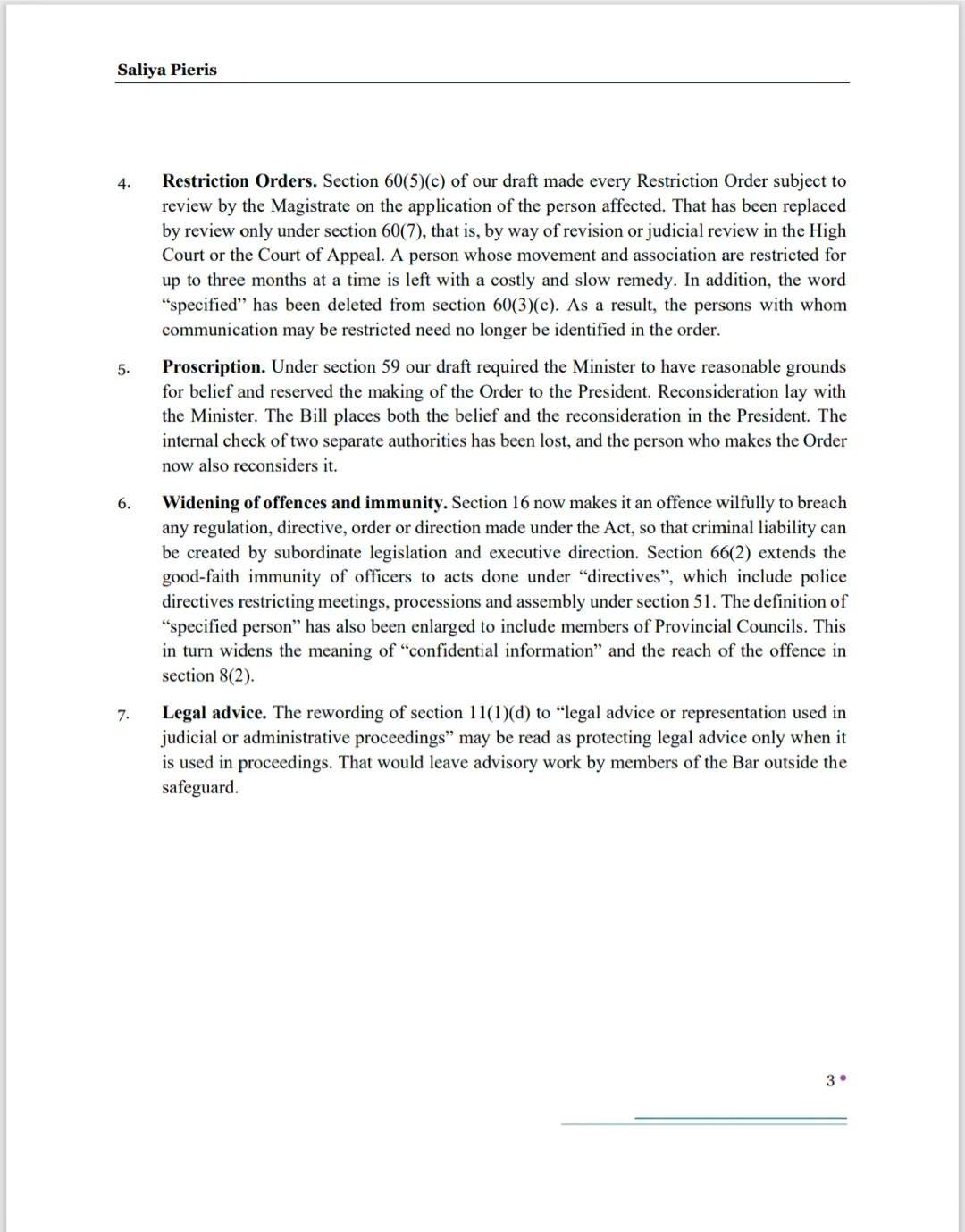
Pieris says section 60(5)(c) of the committee’s draft allowed every restriction order to be reviewed by a Magistrate upon an application by the affected person.
That protection, he says, has been replaced.
Under the gazetted Bill, according to the letter, challenges would instead proceed under section 60(7), through revision or judicial review in the High Court or Court of Appeal.
Pieris warns that someone whose movement and associations may be restricted for up to three months at a time would therefore face a considerably more costly and slower method of obtaining judicial relief.
He identifies another potentially important alteration.
The word “specified” has been deleted from section 60(3)(c). According to Pieris, this means that the persons with whom communication can be restricted would no longer necessarily have to be specifically identified in the restriction order.
Internal check removed from proscription process
The fifth issue concerns the proscription of organisations and the concentration of decision-making power.
According to Pieris, section 59 of the committee draft required the Minister to possess reasonable grounds for belief, while the actual order was reserved to the President. Reconsideration rested with the Minister.
The gazetted Bill, he says, instead places both the relevant belief and reconsideration with the President.
Pieris argues that this eliminates an internal institutional check created by having two separate decision-making authorities.
Under the Bill, he says, the same authority making the order would also reconsider it.
Criminal offences and official immunity widened
Pieris also identifies what he considers a significant widening of both criminal liability and official immunity.
According to his letter, section 16 makes it an offence deliberately to breach any regulation, directive, order or direction issued under the Act.
His concern is that criminal liability could consequently be created through subordinate legislation and executive directions rather than solely by provisions enacted directly in the principal statute.
At the same time, he says section 66(2) extends good-faith immunity for officers to acts performed under “directives”.
Those directives include police directives restricting meetings, processions and assemblies under section 51, the letter states.
Pieris further says the definition of a “specified person” has been expanded to include members of Provincial Councils.
That, he argues, consequently broadens the meaning of “confidential information” and increases the reach of the offence under section 8(2).
Concern over protection of lawyers’ advice
The seventh issue highlighted in the letter has direct implications for the legal profession.
Pieris identifies the rewording of section 11(1)(d), which refers to “legal advice or representation used in judicial or administrative proceedings”.
He warns that this formulation could be interpreted as protecting legal advice only where that advice is subsequently used in judicial or administrative proceedings.
If interpreted in that manner, he says, advisory work undertaken by members of the Bar outside formal proceedings could fall outside the safeguard.
Who authorised the changes?
Beyond the substance of the amendments, Pieris’s letter raises a separate question about the legislative process itself: how and on whose authority were these changes made after the committee had settled its draft?
He tells the chairman that a committee whose work is publicly presented as the foundation of a reformed counter-terrorism law has a legitimate expectation that its considered position will not be altered on matters of principle without consultation.
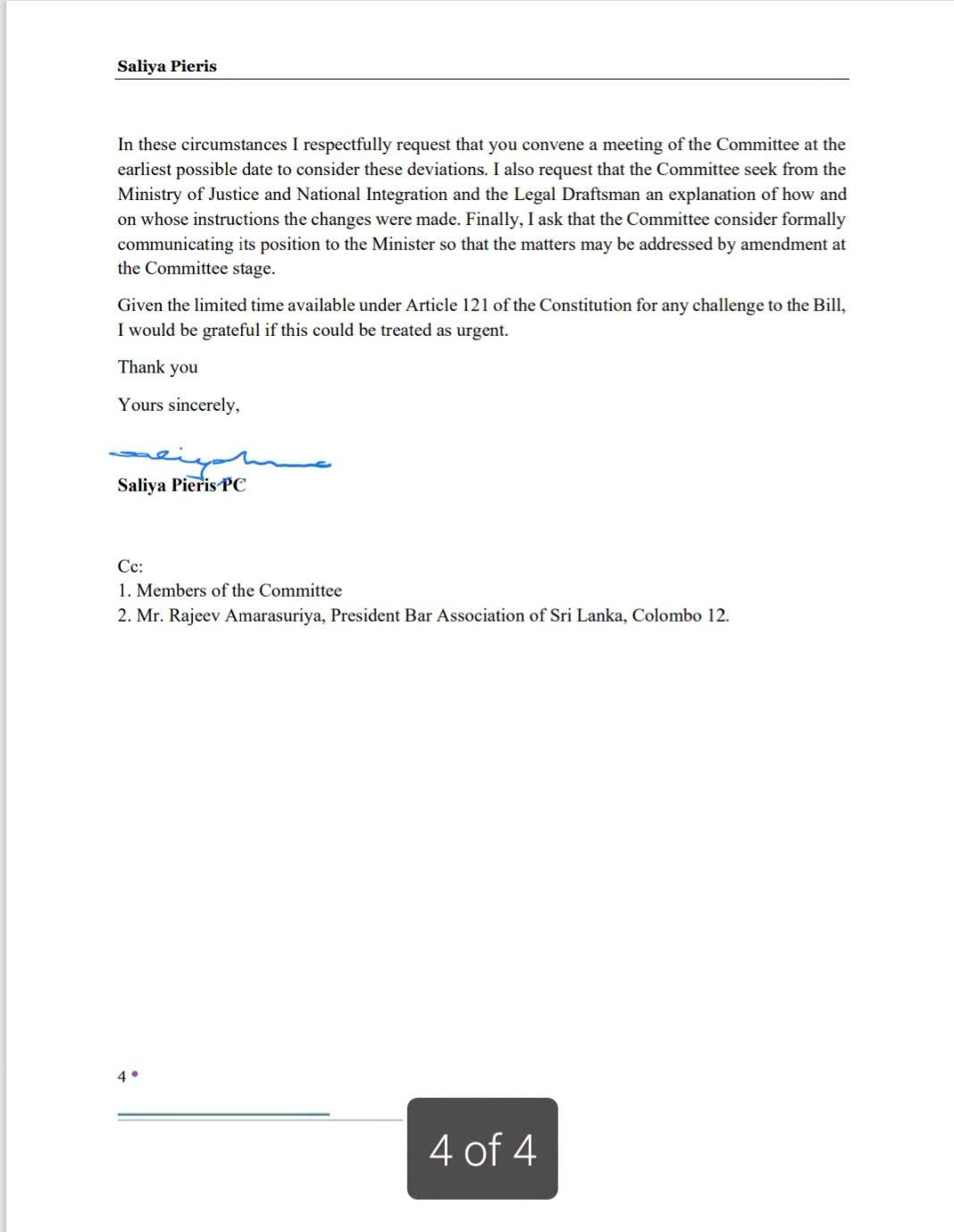
He therefore asks Arsecularatne to convene a meeting of the committee at the earliest possible date to consider the deviations.
Crucially, Pieris also asks the committee to seek an explanation from the Ministry of Justice and National Integration and from the Legal Draftsman as to how the changes were made and on whose instructions.
He further proposes that the committee formally communicate its position to the Minister so that the disputed provisions could be addressed through amendments at the Committee Stage.
Saliya Pieris asks for urgent action
The letter concludes with a warning about time.
Citing the limited period available under Article 121 of the Constitution for challenging a Bill, Pieris asks that the matter be treated as urgent.
Copies of the letter were sent to the members of the committee and to Rajeev Amarasuriya, President of the Bar Association of Sri Lanka.
The significance of Pieris’s intervention therefore extends beyond disagreement about individual provisions of the proposed anti-terrorism legislation.
His letter raises two fundamental issues simultaneously.
The first is substantive: whether a law presented as reform of the PTA has retained or reintroduced mechanisms capable of enabling prolonged detention, restricting access to bail, reducing immediate judicial scrutiny and expanding executive authority.
The second concerns the integrity of the law-making process itself: whether significant provisions of the Bill were changed after an expert committee completed its work, without those changes being returned to the committee for consideration.
For a government seeking to replace one of Sri Lanka’s most controversial security laws, Pieris’s letter places the focus not only on what Parliament is being asked to enact, but also on a question that now demands an official explanation: who changed the committee’s draft, on whose instructions, and why?
The letter: