

(Sri Lanka Advocay/Germany)
Executive Summary
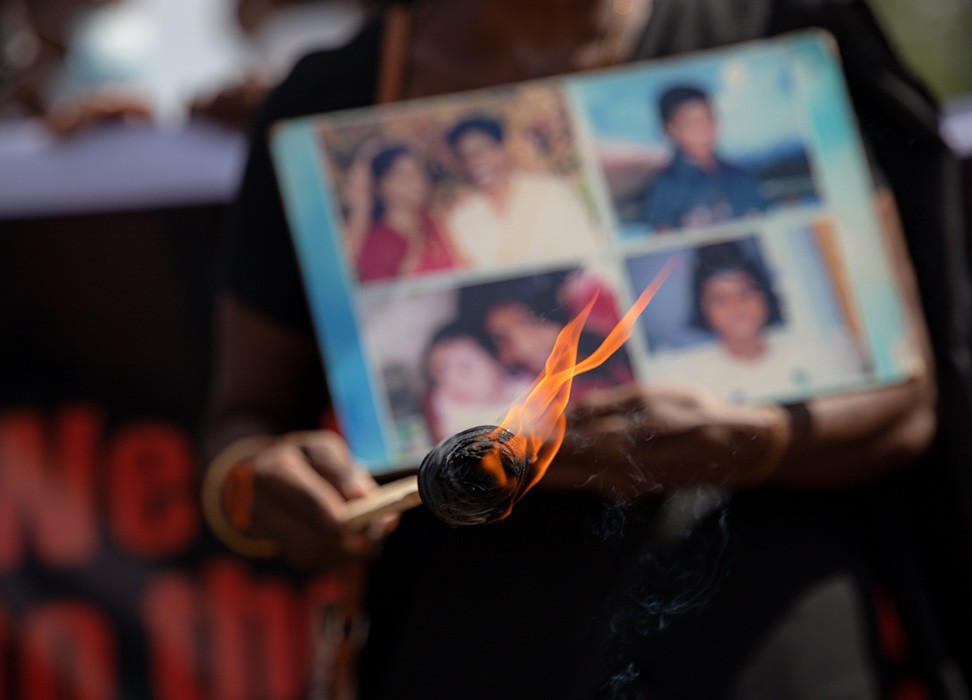
 Enforced disappearances remain an unresolved human rights challenge in Sri Lanka.
Disappearances occurred during several periods, including the 1971 uprising, the 1987– 1989 insurgency, the civil war (1983–2009), and its aftermath. Estimates of missing and disappeared persons range from approximately 40,000 to nearly 150,000, while official records identify approximately 16,000–21,000 cases.
Despite legal reforms and established institutions such as the Office on Missing Persons (OMP), meaningful progress remains limited. The barriers are political rather than legislative. Competing narratives of the conflict, concerns about accountability for the armed forces and weak institutional independence have contributed to impunity.
The policy priority of the international community should shift from securing additional commitments to ensuring implementation of existing obligations. International engagement should combine sustained political scrutiny, incentives for nationally owned reform, technical assistance, support for civil society and measurable benchmarks.
Key Policy Challenges
- Persistent uncertainty for families
Families of disappeared persons continue to lack reliable information about the fate of their relatives. The absence of a State-verified register remains a fundamental obstacle.
- Weak accountability mechanisms
The OMP and other domestic mechanisms have faced criticism concerning independence, transparency and effectiveness. Previous initiatives have also suffered from limited consultation and insufficient confidence among victims’ organisations.
- Forensic and evidentiary limitations
More than 30 suspected mass-grave sites have been identified. Weak forensic capacity, delays in exhumations and limited DNA identification have prevented many victims from being identified and have constrained criminal investigations.
- Political polarisation
Accountability remains highly politicised. Within parts of the Sinhalese majority, investigations may be perceived as attacks on the military and national sovereignty, while many Tamil families regard international involvement as essential because of the failure of domestic mechanisms. This divide continues to obstruct a shared national approach.
Policy Recommendations for the United Nations
- Maintain and strengthen international monitoring.
Retain a strong mandate for the OHCHR Sri Lanka Accountability Project to document violations, preserve evidence and support future accountability processes – as long as there is no credible national mechanism.
- Expand technical cooperation with Sri Lanka.
Prioritize capacity building in forensic investigations, DNA identification, archival preservation and evidence management.
- Strengthen institutional independence.
Promote reforms that increase the independence, transparency and effectiveness of the OMP, Office for Reparations as well as a new Truth and Reconciliation Commission (TRC).
- Ensure victim participation.
Guarantee meaningful and independent representation for families and victims’ organizations in monitoring and accountability mechanisms.
Benchmarks
- publication and regular updating of a credible register of missing persons;
- transparent reporting by the OMP on individual cases;
- increased forensic investigations and DNA identifications;
- improved access to military, police and administrative records;
- effective witness and victim protection;
- meaningful participation of victims’ organisations;
- documented progress in criminal investigations and prosecutions;
- implementation of a credible reparations framework.
Conclusion
Progress should no longer be measured primarily by new legislation or institutional commitments, but by tangible improvements for families of the disappeared. A credible process of truth recovery, reparations and accountability is essential not only to address past violations but also to strengthen public trust, prevent recurrence and support sustainable reconciliation in Sri Lanka.