
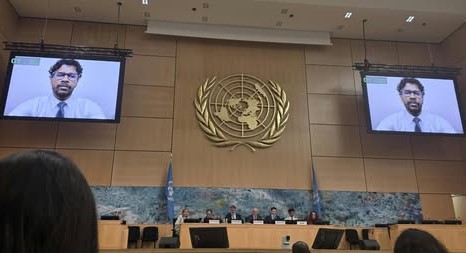

Geneva, September 16, Sri Lanka Brief– A Sri Lankan prisoners’ rights organisation has raised serious concerns at the United Nations Human Rights Council (UNHRC) about deaths in custody, alleged torture, enforced disappearances and chronic overcrowding in the country’s prisons, calling for greater international engagement to ensure accountability and prevent future abuses.
Speaking via video message during an interactive dialogue with the UN Special Rapporteur on the promotion of truth, justice, reparation and guarantees of non-recurrence at the 63rd Session of the UN Human Rights Council, Proboda Rathnayeka of the Committee for Protecting Rights of Prisoners (CPRP), delivering a statement jointly with Pax Romana, warned that Sri Lanka continues to suffer from a culture of impunity over prison-related violence.
Welcoming the Special Rapporteur’s report, Rathnayeka said the report’s finding that “denialism weakens all pillars of transitional justice” was highly relevant to Sri Lanka, where a number of major prison killings have remained unresolved for decades.
The intervention highlighted several deadly incidents, including the killing of 53 Tamil political prisoners during the 1983 Welikada Prison massacre, the deaths of 27 inmates in a 2012 prison riot at Welikada, the killing of 22 prisoners during unrest at Mahara Prison in 2020, and the deaths of 32 inmates and prison officials during violence at Negombo Prison in July 2026.
According to the rights group, none of these incidents has resulted in meaningful accountability, despite repeated demands from victims’ families and human rights advocates.
The organisation also cited official data indicating that 1,021 prisoners have died in custody during the past five years, describing the figure as evidence of a deepening crisis within Sri Lanka’s prison system.
Particular concern was expressed over developments following the July 2026 violence at Negombo Prison. Rathnayeka told the Council that allegations had emerged of torture and custodial deaths involving prisoners transferred to other detention facilities after the incident. The group also reported that at least six prisoners had allegedly disappeared after being moved from prisons and were only located weeks or months later.
The statement further alleged that access to family members, lawyers and the Human Rights Commission of Sri Lanka had been arbitrarily restricted in some cases.
Highlighting broader structural problems, the CPRP said Sri Lanka’s prisons were operating at more than 300 per cent capacity as of August 2026, while more than 72 per cent of inmates were being held on remand awaiting trial.
The organisation also raised concerns over the continued detention of 10 political prisoners more than 17 years after the end of the armed conflict, despite repeated government assurances regarding their release.
The intervention drew attention to the situation of vulnerable groups within prisons, stating that persons with disabilities lacked adequate facilities and that LGBTIQ inmates were exposed to sexual violence and discrimination.
Concluding the statement, Rathnayeka called on UN member states and international officials to engage constructively with the Sri Lankan government to secure accountability for past and recent prison-related abuses and to adopt measures aimed at preventing recurring violence inside detention facilities.
The intervention comes amid increasing international scrutiny of Sri Lanka’s human rights record and broader debates at the Human Rights Council over accountability, transitional justice and institutional reform.