
Colombo, Sri Lanka — A landmark Supreme Court judgment awarding US$1 billion in compensation to victims of the MV X‑Press Pearl disaster has become mired in delays, bench changes, and mounting concerns over judicial independence, raising urgent questions about whether affected coastal communities will ever receive the relief promised to them.
The 2025 judgment—delivered by a five‑judge bench led by then Chief Justice Murdu Fernando—held the ship’s owner, operator, and local agent jointly and severally liable for the worst marine environmental disaster in Sri Lankan history. The Court also established the MV X‑Press Pearl Compensation Commission, chaired by retired Supreme Court Justice E.A.G.R. Amarasekara, to compute and distribute compensation to more than 19,000 fishermen whose livelihoods were destroyed.
But more than a year later, only around US$1 million has reached the Treasury—one‑thousandth of the ordered sum. The first instalment of US$250 million, due within two months of the judgment, was never paid. Instead, the ship’s operator has shifted the dispute to international arbitration in Singapore, where liability is capped at a fraction of the Sri Lankan award.
Bench Changes and Termination of Proceedings
Despite the judgment’s explicit direction that the same five‑judge bench continue hearing the matter, the first post‑judgment sitting on 25 September 2025 was taken by three judges. On 26 January 2026, those three judges terminated the proceedings entirely—effectively shutting down the enforcement process.
Petitioners say they were never served with the Attorney General’s motions leading to the termination, leaving the very parties who won the case unaware that their victory was being unwound.
Compensation Commission Silenced
Justice Amarasekara’s formal report to the Supreme Court paints a picture of a Commission unable to function:
He received the judgment a month late, only after repeated requests.
“He received his copy of the judgment a month late, and only after asking for it more than once.”
Requests for certified records, procedural approvals, and remuneration for Commission members went unanswered.
“The Commission’s written requests… went unanswered.”
Members worked for months without pay, unable to take other engagements.
The Commission learned of the case termination secondhand.
Most critically, the Commission warned that delays would diminish the funds available to victims:
“The delay would contribute to the diminution of the funds to be distributed.”
A possible settlement is reportedly being negotiated behind closed doors, with terms unknown and concerns that it may conflict with the Court’s original computation.
Insurer Appeals to Presidents of Two Countries
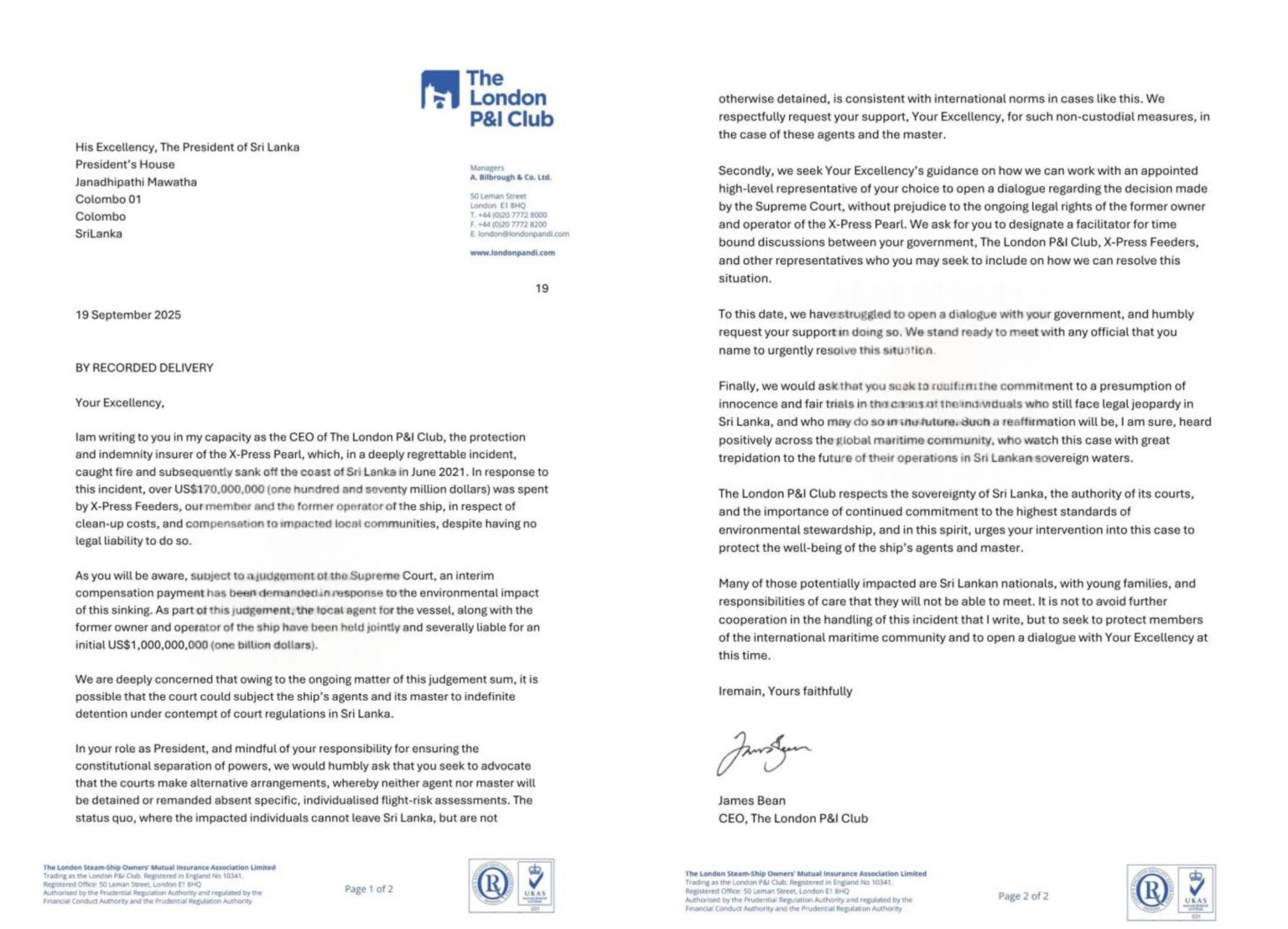
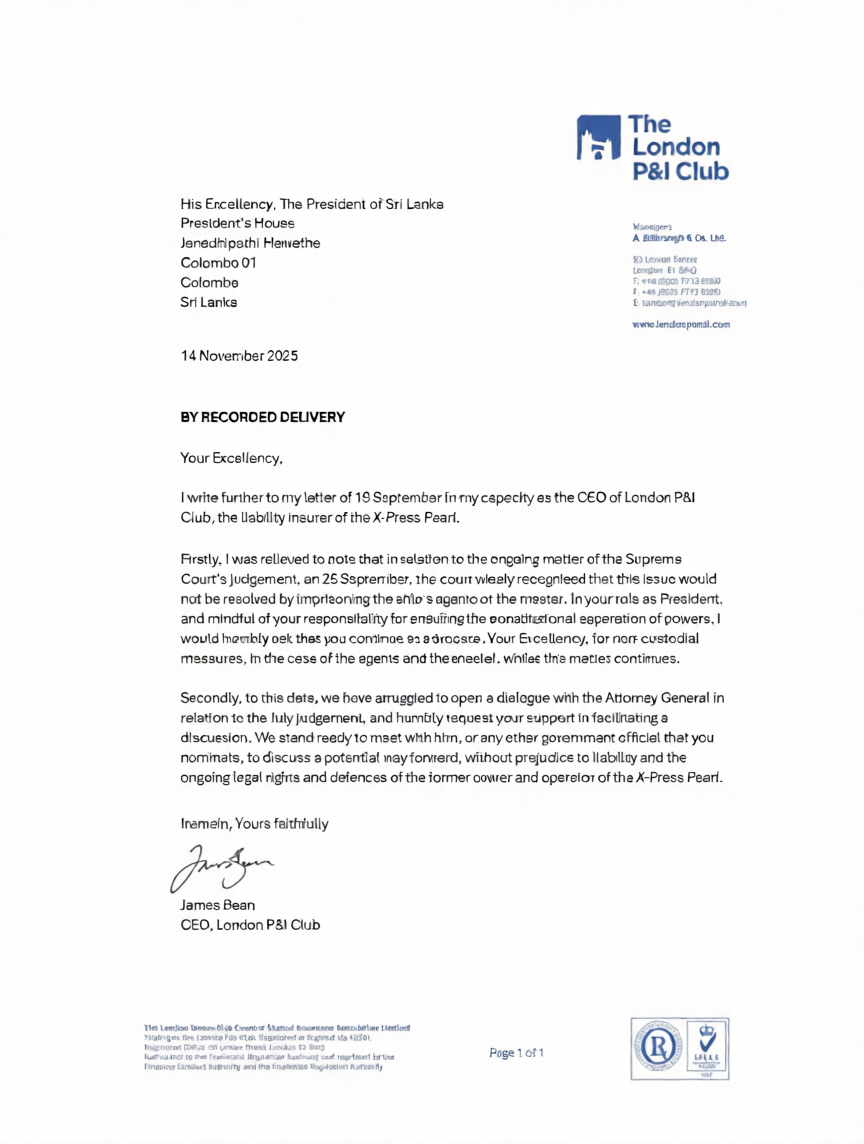
While the judicial process stalled, the ship’s liability insurer—the London P&I Club—took an extraordinary step: writing directly to the President of Sri Lanka twice, and separately to the UK Chancellor of the Exchequer, urging political intervention.
In its letters, the insurer asked the Sri Lankan President to:
Advocate for non‑custodial measures for the ship’s agents and master.
Designate a facilitator for discussions on the judgment.
Encourage “alternative arrangements” regarding the Court’s orders.
One letter states:
“We would humbly ask that you seek to advocate that the courts make alternative arrangements…”
Legal experts note that appealing to heads of state to influence judicial processes is not a recognised legal remedy and raises serious concerns about attempts to exert political pressure on an independent court.
22nd Amendment Sparks Fears of Judicial Interference
Amid the stalled enforcement, the government has moved rapidly to pass the 22nd Amendment, which raises the retirement age of Supreme Court and Court of Appeal judges.
The amendment faces unprecedented opposition:
Bar Association of Sri Lanka – unanimously opposed
Judicial Service Association – opposed
Religious leaders – opposed
Civil society – opposed
International legal bodies – opposed, some calling it a “blatant attempt to interfere with the judiciary”
The Supreme Court itself ruled in 2022 that changing the retirement age of sitting judges impinges on judicial independence and requires a referendum.
Yet the government is pushing the amendment through Parliament alone—without a referendum—before Chief Justice Padman Surasena reaches retirement age later this year. If passed, he would remain in office until 2028.
The timing has raised public concern because the Chief Justice presides over the Court that controls enforcement of the billion‑dollar judgment.
A Crisis of Confidence
The Constitution requires all organs of government to respect, secure, and advance the fundamental rights of the people. But the sequence of events—bench changes, termination of proceedings, a paralysed Commission, foreign insurer lobbying, and a rushed constitutional amendment—has created what legal analysts describe as an appearance of impropriety.
The attached document warns:
“An appearance of impropriety… corrodes public confidence in the courts whether or not a single improper thing has occurred.”
For the thousands of families who lost their livelihoods to the X‑Press Pearl disaster, the question now is whether the billion‑dollar promise of justice is quietly slipping away.