
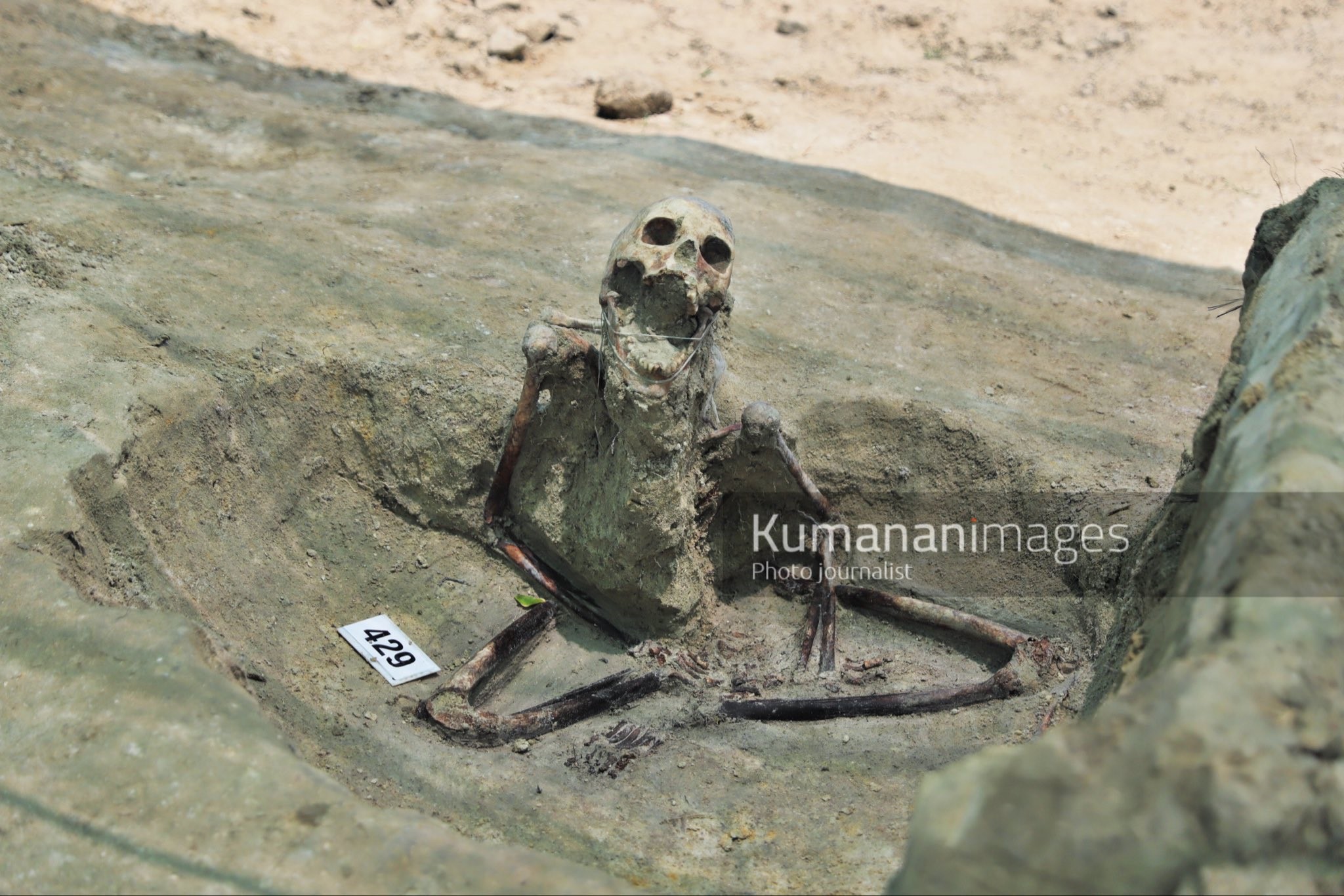

Image courtesy of Kumanan @kumanan93 on X.
Forensic experts note that a dead body does not naturally remain seated unless external forces prevent collapse. After death, muscle tone disappears and the body typically falls backward or sideways unless supported by narrow grave walls or immediate backfilling. This makes the posture of Skeleton 429 especially significant. The tight flexion of the limbs suggests forced placement, either while the person was alive, dying, or freshly deceased. The narrow dimensions of the grave may have physically held the body upright, but the degree of flexion indicates that the posture was not accidental.
The articulation of major joints shows that the individual decomposed in place, with no evidence of later disturbance or reburial. This confirms that the posture observed today reflects the position in which the body was originally deposited. Such constrained burials are typical of hasty, concealed disposal, where perpetrators dig minimal pits to avoid detection.
Deliberate staging?
Some forensic investigators have also raised the possibility that the unusual seated posture may reflect deliberate staging by the perpetrators. In several conflict‑related burial sites worldwide, bodies have been found arranged in positions that appear intentionally humiliating or mocking, suggesting that those responsible may have manipulated the corpse after death. While no direct evidence confirms such actions in this case, the tight flexion and upright placement within a shallow pit leave open the question of whether the burial was carried out in a manner intended to degrade the victim. This line of inquiry remains speculative, but the irregular posture of Skeleton 429 is sufficiently striking to warrant consideration of whether cruelty extended beyond killing to the treatment of the body itself.
Possibility of burial alive
Although the posture raises the possibility of burial alive, forensic experts caution that posture alone cannot confirm this. Indicators such as sediment in the airway, trauma consistent with struggling in confined spaces, or binding marks on skeletal elements would be required. None of these are visible from posture alone, but the seated position remains a critical clue.
Skeleton 429 therefore stands as a stark reminder of the clandestine nature of the Chemmani burials. The seated posture, shallow grave, and rapid backfilling collectively point to coercive, non‑ceremonial disposal, reinforcing concerns about the human rights violations associated with the site.
(Written in consultation with AI experts)