
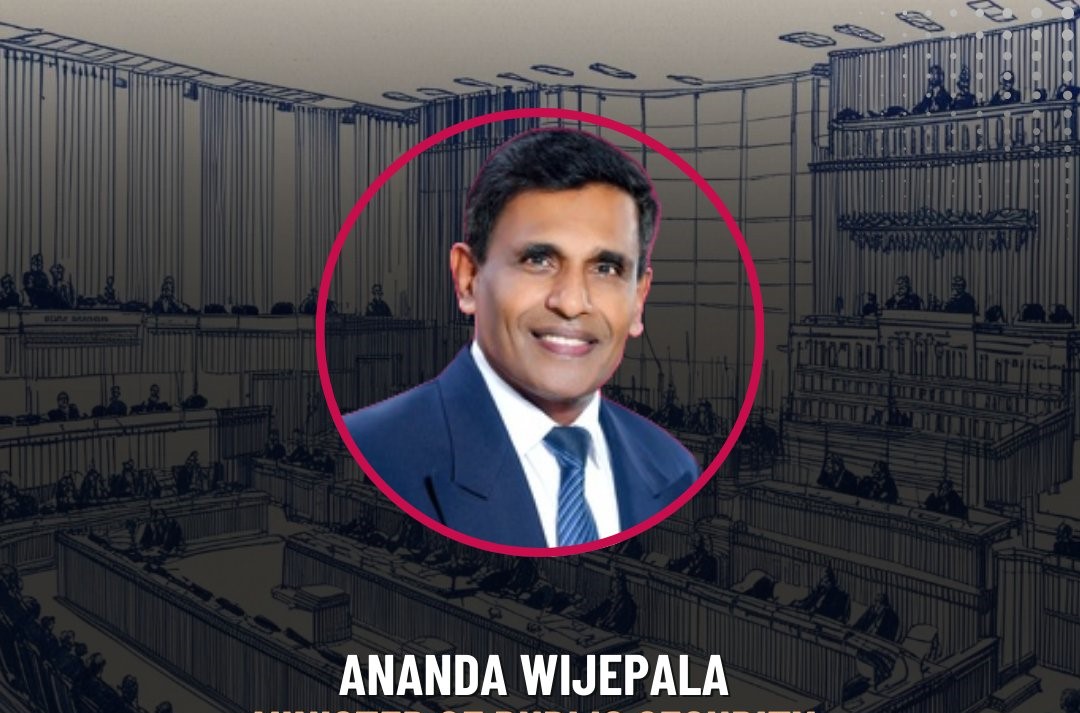

Sri Lanka’s Supreme Court has granted leave to proceed with an appeal challenging the eligibility of Public Security Minister Ananda Wijepala to continue serving as a Member of Parliament (MP), setting the stage for what could become an important constitutional test concerning the separation between parliamentary office and executive appointments.
The appeal was filed by former Sri Lanka Podujana Peramuna (SLPP) official Renuka Perera, who argues that Wijepala’s continued service as Chief of Staff to President Anura Kumara Dissanayake renders him constitutionally disqualified from occupying a parliamentary seat. The Supreme Court has not ruled on the merits of the case but has determined that the legal questions raised are significant enough to warrant a full hearing.
What the Case Is About
At the centre of the dispute is whether a sitting MP can simultaneously hold the position of Chief of Staff to the President without violating constitutional provisions governing parliamentary eligibility. According to the petition, Wijepala continued to serve in the presidential office after being elected to Parliament, creating a potential conflict with constitutional restrictions on MPs holding certain offices under the State.
The petitioner seeks a judicial declaration that Wijepala is no longer qualified to sit and vote in Parliament because the Chief of Staff role allegedly constitutes public employment or a position that falls within constitutional prohibitions applicable to legislators.
If the court ultimately agrees with that interpretation, the consequences could extend beyond Wijepala personally, clarifying the constitutional limits on dual roles involving both legislative and executive authority.
Background of the Legal Challenge
The dispute is not entirely new. Reports indicate that a writ petition challenging Wijepala’s eligibility was filed before the Court of Appeal in February 2025. That earlier application similarly argued that accepting the position of Chief of Staff to the President effectively made him a public officer and therefore incompatible with parliamentary membership.
The latest development arose after the matter reached the Supreme Court through an appeal filed by Renuka Perera. By granting leave to proceed, the court has effectively signalled that the issues raised deserve detailed judicial examination. Importantly, this procedural step does not mean the court has accepted the petitioner’s arguments; it simply means the case has passed the preliminary threshold and will move to a substantive hearing.
The Constitutional Questions
The forthcoming hearing is expected to focus on the interpretation of constitutional provisions relating to:
- Disqualification of Members of Parliament.
- The definition of a public office or public employment.
- Whether the presidential Chief of Staff position falls within categories prohibited for MPs.
- The extent to which an elected legislator may simultaneously hold an executive appointment.
The court will have to determine not only the legal status of the Chief of Staff position but also whether occupying that role creates an incompatibility with parliamentary office under Sri Lanka’s constitutional framework.
Potential Political Significance
Although the case is formally directed at a single parliamentarian, the ruling could have broader implications for governance and constitutional practice in Sri Lanka.
Constitutional systems often contain restrictions on legislators holding executive or state-paid positions to prevent conflicts of interest and preserve the independence of Parliament. A judgment in this matter could therefore provide guidance on how those principles apply to senior presidential appointments.
Should the Supreme Court rule that the Chief of Staff post is incompatible with parliamentary membership, it may require future administrations to reassess similar appointments involving elected representatives. Conversely, if the court finds no constitutional violation, the decision could establish an important precedent permitting MPs to hold comparable executive roles under certain circumstances.
What Happens Next?
The Supreme Court will now hear detailed submissions from both sides before delivering a final determination. The petitioner is expected to argue that the Constitution clearly prohibits the dual role currently held by Wijepala, while the respondents will likely contend that the Chief of Staff position does not constitute a disqualifying office or employment under the relevant constitutional provisions.
Until a final judgment is delivered, Wijepala remains Public Security Minister and a Member of Parliament. The granting of leave to proceed is therefore a significant procedural milestone but not a definitive finding on his eligibility.
Conclusion
The Supreme Court’s decision to hear the case marks one of the more important constitutional disputes currently before Sri Lanka’s judiciary. The hearing will examine whether Ananda Wijepala’s simultaneous roles as Public Security Minister, MP and presidential Chief of Staff are legally compatible under the Constitution. Whatever the outcome, the judgment is likely to become a key reference point in future debates over the boundaries between executive appointments and parliamentary office in Sri Lanka.