
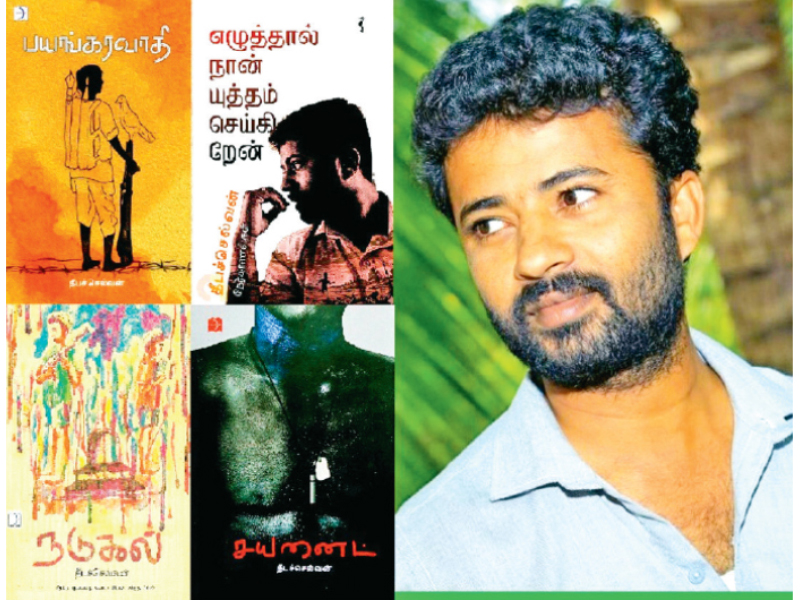

Theepachelvan Pratheepan was born and raised in war-torn northern Sri Lanka. He completed his primary and secondary education at Kilinochchi Central College before pursuing higher studies at the University of Jaffna and later at the University of Madras.
He describes himself as a teacher by profession, while also being actively engaged in writing for over two decades. “I write in multiple forms, including poetry, novels, and articles. The experiences of war, loss, memory, and oppression are at the core of my work. Those experiences are what shaped me as a writer,” he said.
Among his notable works are Nadugal (Tombstone), Terrorist, and Cyanide, authored between 2018 and 2024. He recently reprinted these books in Tamil Nadu, citing lower costs and better print quality. According to him, the books are widely read in Sri Lanka, particularly within the Tamil community.
More recently, he compiled two additional volumes consisting of his columns and interviews published in Sinhala, Tamil, and English between 2008 and 2024, which were printed alongside the reissued editions of his earlier works.
While three books were released, two books, which are being withheld by Customs, are titled Eluththaal Naan Yuddham Seikiren (I Am Waging a War with Words), a compilation of his interviews from 2008 to the present, and Ippoduthum Inge Irandu Thesangal (Even Now There Are Two States).
Reportedly, Sri Lanka Customs, in their Press statements, had indicated that they have concerns with regard to its contents, citing that it could ‘damage national harmony.’ Director General of Customs S P Arukoda had further stated that, based on the recommendations of the Arts Council of Sri Lanka, the State Panel on Literature of the Ministry of Buddhasasana, Religious and Cultural Affairs, and the Ministry of Defence, the books titled Bayagangarawathi (Terrorist) and ‘Cyanide’ have been released along with other books in the consignment, except for the two books viz. Eluththaal Naan Yuddham Seikiren and Ippothum Inge Irandu Thesangal, respectively
They further stated their regret that the two books in question contain material deemed punishable under Section 120 of the Penal Code, read with Schedule B of the Customs Ordinance, Chapter 235.
Speaking to Ceylon Today, Theepachelvan said, he is currently battling to secure the release of the detained books. He stressed that his earlier works – Nadugal, Terrorist, and Cyanide – are not fictional, but rather grounded in lived experiences, reflecting the psychological trauma, political realities, and historical memory of the post-war Tamil community. He believes this candid and critical perspective has sparked ongoing debate.
“The purpose of my writing is to document hidden or unspoken truths and to preserve memory,” he said.
Ceylon Today spoke to Theepachelvan about his views on his books:
What are the topics of the two new books?
A: Eluththaal Naan Yuddham Seikiren is the title of a compilation of all my interviews that were published in Sri Lanka across various Newspapers in Sinhala, Tamil, and English. Even Ceylon Today had reproduced one of my interviews. These interviews were conducted with both local and Indian Newspapers, and some were also published in Indian media outlets.
All of these are my earlier interviews, many of which were covered by different journalists. They reflect my personal life and experiences, which is why I chose the title Waging War with Words — to express a struggle through literature and writing.
They do not refer to any literal ‘two-State’ concept or promote disharmony among communities. There is nothing in these two books that conveys such ideas or intentions.
How many printed books are currently held by Customs?
A: At present, there are 150 copies of ‘I Am Waging a War with Words’ and 80 copies of ‘Even Now There Are Two States’, which are being held by Sri Lanka Customs.
Are these two books different in topic from your earlier books published between 2018 and 2020?
A: No, they are not different in terms of subject matter. They are part of my writing journey that began in 2008 and consists of previously published Interviews and Political Columns. These are not new works. The interviews were conducted by respected journalists in Sri Lanka and India and published in various newspapers. They also reflect my personal experiences during the war, making them deeply personal and close to my heart. However, they do not contain anything against the country or its people.
A: Having been born into war and having felt its pain and consequences, an anti-war sentiment — a deep anguish — runs throughout my writing. As someone who does not believe in violence or destruction, I strive for peace, freedom, and harmony, while expressing the issues and demands of the affected Tamil people.
Have you translated any of your books into Sinhala and English?
A: My first novel, Nadugal, was translated into Sinhala by G G Sarath Ananda. The novel received an overwhelming response among Sinhala readers. It tells the story of a mother who lost her son — a fighter in the war — and her painful journey, along with her younger son and family, to search for his memories.
Similarly, Anusha Sivalingam translated my first poetry collection, A Child Born in a Bunker, into Sinhala. That book, too, went through several editions and received a strong reception.
My poems themselves are the answer to what my literary journey has been, as well as to my thoughts, my anguish, and my dreams.
A: I am currently consulting with my lawyers on the next steps to be taken regarding this matter. This is an effort by a writer to publish books in India at a lower cost, while ensuring a quality edition is brought out. This intention needs to be understood, as does the effort a writer puts into such work. I am also prepared to clarify this matter with the relevant authorities. I think the books are not banned by the Customs. They did not say so.
Have you asked President Anura Kumara Dissanayake to support you?
A: As a next step, my lawyers are exploring the possibility of submitting an appeal to the President regarding this matter. I have seen several speeches by the President in which he has expressed a deep understanding of the pain of those affected, including the anguish of families of the disappeared. He and his Party have also spoken in the past about the experiences endured by Tamil people. Therefore, I believe that a letter addressed to him would be both appropriate and meaningful.
What’s your profession basically? Only a writer?
A: I have been on my journey as a writer for nearly 21 years, beginning with the completion of my school education. At the same time, I work as a school teacher. I dedicate my free time — outside of my teaching responsibilities and during school holidays — to my writing.
Being both a teacher and a writer is not difficult; in fact, the two roles are closely connected. A teacher who is also a writer is well placed to nurture students who aspire to become writers and authors.
How do you see your future in Sri Lanka?
A: From the time I was born, I have experienced hardship and distress in one form or another. As a child, I lived in fear of the sound of gunfire, often unable to sleep. Later, as a young boy, I hid in bunkers in fear of aerial bombardment. As a university student, I continued to face uncertainty and fear amid ongoing violence. Today, I find myself as a writer facing a different kind of pressure — one filled with obstacles and challenges, where even my pen and books encounter resistance, leaving me restless. It pains me deeply to say this.
For many Tamils who wish to live in peace and dignity in Sri Lanka, life has continued to feel like an ongoing struggle.
A: In the past, many journalists in Sri Lanka have been killed. Even Sinhala writers and journalists who spoke out for the rights of Tamils have been forced to leave the country. Despite all these experiences, the situation continues in much the same way even today.
When in opposition, political parties often advocate for the rights of journalists and writers. However, once they come to power, similar forms of pressure and restrictions are imposed on the media and on writers. In Sri Lanka, although Governments change, the reality on the ground remains largely unchanged — this has been the enduring experience of media freedom in the country.