
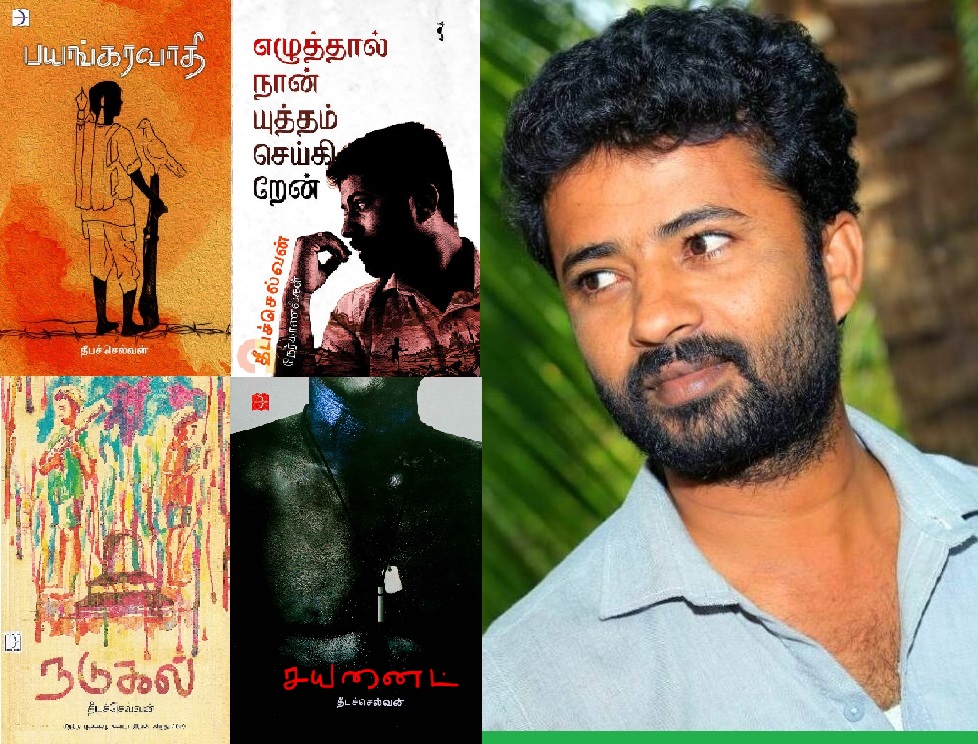

Image: Theepachelvan Piratheepan and his published books.
Conflicting accounts from Sri Lankan authorities over the detention of Tamil-language books by a Kilinochchi-based author, Theepachelvan Piratheepan have raised fresh concerns about transparency, regulatory oversight, and freedom of expression in the country’s handling of imported publications.
The Human Rights Commission of Sri Lanka has expressed concern over the incident, although it is understood that author Theepachelvan Piratheepen has not formally submitted a complaint to the commission.
The controversy centres on 360 copies of Piratheepen’s books, imported from Chennai, India, and detained by Sri Lanka Customs in late March. Authorities have reportedly withheld the publications on the grounds that they may be “damaging to national harmony” — a justification that has drawn criticism from writers and civil society groups.
The books have yet to be released.
Piratheepen has rejected the allegation, stating that his work focuses on post-war social realities rather than political advocacy. His novels — including Nadukal, Payangaravathiya, and Cynaide — explore the lives of students, children, and former combatants affected by Sri Lanka’s civil conflict. He has emphasised that his writing aims to contribute to reconciliation and has noted that some of his works have been translated into Sinhala and read across communities.
Despite writing to Minister of Buddhasasana, Religious and Cultural Affairs Hiniduma Sunil Senevi, seeking intervention, Piratheepen says he has received no meaningful response. He was informed that the books could only be released with clearance from the Defence and Cultural Affairs Ministries, but no official update has followed.
The situation has been further complicated by conflicting statements from authorities. A senior Customs official stated that materials suspected of affecting religious or ethnic harmony are referred to specialised committees under the Ministry of Cultural Affairs. However, no clear explanation has been provided as to what criteria triggered such scrutiny in this case.
In contrast, the Ministry of Buddhasasana, Religious and Cultural Affairs has denied that it reviews general literary works, stating that its role is limited to religious publications. Meanwhile, the Arts Council of Sri Lanka acknowledged procedural gaps and indicated that a mechanism would be introduced to prevent similar incidents in the future, while noting that Customs retains authority over imports.
Civil society organisations have strongly criticised the detention of copies of the book. The Free Media Movement (FMM) described the move as a violation of fundamental rights and questioned whether Customs has the expertise to assess literary content. It argued that the decision interferes with both the author’s freedom of expression and the public’s right to information.
The HRCSL has warned that detaining publications without clear evidence of inciting communal disharmony could violate constitutional protections, including freedom of expression and equality before the law. Commissioner Nimal Punchihewa noted that such actions may amount to a misuse of power and a potential human rights violation.
As the books remain in custody and authorities continue to offer differing explanations, the incident has evolved into a broader debate over censorship, institutional accountability, and the protection of artistic freedom in Sri Lanka.
( With the inputs from The Morning)