
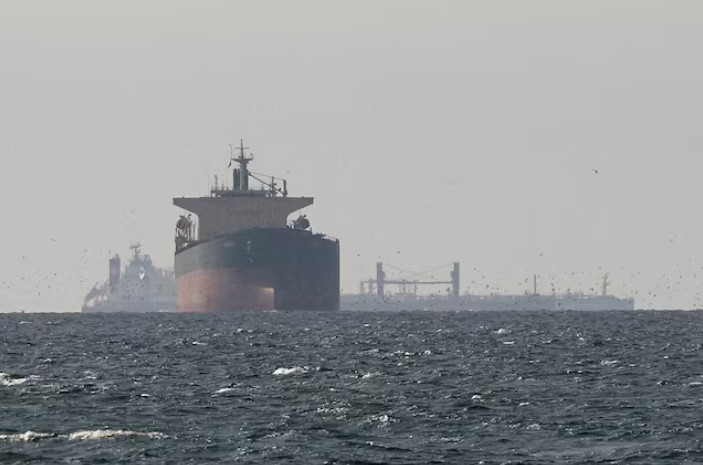

Image: Reuters Pictures– Cargo ships in the Gulf, near the Strait of Hormuz, as seen from northern Ras al-Khaimah, near the border with Oman’s Musandam governance, amid the U.S.-Israeli conflict with Iran, in United Arab Emirates, March 11, 2026. REUTERS/Stringer/File Photo Purchase Licensing Rights
Analysis | Iran War Impact/
When the United States and Israel launched surprise airstrikes on Iran on February 28, 2026, killing Supreme Leader Ali Khamenei and triggering one of the most dangerous military escalations in decades, Colombo appeared a world away from the battlefield. Thirty-two days later, the war’s fingerprints are everywhere across Sri Lanka — in fuel queues, in the anxious calls of migrant workers in Dubai, and, most starkly, in the Indian Ocean waters just south of Galle.
The conflict has now entered a new and deeply unsettling chapter. On Tuesday, Iran’s Islamic Revolutionary Guard Corps issued a warning that it would begin striking the Gulf offices of seventeen major American corporations — including Apple, Google, Microsoft, Boeing, and Tesla — starting Wednesday evening. The strikes, the IRGC said, were set to commence at 8 p.m. Gulf time, roughly 10 p.m. Colombo time. The warning marks the first time in the war that Tehran has explicitly threatened to destroy civilian technology infrastructure on a mass scale, representing a dramatic broadening of the conflict’s reach.
“The war did not stay in the Middle East. It is already in Sri Lanka’s waters, in its fuel prices, and in the livelihoods of hundreds of thousands of its citizens abroad.”
War at Sri Lanka’s doorstep
The clearest indication that Sri Lanka is no mere bystander came with a single, chilling entry in the war’s record: an Iranian Navy frigate, the IRIS Dena, was sunk by a US submarine approximately 40 nautical miles south of Galle. The vessel had been returning to Iran after participating in the International Fleet Review 2026 and multilateral exercises at Visakhapatnam, India. Active naval warfare — submarine strikes, sinking warships — occurred within sight, in geopolitical terms, of Sri Lanka’s southern shore.
Separately, Iran has made at least one attempt to strike the joint US–UK military base at Diego Garcia, located in the British Indian Ocean Territory directly south of Sri Lanka. While the strike was reportedly unsuccessful, the very attempt confirms that Tehran’s operational reach now extends deep into the Indian Ocean. For a small island nation that has historically prided itself on non-alignment and neutrality, this proximity to active combat operations is deeply uncomfortable.
The fuel crisis no one wanted
Sri Lanka’s economy, still recovering from its catastrophic 2022 debt crisis, has been battered by the war’s most immediate economic consequence: soaring oil prices. The Strait of Hormuz, the narrow waterway through which approximately 20 per cent of the world’s daily oil supply flows, has been effectively shut down since early March, when the IRGC declared it closed to vessels travelling to or from ports linked to the United States, Israel, and their allies. Prior to the blockade, roughly 138 vessels transited the strait every day. By late March, that number had fallen to just eleven.
Brent crude surged past $100 per barrel on March 8 — the first time in four years — and hit a peak of $126 per barrel. For Sri Lanka, which imports nearly all of its petroleum needs, this translates directly into pump prices, electricity tariffs, and the cost of almost every domestically produced good. The government has limited fiscal space to absorb subsidy costs, and analysts warn that a prolonged blockade could push the country toward a fresh balance-of-payments crisis reminiscent of 2022.
Key pressure points for Sri Lanka
Brent crude hit $126/barrel at its peak — Sri Lanka imports nearly all its petroleum
Strait of Hormuz traffic collapsed from 138 vessels/day to just 11 by late March
Iranian naval combat occurred ~40 nautical miles south of Galle
Iran attempted to strike Diego Garcia — directly south of Sri Lanka
Gulf migrant workers face growing danger; remittances are at risk
US tech company strikes tonight may disrupt regional cloud & digital services
The human cost: workers in the Gulf
Beyond the macroeconomic numbers lies a profoundly human story. Sri Lanka has one of the highest rates of labour migration in South Asia, with an estimated 1.5 to 2 million workers employed across the Gulf states — primarily in the UAE, Saudi Arabia, Qatar, Kuwait, and Bahrain. These workers collectively send home remittances that represent one of the country’s most critical sources of foreign exchange income.
Many of these workers are now in cities where Iranian missiles and drones have struck military bases, oil terminals, and — as of this week — potentially the corporate offices of major technology firms. Iranian attacks have already damaged infrastructure in Saudi Arabia, the UAE, Bahrain, and Kuwait. Civilian casualties, while not the primary target, have occurred. The government in Colombo has so far issued only limited guidance to Sri Lankan nationals in the region, a silence that advocacy groups and opposition politicians have begun to criticise.
The tech strike and its digital ripple effect
Tonight’s threatened IRGC strikes against US corporations introduce a new dimension of risk. The Gulf — particularly Dubai and Abu Dhabi in the UAE, and Doha in Qatar — has become a major hub for regional data centres, cloud computing infrastructure, and technology company offices. Google, Microsoft, and Amazon Web Services all operate significant infrastructure in the region. If strikes cause serious damage to these facilities, Sri Lankan businesses and government services that rely on cloud platforms could face outages or slowdowns.
The digital economy’s dependence on Gulf-based infrastructure is rarely discussed in Colombo’s policy circles, but it is real. From banking systems to e-commerce platforms to government digital services, the connectivity threads running through Middle Eastern data hubs are more numerous than most appreciate.
What Colombo must do now
Sri Lanka’s government faces a set of challenges that demand urgent, coordinated action rather than passive observation. The Central Bank and the Ministry of Finance must urgently model the impact of sustained $120+ oil prices on the country’s import bill and foreign reserve position, and communicate contingency plans to markets. The Foreign Ministry must issue clear advisories and establish an emergency response mechanism for the Sri Lankan diaspora in conflict-affected countries.
At a strategic level, Sri Lanka’s traditional posture of non-alignment has served it well — but the war has physically entered the Indian Ocean. Colombo must quietly engage with both regional powers and international bodies, including the International Maritime Organization, to ensure that Sri Lanka’s maritime approaches are treated as civilian and neutral waters, not as an extension of any theatre of war.
The conflict between Iran and the United States is not yet over. Talks are described as ongoing, and President Trump has set an April 6 deadline for Iran to reopen the Strait of Hormuz or face strikes on its energy infrastructure. Whether that deadline brings a deal or a devastating further escalation remains to be seen. What is already certain is that Sri Lanka — sitting at the intersection of Indian Ocean trade routes, dependent on Gulf fuel and Gulf remittances, and now with enemy navies sinking vessels off its own southern coast — cannot afford to watch from a comfortable distance any longer.
Anuruddha Lokuhapuarachchi is the Director of International Media and Strategic Communications at the Presidential Secretariat of Sri Lanka.
From FaceBook.