

Introduction
On 12 March 2026, during its 70th session, the United Nations Commission on the Status of Women (CSW) adopted resolution E/CN.6/2026/L.2, titled “Agreed Conclusions”, marking a significant milestone in global efforts to advance gender equality and women’s human rights. The resolution represents the principal negotiated outcome of CSW70 and focuses on the priority theme: ensuring and strengthening access to justice for all women and girls, including through inclusive and equitable legal systems, the elimination of discriminatory laws and practices, and the dismantling of structural barriers to equality.
The adoption of the Agreed Conclusions took place in a complex and politically charged international environment, reflecting both the progress made and the persistent challenges facing the global women’s rights agenda.
Context and Significance of CSW70
The Commission on the Status of Women is the United Nations’ principal intergovernmental body dedicated to the promotion of gender equality and the empowerment of women. Its annual sessions bring together Member States, UN entities, and civil society organizations to assess progress, identify gaps, and agree on actions to advance women’s rights globally.
The 70th session (CSW70), held in New York from 9 to 20 March 2026, was particularly significant as it addressed access to justice—a foundational human right and a prerequisite for the realization of all other rights for women and girls. The session occurred amid widening inequalities, geopolitical tensions, and a growing backlash against gender equality and women’s human rights in various regions of the world.
Adoption of Resolution E/CN.6/2026/L.2
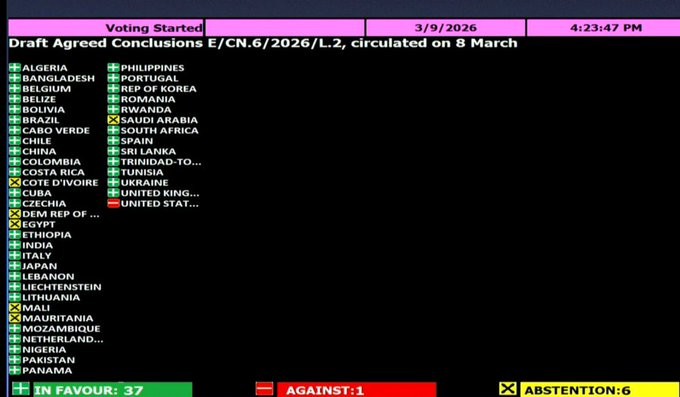
Unlike most previous CSW outcome documents, which were traditionally adopted by consensus, the Agreed Conclusions of CSW70 were adopted by a recorded vote. The resolution was approved by a substantial majority of Member States, with 37 votes in favour, one vote against, and six abstentions. This marked a historic departure from consensus adoption and underscored the polarized global debate surrounding gender equality and women’s rights.
Despite attempts to defer or amend the text, the Commission proceeded with the vote after extensive negotiations. The Chair of the Commission emphasized that the final document represented the most balanced and inclusive outcome achievable under the circumstances, reflecting a broad range of views while remaining firmly grounded in internationally agreed human rights standards.
Core Themes and Commitments
The Agreed Conclusions reaffirm existing international commitments, including the Beijing Declaration and Platform for Action, the Convention on the Elimination of All Forms of Discrimination against Women (CEDAW), and the 2030 Agenda for Sustainable Development. Central to the resolution is the recognition that access to justice is both a human right and an essential condition for gender equality.
The document calls on governments to strengthen legal and institutional frameworks that ensure women’s and girls’ equal access to justice. This includes promoting gender‑responsive legal systems, removing discriminatory laws and practices, addressing intersecting forms of discrimination, and ensuring accountability for violations of women’s rights. The Agreed Conclusions also emphasize the importance of survivor‑centred, accessible, and adequately resourced support services, particularly for victims of violence and abuse.
Political and Global Implications
The adoption of resolution E/CN.6/2026/L.2 carries significant political and normative weight. While the absence of consensus highlighted divisions among Member States, the strong majority vote demonstrated continued global support for gender equality and women’s rights. Many observers viewed the adoption as a reaffirmation of multilateralism and international cooperation at a time when these principles are under strain.
The resolution also sends a clear message that efforts to weaken or roll back internationally agreed language on women’s rights will face strong resistance within the United Nations system. By upholding established human rights frameworks, the Agreed Conclusions reinforce the role of CSW as a key norm‑setting body for gender equality.
Highlights of the Agreed Conclusions
Key highlights of resolution E/CN.6/2026/L.2 include:
- A strong focus on access to justice as a cornerstone of women’s empowerment and equality.
- Reaffirmation of international human rights commitments, including the Beijing Platform for Action and the 2030 Agenda.
- Calls for the elimination of discriminatory laws, policies, and practices that hinder women’s rights.
- Emphasis on inclusive, equitable, and gender‑responsive legal systems.
- Recognition of the need for adequate resources and survivor‑centred services, including in the areas of violence prevention and redress.
- A historic adoption by recorded vote, reflecting both challenges and resilience in the global women’s rights movement. [press.un.org], [countdown2…europe.org]
Conclusion
The adoption of the Agreed Conclusions at CSW70 on 12 March 2026 represents a pivotal moment in the international community’s ongoing efforts to advance gender equality and justice for women and girls. Resolution E/CN.6/2026/L.2 not only outlines concrete policy directions for Member States but also reaffirms the enduring relevance of international human rights norms in the face of political and social challenges.
While the lack of consensus highlights persistent divisions, the resolution’s strong support underscores a shared global commitment to ensuring that women and girls can fully exercise their rights and access justice on an equal basis. As such, the Agreed Conclusions of CSW70 will continue to serve as an important reference point for national policies, international cooperation, and advocacy efforts in the years ahead.
The resolution: