
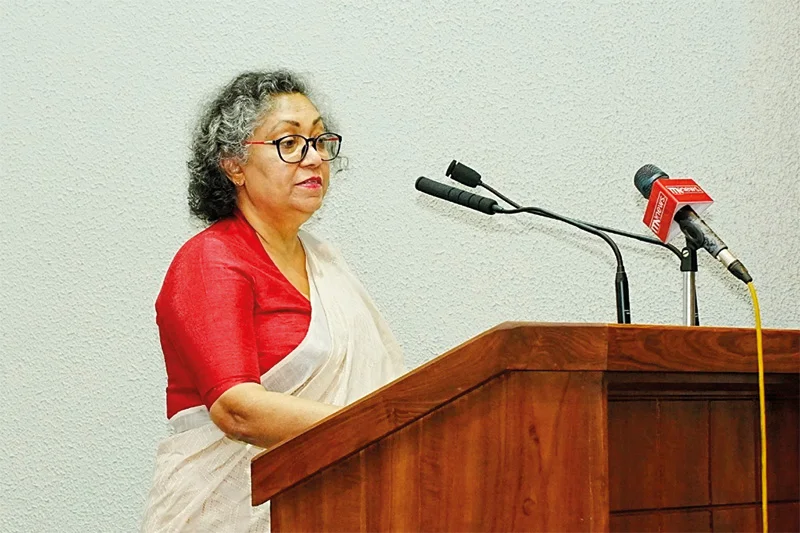

Judge of the Supreme Court Justice Kumudini Wickramasinghe has recently presented a stark analysis of the legal profession’s gender disparity, noting that in spite of women entering the legal field in substantial numbers, their representation dwindles at senior levels. She has highlighted critical statistics and the fact that only two women currently serve in the Supreme Court, none in the Court of Appeal, and that there has never been a woman President of the Bar Association of Sri Lanka (BASL).
“Inclusive leadership is not satisfied by entry-level participation,” Justice Wickramasinghe said. “It concerns who occupies the apex of institutional authority, who shapes doctrine, who speaks for the profession. These figures are not merely statistics; they are indicators of work yet unfinished.”
Justice Wickramasinghe said so at a seminar organised on the eve of International Women’s Day by the Bar Association of Sri Lanka (BASL), in collaboration with the Sri Lanka Women Lawyers’ Association (SLWLA). She underscored the need to address the systemic barriers preventing women from reaching the apex of the legal profession. Justice Wickramasinghe addressed the gathering as the Chief Guest.
BASL President Rajeev Amarasuriya, in his address, framed inclusivity not as charity or tokenism, but as “structural fairness.” He raised an important question being ‘who bears the responsibility of inclusivity’ and addressed the vital role of leadership in inclusivity. Furthermore, Amarasuriya challenged the profession to address the “gap between what we see coming into the profession and what we see at the top,” and clarified that such disparity did not stem from a lack of competence or commitment but from deep rooted practices and structural issues.
A dynamic panel discussion, moderated by Attorney-at-Law Tanushka Gunawardane, explored the multifaceted nature of inclusive leadership. The panel featured Justice Wickramasinghe, Constitutional Council Member Professor Wasantha Seneviratne (joining online), Senior Instructing Attorney Shiranthi Gunawardhana, and corporate leader Yanina Weerasinghe.
Professor Wasantha Seneviratne distinguished between mere representation and true participation, stating that inclusion becomes meaningful only when women have the “agency and authority to make decisions.” She emphasised that inclusive leadership is both a moral obligation and a pragmatic governance strategy.
Senior Instructing Attorney Shiranthi Gunawardhana shared personal anecdotes from her 50-year career, urging senior lawyers to act as mentors rather than gatekeepers. She stressed the importance of creating space for young female lawyers by offering flexibility and support to help them balance professional and personal responsibilities.
Yanina Weerasinghe, Head of Legal at Brandix, argued that true inclusion is measured by influence, not optics. “Diversity is being present; inclusivity is being influential,” she explained, warning against tokenism and calling for “cerebral opportunities” where women are selected, based on talent, and given a genuine voice in decision-making.
Justice Wickramasinghe addressed the relationship between judicial hierarchy and inclusion, asserting that authority and accessibility can coexist. “A judge can be firm in decisions while remaining approachable,” she said, adding that power exercised with transparency and humility strengthens, rather than weakens, institutional legitimacy.
The seminar also heard from Dilani Yatawaka, Managing Director/CEO of Ideal Motors, who shared her perspective as a female leader in the male-dominated automotive sector. She reinforced the critical role of supportive superiors and societal encouragement to enable women to ascend the career ladder while managing family responsibilities.
BASL Women Lawyers’ Professional and Career Development Committee Chair Indika Nagaratne Koththagoda in her welcome address said that the distinguished gathering was honoured to have Her Ladyship Justice Kumudini Wickramasinghe, Judge of the Supreme Court of Sri Lanka, as the Chief Guest and a key panellist and also welcomed the other panellists Attorneys-at-Law Professor Wasantha Seneviratne, Ms. Shiranthi Gunawardena and Yanina Weerasinghe for agreeing to share their insights on the subject during the ensuing panel discussion to be moderated by Attorney-at-Law Ms. Tanushka Gunawardane.
In her closing remarks, Nalani Manatunga, Co-Chairperson of the BASL Women Lawyers’ Professional and Career Development Committee, challenged the audience to reflect on the true meaning of leadership. “A position gives authority, but leadership gives direction,” she said. “Inclusive leadership is not about occupying space; it’s about creating space. Let our leadership not be measured by the chairs we occupy, but by the doors we leave open.”