


Sri Lanka’s Supreme Court on Thursday brought closure to the controversial arrest of comedian and civil activist Natasha Edirisuriya, recording a written apology from the arresting officer and reaffirming that the ICCPR Act cannot be used to justify arbitrary arrests or suppress free expression.
Former Officer-in-Charge of the Cyber Crime and Intelligence Analysis Unit of the Criminal Investigation Department (CID), M. M. U. Subasinghe, today expressed his regret in writing to the Supreme Court over the arrest of civil activist and comedian Natasha Edirisuriya under the International Covenant on Civil and Political Rights (ICCPR) Act.
The Attorney General’s Department, appearing for the respondents, informed the Court that the Inspector General of Police (IGP) would issue a circular to all police officers to prevent illegal arrests under the ICCPR Act. It was further stated that the circular would be issued within two weeks, and that the petitioner, Natasha Edirisuriya, had reviewed the proposed guidelines and expressed her agreement with them.
The fundamental rights application filed by Natasha Edirisuriya in connection with her alleged illegal arrest was taken up for hearing today before a three-member bench headed by Justice Padman Surasena. When the matter was called, the respondents informed the Court of the written expression of regret and the decision to issue the IGP circular.
Accordingly, the Court ordered the respondents to notify the Court by way of motion within two weeks of issuing the relevant IGP circular and directed that the case be concluded thereafter.
Ms. Natasha Edirisuriya was present in open court today. Addressing her, Chief Justice P. Padman Surasena stated that the Court appreciated her cooperation in facilitating the closure of the case.
The written apology submitted to the Court stated:
“As the arresting officer, considering the overall circumstances, I express my deepest regret for the arrest made on 27 May 2023 and for your subsequent remand until 5 July 2023. I also express my deepest regret for the damage caused to your reputation and honour, as well as the mental and emotional distress caused to you as a result of this arrest and remand.”
The apology and the issuance of the circular were made in accordance with the terms and conditions proposed by the petitioner, Natasha Edirisuriya.
The controversy arose after a video of remarks made by Ms. Edirisuriya at a comedy show titled “Modabhimana”, held at a leading school in Colombo, was circulated on social media. Investigations were initiated following complaints alleging that the remarks were insulting to Buddhism and to the birth of Prince Siddhartha.
Ms. Edirisuriya was arrested by officers of the Airport Police and the CID on the morning of 28 May 2023, while she was about to depart for Singapore from the Bandaranaike International Airport in Katunayake. On the same day, the Colombo Fort Magistrate’s Court ordered that she be remanded until 7 June 2023, after she was produced before Fort Magistrate Thilina Gamage by officers of the CID’s Cyber Crime Investigation Unit.
Subsequently, on 5 July 2023, the Colombo High Court ordered her release on personal bail in the sum of Rs. 100,000. The order was made by High Court Judge Aditya Patabendi after considering a bail application filed on her behalf. The Deputy Solicitor General, appearing for the Attorney General, informed the Court that the prosecution did not object to granting bail.
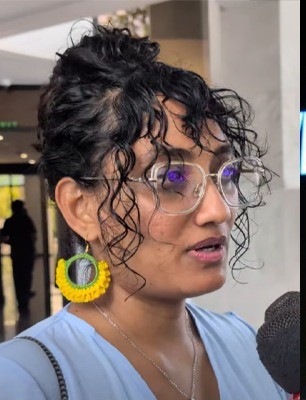
President’s Counsel Anuja Premaratne, appearing for Ms. Edirisuriya, submitted that there had been no intention to insult Buddhism through the statements made during the “Modabhimana” programme, and that his client had apologized for any hurt caused by her remarks.
However, the Deputy Solicitor General contended that the statements were obscene and hateful, and further alleged that Ms. Edirisuriya had earned significant income from such content.
In his ruling, the High Court Judge emphasized that earning income from YouTube videos was not unlawful. He further observed that a statement does not amount to hate speech merely because it offends certain individuals, and that persons who believe in science have the right to question religious matters. The Judge also noted that Buddhism itself encourages freedom of inquiry and examination.
The Judge stated that the ICCPR Act had been enacted to strengthen human rights protections in Sri Lanka and not to suppress individuals. He explained that arresting a person solely on the basis of a complaint by a powerful individual or a religious figure runs contrary to the objectives of the Act, and that hate speech must be interpreted in line with international standards.
Ultimately, the Court ruled that since the B Report did not establish that Ms. Edirisuriya’s statements had caused public disorder, continued remand was unnecessary. She was accordingly released on bail.
Meanwhile, the Young Journalists Association also addressed a letter to the Inspector General of Police requesting the repeal of the ICCPR Act. The Association stated that the Sri Lanka Police had increasingly used the Act to restrict civil and political rights, contrary to its intended purpose.
The Association further emphasized that matters falling under Article 20 of the ICCPR must be interpreted in harmony with the freedom of expression guaranteed by Article 19 of the same Convention. It urged that the law be implemented in a manner that safeguards the right to express opinions, rather than being applied arbitrarily to suppress individual freedoms under the guise of preventing religious hatred.
( Adopted from a Sinhala language article published by satahan web site.)