
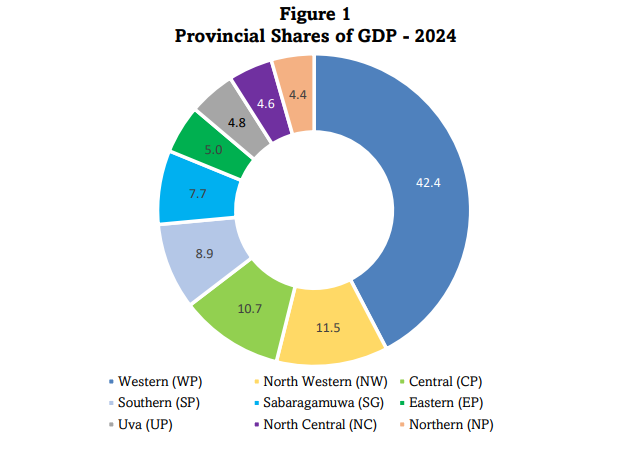
The Western Province continued to dominate Sri Lanka’s economy in 2024, accounting for 42.4% of nominal GDP, despite a slight decline from 44.0% in 2023. This concentration underscores the stark disparity between the highly urbanised Western Province—home to Colombo and its dense metropolitan infrastructure—and the largely rural provinces, where economic activity and living standards lag behind.
Sri Lanka’s nominal GDP for 2024 was Rs. 29.9 trillion, up from Rs. 27.4 trillion in 2023. The Western Province alone generated Rs. 12.66 trillion, while the North Western and Central Provinces contributed Rs. 3.45 trillion and Rs. 3.20 trillion, respectively. These figures highlight the economic imbalance: the Western Province’s output is nearly four times that of the second-ranked province.
Population and Poverty Snapshot
According to the 2024 Census, Sri Lanka’s population reached 21.76 million. The Western Province remains the most populous with 6.11 million people (28.1%), while rural provinces such as Northern and Uva have populations of 1.15 million and 1.39 million, respectively. Other provinces include:
- Central: 2.71 million
- North Western: 2.58 million
- Southern: 2.60 million
- Sabaragamuwa: 2.01 million
- Eastern: 1.78 million
- North Central: 1.40 million
This demographic concentration in the Western Province reinforces its economic dominance and urban-centric development.
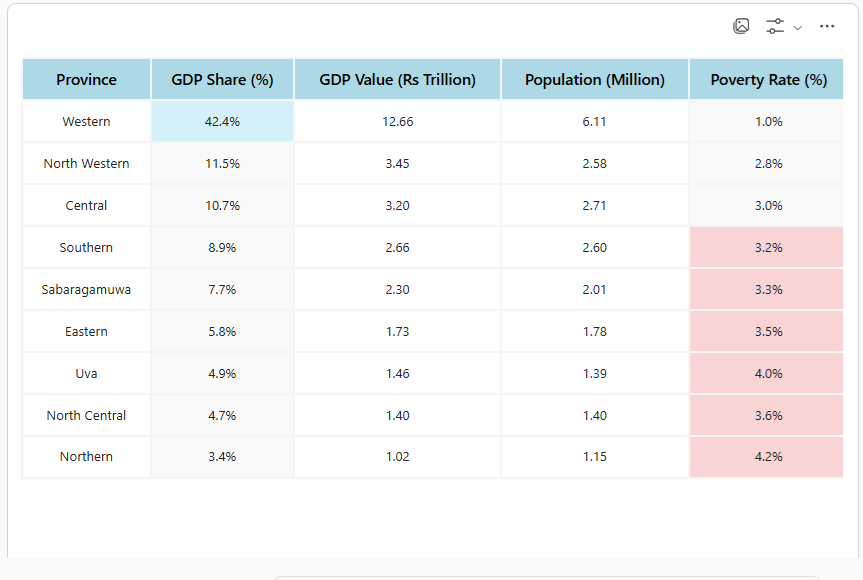
- Western Province dominates with 42.4% GDP share and the lowest poverty rate (≈1%), highlighting the urban advantage.
- Rural provinces like Northern and Uva have higher poverty rates (4%+) and much smaller GDP contributions.
- Population distribution is relatively balanced, but economic output is heavily skewed toward the Western Province.
Poverty remains a pressing issue, particularly in rural areas. The national poverty rate stood at 23.4% in 2024 (measured at US$3.65/day), with multidimensional poverty disproportionately affecting rural households. While urban poverty incidence is around 1%, rural areas record 3.3% multidimensional poverty, reflecting gaps in education, health, and living standards. Provinces such as Uva, Northern, and Eastern show higher vulnerability compared to the Western Province, where poverty levels are significantly lower.
Sectoral Disparities
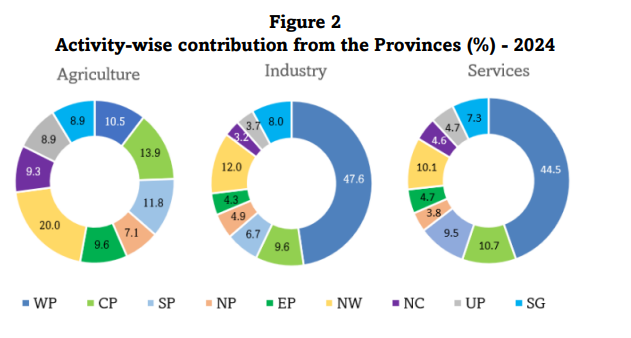
- Agriculture: Dominated by rural provinces—North Western leads with 20% of national agricultural value added, followed by Central (13.9%) and Southern (11.8%).
- Industry: Highly concentrated in Western Province (47.6% of total output), leaving rural provinces with limited industrialisation.
- Services: Again, Western Province leads with 44.5%, while Central and North Western trail at 10.7% and 10.1%, respectively.
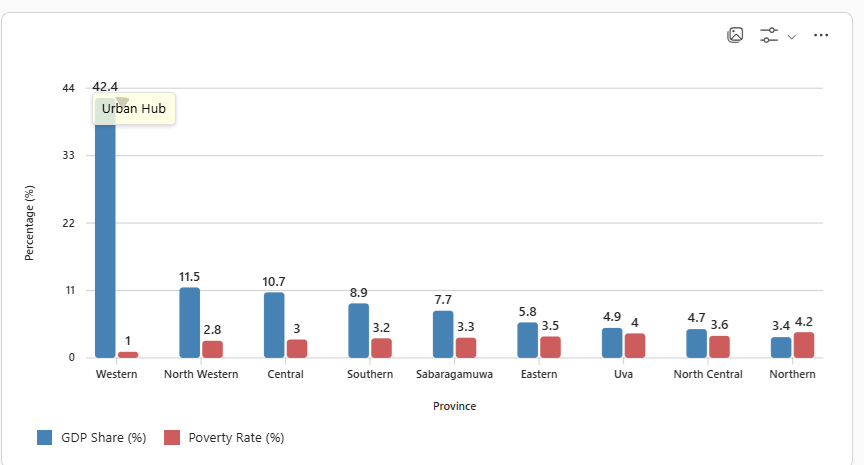

Key Insight
The data paints a clear picture: Sri Lanka’s economic geography is heavily skewed towards urban centres, particularly the Western Province. Rural provinces, despite their agricultural contributions, face structural disadvantages—lower GDP shares, higher poverty rates, and limited access to industrial and service-sector opportunities. Bridging this gap requires targeted investments in infrastructure, education, and rural development to ensure inclusive growth.
Note:The Central Bank explained that above mentioned Provincial GDP (PGDP) figures are calculated using a top-down methodology. National GDP, compiled by the Department of Census and Statistics, is broken down to provincial level based on relevant economic indicators. The estimates for 2024 are classified as provisional.
(With the inputs from FT and Central Bank reports)