
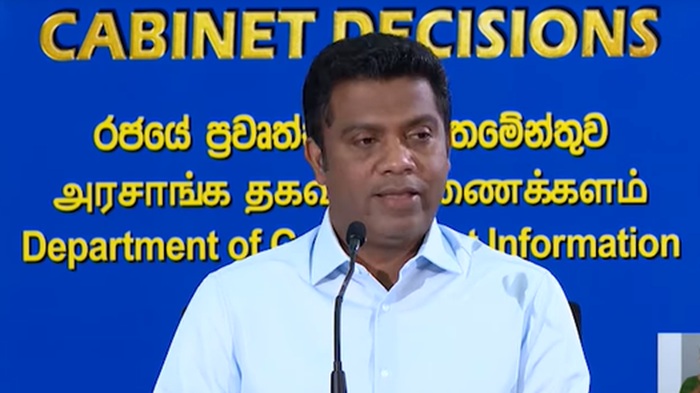

Cabinet Spokesman and Minister of Mass Media Nalinda Jayathissa on Tuesday underscored the importance of freedom of expression and responsible journalism, while urging media institutions to verify information before publication, as the government rejected allegations that it ignored early warnings about severe weather linked to Cyclone Ditwah.
Addressing a media briefing following Cabinet decisions taken on December 15, Jayathissa said the government fully respects the right of the media to question, critique, and express differing views, but stressed that such freedoms carry a responsibility to ensure accuracy. He defended the credibility of official information released to the public and dismissed opposition demands for a parliamentary select committee to probe the issue.
“Media institutions are free to seek legal redress if they wish. In that forum, we will be able to demonstrate how certain clips were selectively edited and presented in a misleading manner,” he said.
Jayathissa noted that the government had already provided comprehensive clarifications through multiple television discussions and a detailed statement in Parliament. He said that while open debate is welcome in a democratic society, several claims circulating in sections of the media were inaccurate and risked misinforming the public.
Reiterating the government’s position, the minister said the Department of Meteorology officially issued information on critical weather conditions on November 25, rejecting assertions that authorities had been alerted significantly earlier. He described reports suggesting the government received cyclone-related information as early as November 12 as unfounded.
“These allegations are completely false,” he said.
Responding to claims that authorities were informed through 23 red notices, Jayathissa said official records showed that 19 of those notices were issued after November 27, a timeline he said could be independently verified through the Disaster Management Center’s website.
He also addressed media reports referencing an article published by India’s Indian Express, which some local outlets cited as evidence that Indian meteorological agencies had warned of the cyclone from November 12. Jayathissa said Sri Lanka’s Ministry of Foreign Affairs, together with the Ministry of Defence, had formally sought clarification on the matter.
According to Jayathissa, Sri Lanka’s Department of Meteorology confirmed on the morning of November 25 that the weather system had weakened into a deep depression, and only on November 27 indicated the possibility of it developing into a cyclone.
“All of this information is available in official archives and online records,” he said, adding that repeatedly revisiting disproven claims served little public benefit.
While reaffirming the government’s commitment to safeguarding freedom of expression, Jayathissa cautioned that persistent dissemination of false information could fuel public anxiety, social tension, and broader security concerns. He said the government would act within the law if misinformation continued to pose such risks.