

By Moiz Mustafa
Colombo, Dec. 11 (Daily Mirror) – Cyclone Ditwah left Sri Lanka facing a national disaster of extraordinary scale.
In a matter of days, the storm triggered lethal landslides, unprecedented flooding and the collapse of critical infrastructure that millions rely on.
Entire districts were cut off, thousands were displaced and the economic impact continues to grow.
The numbers tell the story of a country confronting one of its most severe crises in recent memory.
Human Impact of Cyclone Ditwah
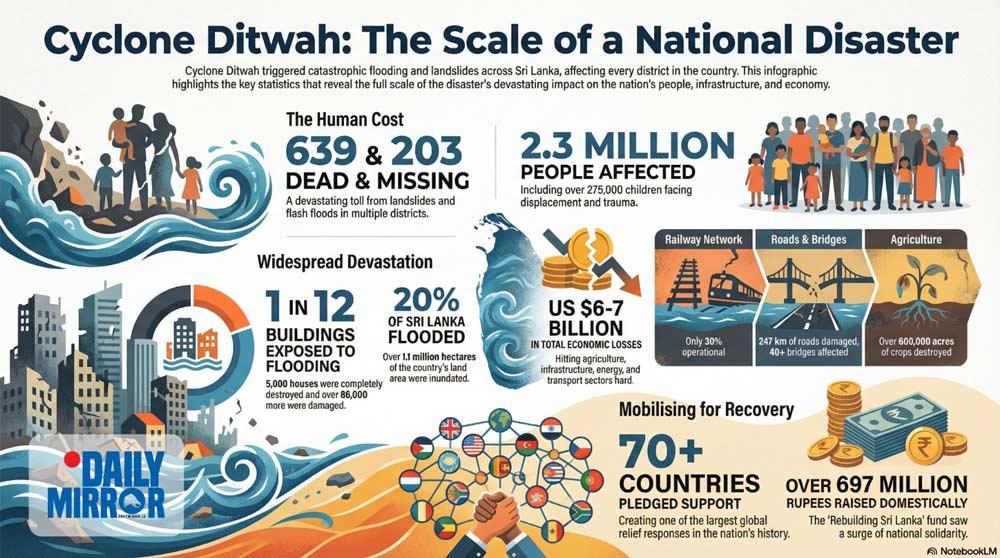
639* people confirmed dead
The storm left a devastating human toll. The Disaster Management Centre confirmed that 639 Sri Lankans had lost their lives.
Most deaths were recorded in the Kandy, Badulla, Nuwara Eliya and Matale Districts where landslides and flash floods struck without warning.
Up to 203 people reported missing
Many families are still searching for loved ones who disappeared during the flooding and landslides. Several remote areas remain inaccessible.
More than 2.3 million people affected
Every district in the country has been impacted. According to UNDP, over 2 million Sri Lankans experienced flooding, displacement, property loss, loss of livelihoods or severe disruption to daily life.
More than 275,000 children affected
UNICEF reports that hundreds of thousands of children are dealing with damaged schools, destroyed homes, traumatising experiences and rising risks of post-flood disease.
Homes, Schools and Community Spaces Destroyed
5,000 houses completely destroyed
These families now depend entirely on shelters, emergency centres and government support.
More than 86,882 houses partially damaged
Many homes are unstable or unsafe, leaving thousands displaced.
764 religious sites damaged
Cyclone Ditwah damaged or destroyed sacred sites including
379 Buddhist Temples, 165 Hindu Kovils, 63 Churches and 157 Mosques.
159 schools damaged in Central Province
A total of 115 of these schools had to be converted into temporary camps for displaced families.
Floodwaters reached nearly 720,000 buildings (UNDP, 2025)
According to UNDP, one in every twelve buildings in Sri Lanka was exposed to floodwater.
Infrastructure Damage Across Sri Lanka
Almost 20% of Sri Lanka – 1.1 Million Hectares
United Nations Development Programme (UNDP) shows floodwaters from the cyclone inundated more than 1.1 million hectares – almost 20 percent of the country’s land area
247 kilometres of roads damaged
Road networks across the island collapsed under landslides, floodwater and soil erosion. Over 16,000 kilometres of roads and 278 kilometres of railways exposed to flooding (UNDP, 2025)
UNDP notes that the length of roads exposed to flooding could wrap Sri Lanka’s coastline more than twelve times.
More than 40 bridges affected
This includes the collapse of the Nayaru bridge in Mullaitivu and severe structural damage to the Yakkala bridge.
Highway damage estimated at 190 billion rupees
This figure alone shows how deeply Cyclone Ditwah has disrupted transport and commerce.
Only 30 percent of the railway network operational
Out of 1,593 kilometres of track, just 478 kilometres remained usable. Thirty nine power sets are stranded across the country.
Power outages hit 3.9 million consumers
The Ceylon Electricity Board restored most connections later, but nearly the entire country experienced blackouts at the height of the storm.
More than 150 water supply systems disrupted
Major water treatment plants in Kandy, Ambatale and several other areas were submerged or forced to shut down.
Tanks, Dams & Canals
1,777 tanks, 483 dams, 1,936 canals and 328 agricultural roads under the Department of Agricultural Services have been damaged.
Cyclone Ditwah’s Economic Impact
More than 600,000 acres of crops destroyed
From vegetables to paddy lands, Sri Lanka’s food supply took a major hit. Vegetable prices have already increased significantly.
3 million hens lost
The bakery industry warns of a nationwide egg shortage.
More than 600 prawn farms destroyed in Puttalam
Coastal livelihoods have been wiped out in several communities.
Sri Lanka faces a projected GDP loss of 0.5 to 0.7 percent
Economic analysts warn that Cyclone Ditwah will significantly slow down the country’s recovery trajectory.
Total economic loss estimated between 6 and 7 billion US dollars
This includes damage to agriculture, energy, public infrastructure, irrigation systems, homes and the transport network.
Water Levels and Flooding Across River Basins
Spill gates opened in seven major reservoirs
Kala Wewa, Rajanganaya and several others had to release large volumes of water to prevent dangerous pressure buildup.
Historic rise in Kelani River flood levels
The water level at the Nagalagam Street gauge exceeded 8.45 feet and forced mass evacuations across Colombo suburbs including Kelaniya, Biyagama and Kolonnawa.
Several regions recorded more than 300 millimetres of rainfall
Rugam in Batticaloa and parts of Mullaitivu and Vavuniya reported some of the highest rainfall ever measured in a single period.
Health Risks After Cyclone Ditwah
Heart attack risk increased by almost 40 percent
Cardiologists warn that disaster-induced stress is pushing vulnerable individuals into medical emergencies.
Rise in waterborne and vector-borne diseases
Health authorities report increasing cases of leptospirosis, diarrhea, chikungunya, dengue and skin infections.
Pink eye warnings issued for flood shelters
Crowded conditions in safety centres have raised the risk of conjunctivitis outbreaks.
Donations, Relief and National Response
Rebuilding Sri Lanka Fund surpasses 697 million rupees
The Rebuilding Sri Lanka Fund has now surpassed 697 million rupees, driven by a surge of national and corporate solidarity.
Sri Lanka Cricket contributed 300 million rupees, Port City Colombo provided both funds and heavy machinery, the Bandaranaike Foundation donated 250 million rupees, and Lanka Ashok Leyland added vehicles valued at more than 65 million rupees.
These are only a few of the major contributions, with many more organizations, businesses and individuals continuing to step forward to support the country’s recovery.
Government compensation of 5 million rupees for fully destroyed houses
Families who lost land to landslides will receive alternate land allocations.
Government allocates 1.2 billion rupees for emergency relief
This is the initial allocation and more funds are expected as assessments continue.
878 Safe Centres for displaced families
878 safe centres have been set up to shelter 86,040 individuals from 27,145 displaced families.
International Aid for Cyclone Ditwah Victims
More than 70+ countries have pledged help for Sri Lanka.
India deployed C-17 and C-130 aircraft, Bailey bridge units and specialist search and rescue teams.
The UAE established a continuous air bridge with multiple relief flights carrying emergency supplies.
China provided 85 tonnes of humanitarian aid, while the United States committed 2 million US dollars in life-saving support.
The Maldives delivered 25,000 cases of canned tuna in 14 containers and 50,000 US dollars, with Japan, Bangladesh, Pakistan, Myanmar, Korea and Israel also supplying medical teams, food stocks and essential relief materials.
Many more countries have extended their support, contributing to one of the largest global relief responses Sri Lanka has received in recent years
A Country Forever Changed by Cyclone Ditwah
These numbers reveal the true scale of the disaster, but they also hint at something else. Sri Lankans continue to show extraordinary resilience. The record blood donations, the volunteer rescue missions and the rapid global response show that Sri Lanka is not facing this disaster alone.
Communities have come together: volunteers distributing water, food and hygiene kits; neighbours sheltering neighbours; youth, NGOs, and citizen-groups mobilizing to clean water sources and rebuild; and everyday Sri Lankans rallying to help each other in cities, towns and remote villages.
Even as the nation counts losses, these efforts offer a glimmer of hope: that out of devastation, a renewed, united resolve to rebuild and rebuild better might emerge.
This data is as of 10th December, 4.00 PM.
Daily Mirror.