
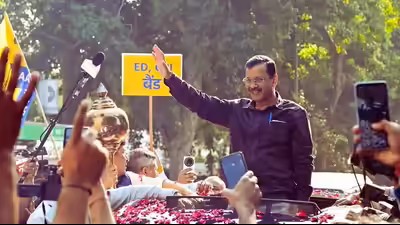

Image{ Aam Aadmi Party, national convener, Arvind Kejriwal,
Part 2
The Desertion Dynamic: When Colleagues Become Critics
One of the most damaging features of the collapse of the Aam Aadmi Party (AAP) was the speed at which its own ranks fragmented under pressure. As corruption scandals mounted and electoral defeats accumulated, former allies, MPs, and party functionaries abandoned the sinking ship, many defecting to the BJP. In the last week of April 2026, seven AAP MPs including prominent figures quit to join the BJP. Kejriwal reportedly tried personally to prevent the defections. He could not.
The lesson here for the NPP is sobering. The NPP is a coalition, not a homogeneous party. It contains the JVP’s disciplined cadre structure, but also civil society professionals, trade unionists, women’s activists, and community leaders who joined because they believed in the NPP’s manifesto rather than the JVP’s ideology. As reports on Sri Lanka’s situation observe, many of these non-JVP members are already feeling marginalised. The NPP’s manifesto reflected the priorities of its newer, more liberal elements — but in practice, the JVP dominates decision-making at every level.
If the NPP fails to honour its commitments to these coalition partners — if the JVP’s statist, nationalist tendencies continue to override the manifesto’s promises of devolution, constitutional reform, and ethnic reconciliation — the coalition will fracture. The desertion dynamic that destroyed the AAP does not require defections to the opposition; it only requires the withdrawal of enthusiastic support, the demoralisation of activists, and the gradual erosion of the broad popular mandate that made the NPP’s 2024 victory possible.
The Opposition’s Own Glass House
A crucial contextual point must not be overlooked. The forces mounting accusations of corruption against both the AAP and the NPP are not themselves paragons of virtue. The BJP, for all its anti-corruption rhetoric, has its own long catalogue of politicians facing serious charges. In Sri Lanka, the opposition parties campaigning against the NPP — the remnants of the SLPP, the SJB, and various nationalist formations — include figures directly implicated in the economic mismanagement and corruption that brought the country to its knees in 2022.
The Rajapaksa family, whose misrule was found by the Supreme Court to have demonstrably contributed to the economic crisis and to have violated public trust, remains a political force. Former President Ranil Wickremesinghe, arrested briefly in August 2025 on charges related to private use of state resources, attracted the defence of parties across the political spectrum. It was a spectacle that illustrated, as the NPP correctly pointed out, the depth of the corrupt political class that it is attempting to displace.
This context is important but insufficient. In the AAP’s case, pointing to BJP corruption did not save the party from electoral defeat. Voters do not always — or even often — make decisions on the basis of comparative moral accounting between competing parties. They vote on the basis of what they feel, what they experience, and what they expect. A government that campaigns on cleaning up corruption but appears to selectively apply that standard, or that governs incompetently, or that responds to legitimate criticism with arrogance and legal threats, will lose the trust of voters regardless of how much more corrupt its opponents may be.
Structural Differences and Sri Lanka-Specific Vulnerabilities
Sri Lanka’s political context differs from Delhi’s in ways that are both advantageous and challenging for the NPP. The NPP governs nationally, not as a regional government within a hostile central government. It commands a two-thirds parliamentary majority — rare in Sri Lankan political history. The opposition is fragmented and weak. These structural advantages give the NPP room to act boldly.
However, Sri Lanka also presents unique vulnerabilities that have no Indian counterpart. The ethnic and religious fault lines that have defined Sri Lankan politics for decades — and that produced a devastating civil war — remain insufficiently addressed. The NPP’s failure to set a clear timetable for provincial council elections, its silence on the specifics of constitutional devolution, and the continued harassment of Tamil activists by counter-terrorism police have deepened disenchantment in the north and east. Tamil parties won most of the councils they contested in the May 2025 local elections, suggesting that the NPP’s claim to a pan-ethnic mandate is more fragile than its 2024 parliamentary numbers implied.
The NPP also faces a more precarious economic situation than the AAP ever did. Sri Lanka remains saddled with one of the highest debt burdens of any middle-income country, with 49 per cent of revenues projected to go toward debt service in 2026. The government’s adherence to IMF conditionalities — while fiscally responsible — has left it with limited capacity to deliver the economic relief it promised voters. The triple shocks of Cyclone Ditwah, Middle East conflict-driven fuel shortages, and the lingering effects of the 2022 crisis have placed further strain on living standards. As has been noted repeatedly, Sri Lanka cannot afford to make the same mistakes twice. The window for genuine reform is narrow, and it will not remain open indefinitely.
Sri Lanka’s recent political history demonstrates that several important political figures have damaged their own credibility through their own actions — whether through inexperience, lack of situational awareness, or through being manipulated by political opponents. These self-inflicted wounds have provided easy ammunition to critics who would otherwise have to construct their attacks on thinner grounds.
Lessons the NPP Must Learn — Before It Is Too Late
The collapse of the AAP from 67 seats to 22 in a single decade is not inevitable for the NPP. However, it is possible. The following lessons emerge from a comparative analysis of the two cases and deserve urgent attention from the NPP’s leadership.
- Accountability must be universal, not selective. The single most damaging thing the NPP can do is to apply anti-corruption standards selectively — prosecuting opposition figures while protecting its own. The decision to defend Energy Minister must be reversed or convincingly explained. CIABOC and other oversight bodies must be fully resourced and made more efficient. Independent commissions such as the RTI must be funded and empowered, not undermined.
- Tone matters as much as substance. The NPP must move away from moralism and defensiveness. President Dissanayake’s early speeches acknowledged that no single party could solve Sri Lanka’s problems alone and called for constructive criticism and public scrutiny. That spirit must be recovered. Initiating police investigations into critical journalists or opposition commentators, rather than using established media complaints procedures, is precisely the kind of tactic that cost the AAP its middle-class base.
- The coalition must be genuinely inclusive. The NPP’s strength lies in its breadth. If the JVP’s organisational dominance continues to sideline the professionals, civil society leaders, and community activists who joined the NPP in good faith, the coalition will fracture. The NPP’s manifesto belongs to all its members, not only to the JVP.
- Governance capacity must be built urgently. The Cyclone Ditwah response failure was a warning. The NPP must overcome its mistrust of outside expertise and engage academics, civil society organisations, and international technical advisers in developing and implementing its reform agenda. Decisions cannot continue to be made by a small circle of ministers.
- Ethnic reconciliation cannot wait. Provincial council elections must be held without further delay. The harassment of Tamil activists by counter-terrorism police must end. A credible timetable for constitutional reform — including meaningful devolution — must be presented. The NPP’s long-term legitimacy depends on whether it can be a genuinely national government, not merely a Sinhala-majority one with aspirations of national reach.
- Economic relief cannot be deferred indefinitely. The IMF programme is fiscally necessary but politically dangerous if it is perceived as prioritising creditor interests over the needs of the Sri Lankan poor. The NPP must push harder for wealth taxes, for equitable distribution of the tax burden, and for renegotiated debt terms that create fiscal space for social investment. The poorest Sri Lankans — nearly a quarter of the population — are living in poverty. Their patience is not an unlimited one.
- Prepare for intensifying opposition campaigns. The BJP’s anti-AAP campaign in India was relentless, sophisticated, and effective. Sri Lanka’s opposition — despite its weakness — will similarly seek to amplify every NPP misstep, frame every procurement decision as corruption, and use any available institutional leverage to damage the government’s credibility. The best defence against this is not counter-propaganda but genuine, demonstrable good governance.
Conclusion: The Window Is Still Open, But It Is Closing
The Aam Aadmi Party’s story is not a story of inevitable failure. It is a story of what happens when a movement built on anti-corruption promises fails to protect its own integrity, governs inexpertly, and loses the trust of the voters who gave it an historic mandate. The BJP’s campaign against it was ruthless and often cynical, but it succeeded because the AAP handed its enemies the weapons they needed.
Sri Lanka’s NPP government still has time to avoid the same fate. It governs with a majority that the AAP never had. Its opposition is weaker than the BJP was in relation to Delhi. The international community — including Sri Lanka’s bilateral partners — has a genuine stake in Sri Lanka’s success and is prepared to offer support. The window for systemic reform, though narrowing, has not yet fully closed.
Nevertheless, the lessons of the AAP experience must be absorbed honestly and urgently. Anti-corruption mandates are not self-sustaining. They must be renewed, again and again, through consistent and universal application of the law. Governance is not won by rhetoric but by results — in people’s daily lives, in the functioning of public institutions, in the fairness of the tax system, in the safety of communities. And popular mandates — however overwhelming they appear at election time — are, ultimately, conditional.
The broom sweeping away Sri Lanka’s corrupt old order must also be used to sweep clean the state itself — its institutions, its government. A house in constant use demands regular cleaning. A government is no different. Clear systems and methodologies must be developed and rigorously upheld. Corruption can never be defeated once and for all; it must be perpetually managed and led from the top. It cannot rest on a leader’s friendships, loyalties, or personal whims. Fail here, and history will have only a familiar story to tell.
Concluded
5 May 2026