
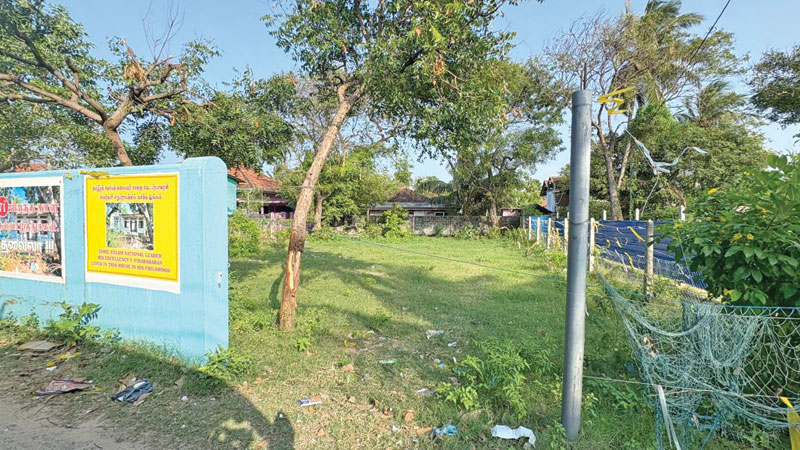

Image: The current state of the land where once the LTTE leaders ancesteral home stood on.
Unpacking how a misleading media report about Prabhakaran’s ancestral home fuelled public outrage, spread disinformation, and deepened tensions, showing the real-world cost of fake news
By Maneshka Borham and B. Nirosh Kumar in Valvettithurai.
Prabhakaran’s house to be renovated and handed over to his sister!” blared a Sinhala newspaper headline earlier this week. The claim spread like wildfire, hopping from social media feed to feed, with another outlet going a step further, “The house of Prabhakaran to be restored for public viewing”
As the frenzy grew, the original report quietly morphed online into “The proposal to renovate Prabhakaran’s home passed!”. The article hinted without evidence that the so-called renovations would be funded by the State before being handed over to the sister of the slain LTTE leader, Velupillai Prabhakaran.
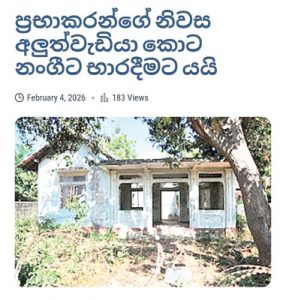
According to the reports, all this was taking place allegedly under a plan devised by the Valvettithurai Urban Council. Responsibility for the move was placed squarely on M. K. Shivajilingam, Chairperson of the Valvettithurai Urban Council and a distant relative of Prabhakaran. The reports were also accompanied by an image of the house which appeared to be still standing to date.
What started as a simple headline became a storm, feeding speculation, outrage, and more than a little misinformation, a perfect example of how a story can take on a life of its own once it leaves the pages of print and hits the chaotic world of online sharing.
The impact of the reports carried by at least one Sinhala language traditional media outlet and amplified primarily through online platforms in the South was immediate. Public reaction in the South was swift and intense, with widespread outrage taking hold.
Despite serious gaps and questionable claims that would have prompted any careful reader to pause, the headlines published by the mainstream outlet, echoed by digital media and aggressively shared by political activists aligned with Opposition parties, spread rapidly. Their timing, coinciding with the country’s 78th Independence Day celebrations ensured the controversy went well beyond a minor stir.
“What was the point of all that we sacrificed? Has it come to nothing?” a Major General of the Sri Lanka Army asked. He had believed every word of the reports, out of which at least two had been written by well-known journalists, one of whom frequently interviews former military personnel who played key roles in the country’s three-decade long armed conflict. The disappointment in the Officer’s voice was unmistakable. Meanwhile, members of the public took to social media to lambast the Government.
But it has since emerged that these articles were riddled with inaccuracies, disinformation and, at times, blatantly false claims. Whether this stemmed from the Southern media’s longstanding weakness in reporting on Northern issues, a failure to fact-check, or deliberate manipulation one can only guess. What is clear, however, is that the damage was immediate and its impact widespread. On social media, disinformation is given wings and a head start, while truth is asked to walk, arriving only after the damage has already landed.

Against this backdrop, it is necessary to unpack the claims on the topic made by various outlets as undoubtedly journalists and traditional media carry a duty to verify information and inform the public accurately, even and especially when some within the profession have let the side down.
The house in question
Today, the property known as ‘Rasinthan Manal’ belongs to Mathiaparanam Jegatheeswary, now 76 and living in India, a sister of the slain terror leader. She had received it from their parents years ago as part of her dowry. The land is currently managed and maintained by Nadarajah Anantharaj, a former Chairperson of the Valvettithurai Urban Council, who holds power of attorney on her behalf.
According to a BBC Tamil report in April 2010, the Sri Lanka Army completely demolished the house around that time. Today, all that remains is an empty plot of land and a fragment of a wall, where two banners hang, one wishing the late LTTE leader a happy 71st birthday, and the other displaying a photograph of the old house, marking the location where it once stood.
The proposal
Almost all media reports claimed that a proposal had been submitted to the Valvettithurai Urban Council on February 2 to renovate the ancestral home and hand it over to Prabhakaran’s sister or at least some variation of that claim.
A Sinhala daily alleged that the proposal had been presented by the Chairperson of the Valvettithurai Urban Council, M. K. Shivajilingam. The report quoted him as saying the house should be renovated for future generations, as has been done for the homes of other leaders around the world, and that it was, therefore, appropriate to hand it over to Prabhakaran’s sister. Another English website also said that the UC had taken a decision that the building must be reconstructed to reflect the original house in which he resided. However, these claims are far from the truth.
The so-called “proposal” is, in fact, a planning permission request submitted by Nadarajah Anantharaj on behalf of the title owner, Mathiaparanam Jegatheeswary. The plans submitted make it clear that her intention is not to reconstruct or renovate the original house, which would be impossible, as nothing of it remains but to build a two-storey study hall and library for community use. The building plan also shows that the new structure bears no resemblance to the old ancestral home, which no longer exists.
Shivajilingam also denied the quotes attributed to him by the newspaper. “I reject the quotes attributed to me. They are completely wrong,” he said, adding that he did not present any proposal either. “Permission has been sought by the relevant party to construct a two-story building, which was then submitted to the Urban Council for the necessary approvals, as per procedure,” he said, adding that he also did not make any proposal regarding the establishment of a memorial for Prabhakaran.
However, he did acknowledge that some members of the Urban Council had expressed the opinion that constructing a new building, different from the ancestral home, was inappropriate.
Some suggested that the new building should replicate the old house, and, if necessary, the owners could construct a library elsewhere. He added that this idea should be proposed to Jegatheeswary, the title owner.
Evidence of the discussion at the UC appears in a publicly available video shared on social media platform Facebook by Valvettithurai Urban Council member Counsel Mahalingam Mayooran. In the recording, Mayooran can be heard proposing that the new building should resemble the old house. Shivajilingam said that the Urban Council has received a request and can only work according to it, noting that they can communicate their opinion to the title owner, but only she can decide what can be done on her land. The muddle made by the media has now forced Shivajilingam to issue a press release explaining the decision by the UC to grant planning permission to Jegatheeswary as well as dispel various other associated rumours.
Taxpayer funding
The insinuation by the media reports that the UC thereby taxpayer money is to fund the project and once completed will be handed over to Jegatheeswary has also drawn public ire.
However, a party close to the land owner confirmed the construction will take place at her private expense and donors and not State funds as assumed by the public. “No discussions took place during the Council session to use funds from the Valvettithurai Urban Council” Mayooran said.
While what transpired may now be clearly substantiated by evidence beyond the immediate confusion and outrage, the real damage lies deeper.
Stories like these amplified, distorted, and shared without verification to fulfil an agenda do more than misinform, they erode trust between communities, deepen existing wounds from decades of conflict, and make the fragile work of reconciliation far harder. The previous case of Dr. Shanti is a clear example of this.
When misinformation about a sensitive site or figure spreads unchecked, it not only inflames emotions but also shifts attention away from constructive dialogue, public understanding, and community development.
In a society still healing from the scars of war even 17 years on, the cost of a headline is measured not only in clicks or outrage, but in the setbacks it imposes on peace, mutual respect, and the long journey towards reconciliation.