

By M.R. Narayan Swamy
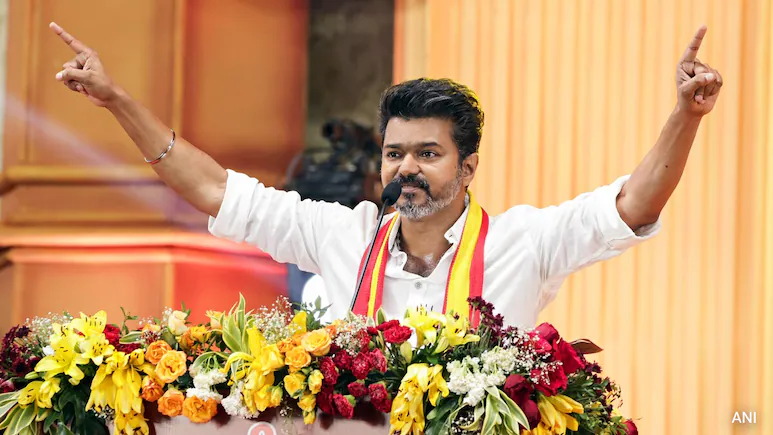
Tamil movie superstar, Vijay created history on Monday by leading his two-year-old TVK to be the single largest party in the Tamil Nadu Assembly in its very first election, winning seats tantalizingly close to a half-way mark and burying six decades of Dravidian rule in one of India’s economic powerhouses.
As counting of the millions of votes cast in the April 23 balloting continued across the state, election officials said the Tamilaga Vettri Kazhagam (TVK) was set to finish most probably with 107 seats in the 234-member Assembly where a winner needs 118 seats for a simple majority.
In political significance, the 51-year-old Vijay’s superb showing matched the sensational and sweeping victory of Prime Minister Narendra Modi’s Bharatiya Janata Party (BJP) in faraway West Bengal, one of India’s most difficult political turfs to conquer.
So punishing was Vijay’s electoral tsunami that outgoing Chief Minister and DMK stalwart M.K. Stalin lost by more than 9,000 votes in Kolathur, Chennai, to TVK’s V.S. Babu — a former DMK leader who had once overseen the constituency’s ground operations when it was created in 2011 and played a key role in securing Stalin’s maiden victory there. Stalin, who had represented Kolathur since its formation, had gone on to win the seat comfortably in 2021 by nearly 70,000 votes against his AIADMK rival.
According to trends from vote counting centres, the outgoing DMK led by Stalin was poised to win 72 seats and claim the second spot, pushing the present main opposition AIADMK to the third standing with 55 seats.
The Naam Tamilar Katchi (NTK), led by fiery orator Seeman — Tamil Nadu’s most vocal political supporter of Sri Lankan Tamil Tigers leader Velupillai Prabhakaran — failed to win a single seat, while Seeman himself lost his deposit in his own constituency of Karaikudi.
Until midday, the DMK, battered by the Vijay most unexpected electoral tsunami, was huffing and puffing at the third place, behind its traditional rival AIADMK, founded by the legendary M.G. Ramachandran and later led by J Jayalalithaa. A third place finish would have been humiliating for the DMK, one of India’s oldest political parties.
Even if the TVK fails to touch the magic mark of 118 seats, Vijay, one of the country’s highest paid actors, is widely expected to garner the legislative support of some smaller parties and form a government.
Vijay, born in 1974 in Chennai to a Christian father and a Hindu mother, made it clear in the run up to the elections that he was firmly opposed to the AIADMK-allied BJP, calling the DMK his political enemy and the BJP his ideological adversary.
If and when Vijay stakes claim to power, it would be the first time since 1967 that Tamil Nadu, India’s most urbanized state with 85 million people, will see a non-Dravidian party in Chennai’s Fort St George where the state secretariat is located.
A Vijay victory would also rekindle the way the AIADMK led by MGR, as the hugely popular actor Ramachandran was known, stormed to power in Tamil Nadu in 1977 and went on to rule the state until his death in December 1987.
But in contrast to Vijay, MGR could taste victory only five years after forming his party during which time he converted his whopping fan devotion into an institutional political machine.
The then undivided DMK stormed to power in Tamil Nadu, then called Madras, for the first time in 1967, ending decades of Congress rule on the strength of a powerful Dravidian movement that launched emotive campaigns against Hindi imposition as well as Brahminical domination of politics and administration.
Since then, Tamil Nadu has always been ruled by either the DMK or the AIADMK, which MGR founded in 1972 after breaking away from the DMK.
After Tamil Nadu voted on April 23 this year, most exit polls predicted that Vijay’s party would do pretty well on the strength of his popularity and could emerge as a kingmaker. One exit poll talked about an outright win for the TVK.
But the DMK, whose overconfident cadres had been lampooning Vijay and his party for some for two years, was confident of winning a second straight five-year term in power although critics had been warning about anti-incumbency.
Naturally, as the election results emerged, there were wild celebrations at TVK offices all over Tamil Nadu as well as in Vijay’s Chennai house. DMK supporters were stunned into silence, taken aback by the sheer scale of the party’s reverses.
Not only Chief Minister and DMK president M.K. Stalin, but also the party’s general secretary, Durai Murugan, along with several senior DMK heavyweights — including School Education Minister Anbil Mahesh Poyyamozhi — were defeated, election officials said.
For the first time in the Dravida Munnetra Kazhagam’s 77-year history, both its president and general secretary have lost their legislative seats in the same election
The Congress, the DMK’s long-term ally, also suffered losses.
It was in February 2024 that Vijay announced his retirement from films and his entry into politics with the launch of the TVK.
Political analysts credited the TVK’s victory march to Vijay’s popularity bordering on frenzy, his decision to go it alone against established political giants, and a well-oiled fan base that acted as ground-level workers and social media amplifiers.
In campaign speeches, he combined welfare promises with an anti-corruption message and vowed not to give space to communalism of any variety.