
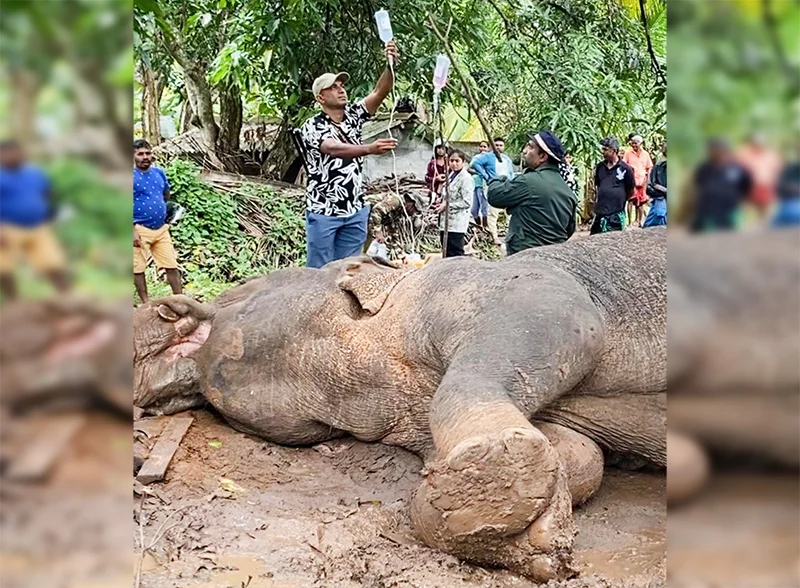

A university student who documented an alleged act of cruelty against a wild elephant in the Sippikulam–Ambagahawela area of the Mihintale Police Division in Anuradhapura has complained of injustice after wildlife authorities seized his mobile phone and failed to return it, raising serious concerns about freedom of expression and the protection of citizen whistleblowers.
The student filmed the incident in an effort to expose what was reportedly a brutal act of violence, in which a wild elephant was allegedly set on fire using torches. The footage later surfaced publicly, drawing widespread condemnation and renewed attention to the ongoing crisis facing Sri Lanka’s wild elephants.
Sri Lanka is home to an estimated 5,800–6,000 wild elephants, one of the largest remaining populations in Asia. However, the country also records one of the highest rates of human–elephant conflict, with nearly 300 elephants and around 100 people dying each year due to clashes, habitat loss, and retaliatory violence. Conservationists have repeatedly stressed that public awareness and documentation play a critical role in exposing cruelty and preventing further harm.
According to the student’s relatives, wildlife officers confiscated his mobile phone as part of the inquiry but have yet to return it, despite repeated appeals. They say the continued seizure has placed the student’s education in jeopardy, as the device contains essential lecture notes, academic materials, and personal documents required for university examinations scheduled in January.
Family members said the student has clearly informed wildlife officials that the phone is indispensable for his studies. The prolonged withholding of the device, they claim, has caused him severe mental distress and uncertainty.
Rights advocates argue that the case highlights a troubling pattern where individuals who document environmental crimes or animal abuse face undue hardship instead of protection.
Image: The burned and injured elephant were treated by veterinarians.
They stress that filming and sharing evidence of wrongdoing—particularly in matters of public interest such as wildlife protection—is a legitimate exercise of freedom of expression and a vital tool for accountability.
Observers warn that punitive or excessive actions against citizens who expose cruelty risk discouraging others from speaking out, ultimately undermining transparency, environmental justice, and democratic freedoms. The student’s case has renewed calls for authorities to safeguard the rights of individuals who act in the public interest while addressing wildlife crimes swiftly and transparently.
Related:
News
Burnt elephant dies after delayed rescue; activists demand arrests
A 55-year-old wild elephant that suffered severe burn injuries at Seeppukulama succumbed to death around 4.00 p.m. yesterday, despite treatment by the Department of Wildlife Conservation (DWC), sparking outrage among wildlife activists and renewed calls for accountability.
Wildlife Conservation Publicity Director Hasini Harishchandra told The Island that the injured elephant had gone missing for a period after the incident and was later located in another area, after which veterinary treatment was initiated.
“We were providing saline and other medication, but the injuries were extensive,” she said, confirming that the elephant died while under treatment.
According to wildlife activists, the elephant had allegedly been set on fire by villagers at Seeppukulama, causing critical burns across large parts of its body. Graphic images and videos circulating on social media intensified public anger, with many questioning the speed and seriousness of the official response.
Elephant activist Panchali Panapitiya, speaking to The Island, accused authorities of failing to act swiftly. “This elephant was burnt by fire by villagers. It was badly injured and in immense pain. The Director General of Wildlife Conservation is yet to ensure timely treatment and, more importantly, arrest those responsible,” she said.
She stressed that the incident was not an isolated case but part of a disturbing pattern of violence against wild elephants, amid escalating human-elephant conflict. “If perpetrators are not arrested and prosecuted, these crimes will continue. Strong action is the only deterrent,” Panapitiya added.
Environmentalists and conservationists say the death of the elephant underscores systemic failures in wildlife protection, particularly in conflict-prone areas where elephants are increasingly targeted with firecrackers, explosives and now fire itself.
They called for an immediate criminal investigation, arrests of those involved, and stronger ground-level intervention to prevent such acts of cruelty.
As public anger mounts, pressure is growing on the DWC and law enforcement authorities to demonstrate that the killing of a protected animal will not go unpunished.
By Ifham Nizam/ The Island. 2025/12/17