
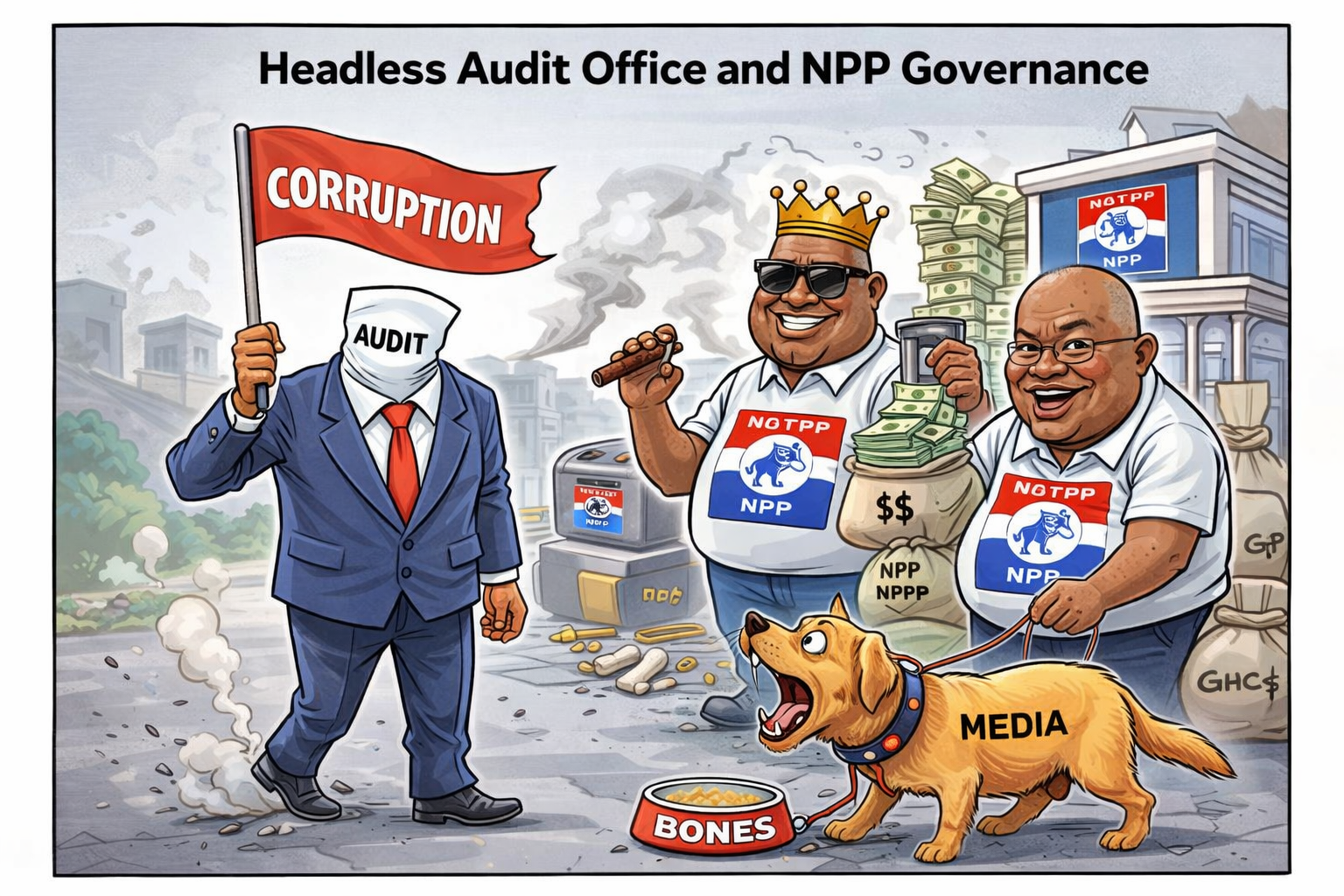

Headless Audit Office – Editorial, The Island.
The National Audit Office (NAO) has remained headless since last month. It was under an Acting Auditor General for about nine months from April 2025. The longstanding vacancy at the highest level of the supreme audit institution in the country and deplorable attempts being made to appoint a crony of the ruling party as Auditor General (AG) will severely erode the confidence of investors and donors. The post-Ditwah rebuilding programme requires donor assistance, which is not likely to be forthcoming if the NAO remains without a head. This situation would not have come about if President Anura Kumara Dissanayake had nominated a senior official in the NAO for the post of AG. Instead, he nominated less qualified outsiders and the Constitutional Council (CC) rightly refused to approve those nominations.
The Opposition has argued that the government is desperate to appoint one of its loyalists as AG due to the sheer number of questionable deals on its watch, some of the high-profile ones being the green-channelling of 323 red-flagged freight containers in January 2025, the coal scandal, the Ondansetron or pharmaceutical procurement scam, questionable rice imports and controversial pickup truck deal. They have the potential to bring down what has been touted as the central pillar of the NPP government—the much-advertised anti-corruption campaign
At the time of going to press, pressure was mounting on the government to reveal a foreign laboratory report on substandard coal stocks procured for power generation. The Energy Ministry has refused to accept the results of tests conducted by a state-owned laboratory, which found the coal stocks substandard. Coal samples were then sent to a laboratory in India for testing, and the Frontline Socialist Party has said the test results have been submitted to the government, but it is keeping them under wraps as part of a grand cover-up.
SJB MP Dr. Harsha de Silva, who has evinced a genuine interest in resolving the NAO issue, has gone on record as saying that President Dissanayake sought his assistance to put the matter to rest, but the Speaker prevented him from communicating with the CC members. It was a case of the President proposing and the Speaker disposing, as we said in a recent headline.
The current CC has lived up to the expectations of the campaigners for good governance mainly thanks to its intrepid civil society members, who have become an effective counter-balance. The government is allegedly biding time until the reconstitution of the CC and the exit of the civil society members who have frustrated its efforts to appoint one of its cronies as AG. Speculation is rife that the JVP/NPP will do everything in its power to make the CC a mere rubber stamp for the President.
The AG must be free from executive control to ensure unbiased scrutiny of government accounts. He or she is required to perform multiple tasks impartially to strengthen good governance, some of them being ensuring financial accuracy, preventing misuse, evaluating performance, reporting to Parliament, reinforcing accountability, and supporting governance reforms. If the President succeeds in parachuting an outsider with NPP links into the post of AG, over the eligible candidates in the NAO, that person will naturally be beholden to the government, compromising the integrity of the vital institution. Such an appointment, tainted with politics, will run counter to the letter and spirit of the 21st Amendment to the Constitution, which was introduced to reinforce independent institutions, restore mechanisms for transparent appointments, and uphold good governance.
The Police Department has become a malleable tool for the ruling party. The Executive’s pressure tactics have compromised the autonomous decision-making powers of the Attorney General to a considerable extent. Only the judiciary is still held in high esteem as most of its decisions have so far embodied certain core hallmarks that uphold fairness, legitimacy and public trust. One can only hope that it will continue to safeguard its independence vis-à-vis the hostility of meddlesome politicians. It may be recalled that the previous government sought to summon some Supreme Court (SC) judges before the parliamentary Committee on Ethics and Privileges over an interim order that cleared obstacles to conducting elections. The order was given by a three-member SC bench, comprising Justice Preethi Padman Surasena, (who became Chief Justice), Justice Janak de Silva and Justice Priyantha Fernando, allowing the consideration of a fundamental rights petition filed by the SJB. Fortunately, sanity prevailed and the SLPP-UNP administration walked back its decision.
The laudable objectives that the 21st Amendment to the Constitution was expected to help achieve remain unattainable. The NPP Manifesto, A Thriving Nation: A Beautiful Life, pledges to “Improve public finance efficiency, transparency, governance and accountability, and eliminate unnecessary public expenditure” (p. 57). It also promises “merit-based appointments and promotions” (p. 110). How can a government ensure public finance efficiency, etc., without an AG independent of the Executive and free from any conflict of interest or quid pro quo? It is imperative that the most suitable official in the NAO be appointed as Auditor General urgently
20.01.2026