
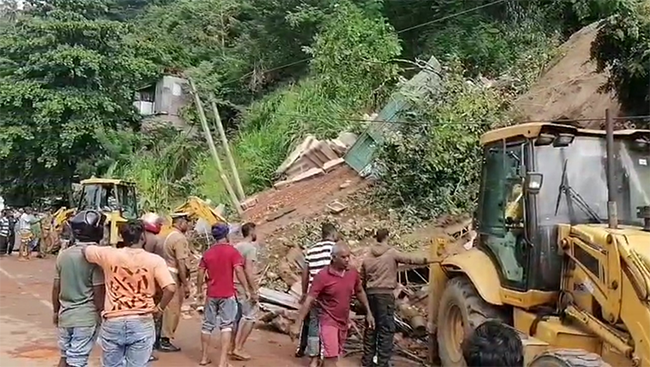

By Savani Sheashadhi/Ceylon Today.
The stretch of road that climbs gently through Kadugannawa on the main Colombo to Kandy route is one of the most scenic corridors in the country. Many travellers stop there to savour a steaming cup of tea, perhaps with a slice of warm roast bread and a spoonful of spicy kochchi sambol, or to enjoy a portion of ash plantain curry or a hearty stew. It is widely known that people often halt their journeys at these wayside eateries to enjoy such treats. Numerous stalls line both sides of this roadway, catering to the constant flow of visitors.
Yet many of these small shops are unauthorised constructions. This has been known for quite some time, but no one appeared eager to take meaningful steps to address the issue. Such neglect came to a tragic culmination recently, when a landslide claimed the lives of six people.
Kadugannawa is a highly sensitive geological zone, vulnerable to landslides, rockfalls and similar disasters due to its terrain and underlying geological makeup. In such areas, all construction and development work must be meticulously planned. Unregulated building increases the inherent risks of the region even further. Ordinary methods cannot be used when erecting structures in such locations. Thorough study is essential, and specialised technical measures are required.
In a discussion with Ceylon Today, Laksiri Indrathilaka, Senior Geologist at the National Building Research Organisation (NBRO), warned of the growing threat posed by landslides, intensified by unplanned development and changing land-use patterns.
According to Indrathilaka, stretches such as the 97th to 100th mileposts in Kadugannawa forms an extremely sensitive belt prone to landslides and rockfalls. Several such incidents have been recorded in this zone over the past few years. Constructing anything in such a location demands great caution. One cannot simply build at every point along this road. The beauty of the landscape or the convenience of roadside facilities does not make it suitable ground for construction. Land should only be used in ways that do not damage it. Ignoring this fundamental principle invites painful retaliation from nature.
Kadugannawa between the 99th and 98th mileposts
Along certain sections of this route, the main road has been built directly upon exposed bedrock. Elsewhere, the southern embankment of the road has been shaped by filling earth, breaking fallen rock or using newly placed boulders. The embankment near the 99/5 and 96 markers, located between the 99th and 98th mileposts, is particularly old. It is this section that has recently begun to slip. The landslide that occurred last Saturday near the 97th milepost has further destabilised the slope, and fragments of rock now suspended midway pose a continuing threat. There remains a real risk of more material collapsing onto the road.
Identifying a landslide-prone area
Two main methods are used to identify a landslide-prone area. The first relies on hazard zonation maps, which simply indicate that there is a likelihood of a landslide occurring. Experienced geologists examine the terrain and, after assessing geological structure, soil layering, soil density, hydrological factors, ground inclination, landform characteristics and prevailing land-use patterns, they determine the level of risk shown on these maps. Based on these evaluations, landslide hazard maps are drawn, categorising areas as high, medium or low risk. These maps, which show the probability of landslides, are frequently used as essential tools when planning development projects.
The second method is on-site inspection. When geologists and engineers suspect that a certain location may be at risk of landslides, they conduct a thorough field assessment. This involves examining visible early warning signs as well as other geological features. Landslides are usually preceded by clear indicators. These may include cracks forming in the ground and the sinking of earth along those fractures, cracks appearing in existing buildings, roads and other structures, the gradual widening of those cracks, and the tilting of buildings, trees, electricity poles and telephone poles towards the slope.
In the upper areas of a slope, curved cracks aligned perpendicular to the slope can often be observed. In some cases, irregular fissures appear in the upper ground. The land may begin to lift in certain sections, causing building walls to rise or tiles to loosen and fall. Wells, ponds and other water sources located higher up may suddenly dry up. In the lower sections of a hill or slope, muddy springs can emerge. These warning signs vary from place to place.
The portion of land that detaches completely during a landslide, together with the area where the debris is believed to settle once the slide becomes active, is classified as a high-risk zone. Land believed likely to face threat if the slide continues to develop is classified as medium risk. The low-risk zone comprises people living in areas that would only face danger if both the high-risk and medium-risk sections were affected by a severe landslide.
14,184 landslide-prone locations
At present, 14,184 landslide-prone locations have been identified across fourteen districts: Badulla, Nuwara Eliya, Kandy, Matale, Kegalle, Ratnapura, Kalutara, Galle, Matara, Hambantota, Kurunegala, Moneragala, Gampaha and Colombo. Of these, 12,265 are rural houses and 1,919 are estate houses or buildings. Among them, 2,779 rural homes display severe early-warning signs. Another 7,876 fall into the medium-risk category, while 1,610 are considered low risk. Among estate buildings, 258 are high risk, 1,199 are medium risk and 462 are low risk.

Badulla at highest risk
The district with the highest risk is Badulla, where 2,959 rural homes and estate buildings are categorised as high risk. Ratnapura has 2,548 rural homes at risk, Kandy has 2,089 rural and estate buildings, Kalutara has 1,987 rural homes, Matale has 1,344 rural and estate houses, and Nuwara Eliya has 1,183 such dwellings identified as high risk.
Although authorities have attempted to relocate the identified at-risk families to safer ground, this has proved difficult for several reasons. Some residents are reluctant to leave the homes they have lived in for generations. Finding suitable, safe land for resettlement is another significant challenge. Even when such land is identified, it is often economically valuable. If that land is already cultivated, removing the crops to settle people there can create long-term economic problems.
Short-term Cultivation Risks
Because of changing land-use patterns, some areas that were not previously categorised as hazardous have now become high-risk zones. For instance, a plot of land used for many years to grow rubber or another long-term crop can become unstable once the crops are removed and short-term cultivation begins. Similarly, turning former plantation land into residential plots can also make the land vulnerable.
Short-term cultivation leaves the soil continuously exposed to rain, which increases the danger. In flat terrain, farmers sometimes divert water from higher ground through unregulated channels to fill ponds or storage tanks, and this too can destabilise the land. When land-use patterns shift in this way, regions that were once considered safe can be transformed into hazardous terrain. These are mostly not natural causes but the result of human activities.
While both natural conditions and human actions influence landslide risk, the increase in unsafe development has now become the primary driver of landslides across the country. Disasters have intensified because of activities that are unsuitable for the terrain. During investigations, when experts identify a location suspected of being prone to landslides, this pattern becomes even clearer.
Classification of Landslides
Landslides are classified in several ways based on how they occur. These include landslides, slope failures, rockfalls, hill collapses and subsidence. Landslides are driven almost entirely by natural factors, but hill collapses are caused entirely by human activities. Today, the most frequently reported incidents are hill collapses and related disasters triggered by unauthorised development. In unplanned development, the most common problem is the obstruction of natural water flow paths. In some cases, the accumulated debris from landslides blocks the natural routes through which soil should move.
Places naturally shaped for the flow of rainwater are known as valleys or gullies. However, some people, lacking proper understanding, misinterpret these as dry valleys or dead gullies. They may not always carry flowing water, which leads some to assume they are harmless. For this reason, such land is often used for housing or other development. Yet even if water does not flow through these depressions all the time, rain inevitably sends water rushing along these paths. When a natural watercourse is blocked by construction, the water fails to drain downwards and instead accumulates in the upper slope. Prolonged saturation of these upper slopes causes instability and can ultimately trigger landslides.
15 collapses in Ratnapura
Between 20 and 24 November alone, fifteen hill collapses were reported from the Ratnapura District. Every year, numerous such incidents occur during the rainy season. More than half of all reported disasters fall into this category.
In many hill-country areas, homes and other constructions stand on sloping or mountainous terrain. Developers often cut into a hillside, level the ground, and then extend the plot by filling in soil at the front to create extra space. This completely alters the natural stability of the land. Once the soil and rock that kept the slope secure are removed, the hill loses its ability to remain stable. Although the soil may hold for a certain period due to its natural engineering properties, its strength diminishes over time, increasing the likelihood of collapse.
Whenever a slope is cut for a house or another structure, a supporting retaining system is essential. If a cut slope exceeds 1.5 metres in height, a support structure must be built. However, most hill-country houses have slopes rising eight to twelve feet directly behind them, creating a significant hazard. The probability of such slopes collapsing is extremely high. The time it takes for a collapse varies, potentially occurring five to fifteen years after the slope has been cut. Geological conditions, soil composition, the volume of water accumulating in the area and similar factors all influence the timing. The angle of the slope and the height of the hill also play a role. If the hill does not extend much further upward, the risk decreases. If the hill rises significantly beyond that point, the risk is greater.
The height of the slope and the distance between the building and the cut face are also crucial. For safety, this gap should increase proportionately with the height of the slope. If a slope is eight feet high, the building should be set back more than eight feet. This spacing does not prevent a collapse, but it reduces the chance of the building being damaged if one occurs.
If constructing a support system is not feasible, the building must be designed in a way that accommodates the natural placement of the slope. Proper drainage systems must also be installed to manage water that collects in the upper regions.
Unfortunate reality: Nobody Cares
However, the unfortunate reality is that hardly anyone follows these guidelines. At best, only part of the instructions is observed. Even when people obtain numerous certificates from the relevant authorities, many ignore the conditions or instructions that accompany them, and this neglect becomes the root cause of many problems. Merely receiving official guidance does not eliminate risk. The moment those instructions are abandoned, the groundwork is laid for future tragedy.
Another challenge is that slopes and embankments seldom display clear early warning signs before failure. They often collapse without notice. At times there may be a minor initial slip, with a small amount of soil breaking away. This can often be removed with a simple spadeful of earth. The second stage may bring a more significant slip. If that too is ignored, the entire slope can give way all at once.
Many people pay little attention to such early indicators. If water begins to seep continuously down the face of the slope, the danger becomes even greater. Increased rainfall adds to the volume of water accumulating in the soil, and the likelihood of a landslide becomes far higher.