
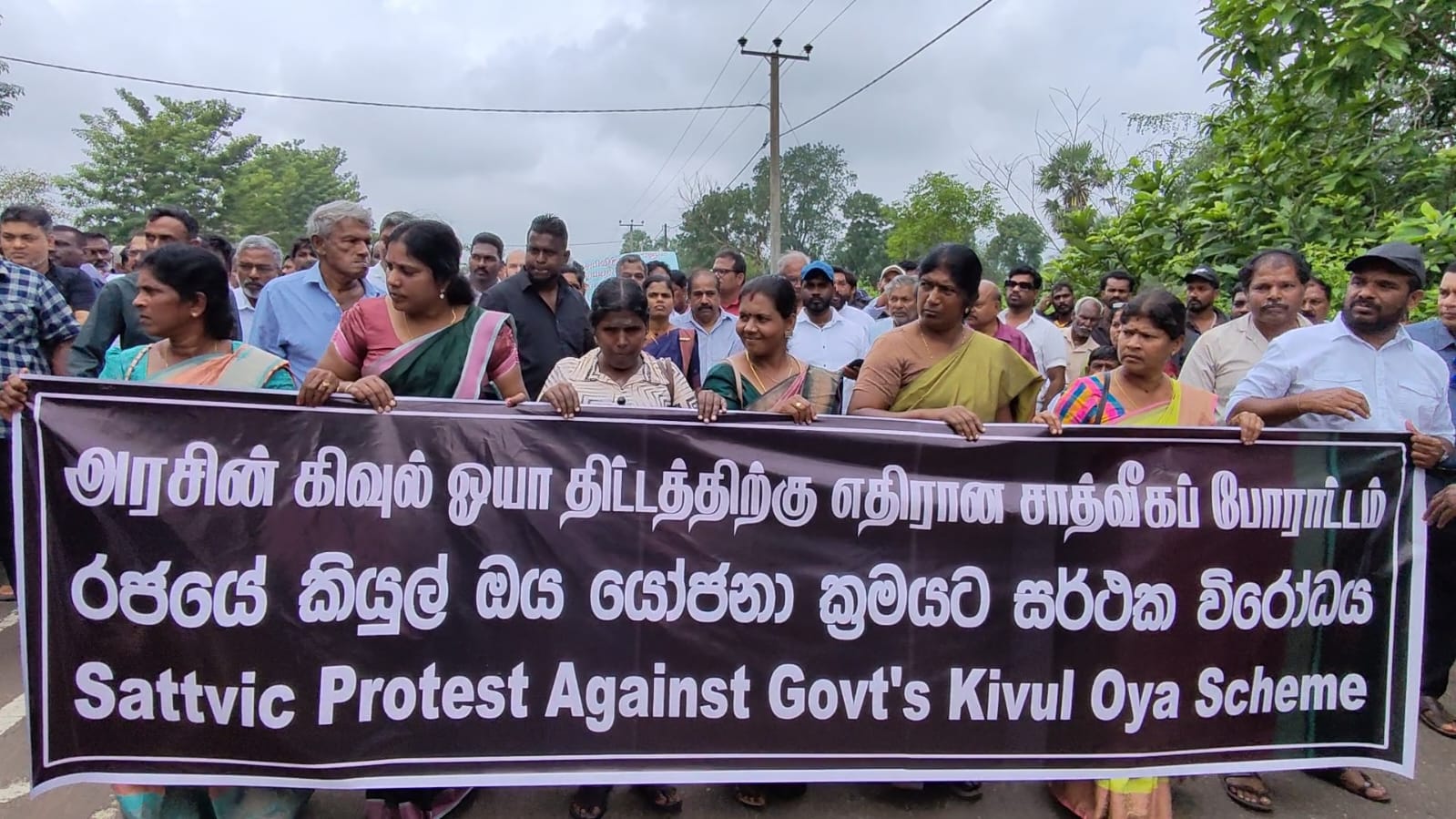

The revival of the long‑stalled Kivul Oya Development Project under the Mahaweli L Scheme has triggered renewed fears among Tamil communities in Vavuniya and Mullaitivu, who warn that the project represents the latest attempt to dispossess them of their ancestral lands under the guise of development. The Centre for Policy Alternatives (CPA), which first raised alarm bells more than a decade ago, says the project’s reactivation in January 2026 threatens not only livelihoods but also the fragile ethnic balance and long‑term coexistence in Sri Lanka’s North.
Approved originally in 2011 during the Rajapaksa administration, the project stalled but never disappeared. Newly uncovered documents indicate it was revived in 2019 and then again under the current government. Tamil residents see a clear pattern: development schemes used as political cover for land alienation and Sinhalese settlement expansion in predominantly Tamil regions. Similar concerns were noted in CPA’s 2011 report on land issues in the Northern Province, which documented state-led attempts to redistribute land in ways that altered demographics following the civil war.
Massive Land Confiscations and Unequal Settlement Plans
The most pressing concern for affected communities is the confiscation of 1,615 acres of paddy land belonging to Tamil farmers, land they have cultivated for generations. According to a letter submitted by local Tamil residents to the Mullaitivu District Secretary, these acquired lands span multiple villages, including Uththarayankulam (Nelunkulam), AmayanKulam (Kiribanweva), Kulavadukkulam, and parts of Kokkuthoduvai and Kokkilai, among others.
Even more alarming is the revelation that more than 7,000 Sinhalese settlers are expected to be resettled in the Mahaweli “L” zone under the project — while no land allocations have been identified for the Tamil communities living in the area. Tamil residents argue this represents a deliberate attempt to engineer demographic change, turning a historically Tamil region into a Sinhalese-majority zone.
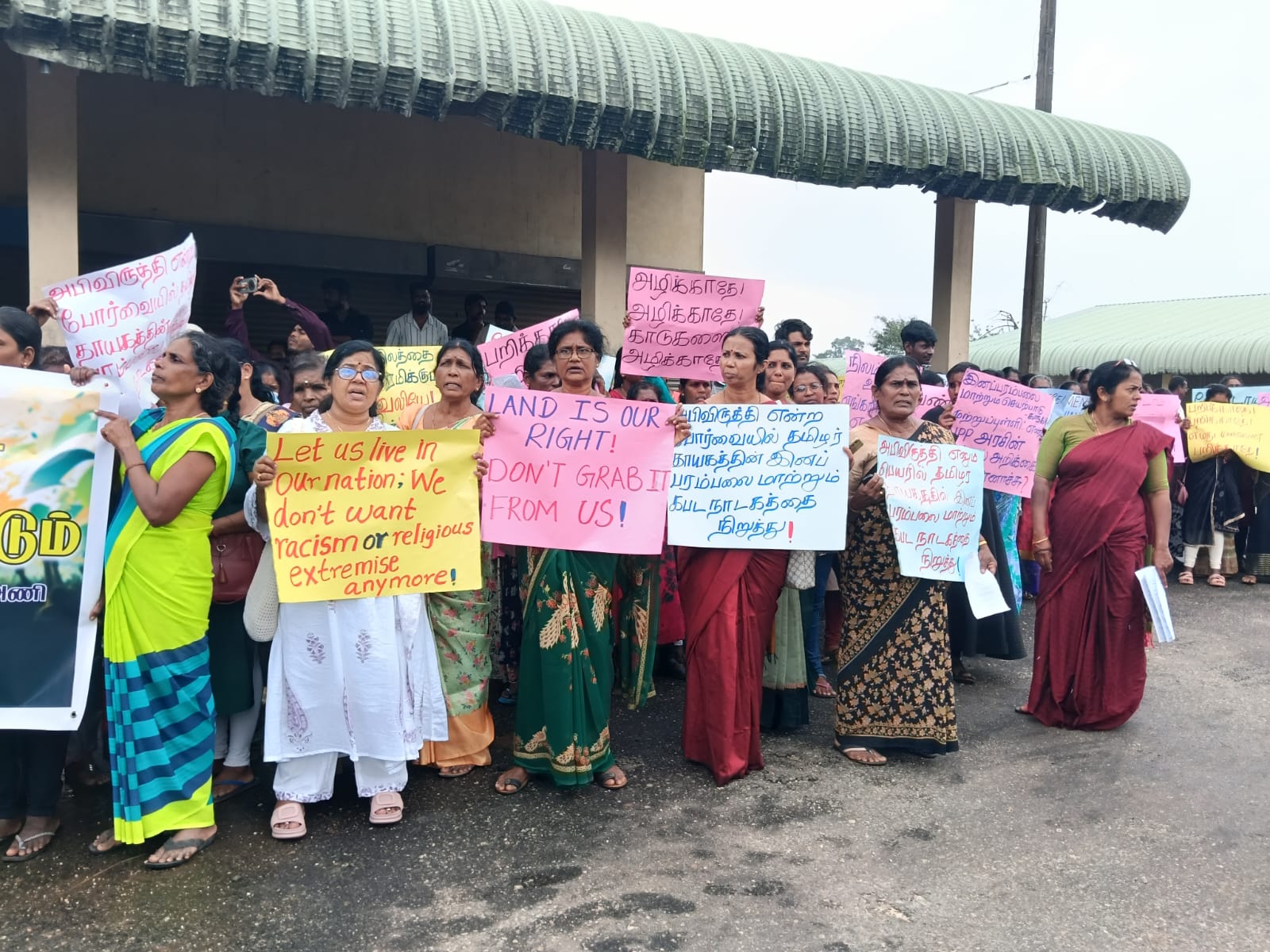
Such concerns are not unfounded. The Mahaweli system has long been associated with demographic transformation, particularly in the North and East, where successive governments have used irrigation and development schemes to introduce new settlements. CPA stresses that land has been a root cause of conflict, and tampering with ownership and use in ethnically‑mixed regions risks reigniting old tensions.
Environmental Losses that Deepen Community Vulnerability
Beyond land alienation, the project threatens key environmental resources relied upon by Tamil communities. The Environmental Impact Assessment (EIA) for the project predicts the loss of 2,500 hectares of forestland, worsening the already severe human‑elephant conflict in Mullaitivu and Vavuniya. The government proposes Rs. 720 million for reforestation and Rs. 100 million for electric fences—but affected villagers say these measures cannot compensate for the destruction of shared ecosystem resources.
Small irrigation tanks—Ramankulam, Kottodaikulam, Vellankulam, Periyagattukulam, and more—face submersion or damage. These tanks support village‑level agriculture that is central to Tamil livelihoods and cultural traditions. Their loss directly undermines food security for thousands of families.
Additionally, ancient Tamil villages such as Kattupūvarasankulam, Kanchuramottai, and parts of Maruthodai are at risk of becoming water‑retention zones under the proposed reservoir. The threat extends beyond land loss to a potential erasure of centuries‑old cultural and archaeological heritage.
Government Persistence Despite Protests and Legal Challenges
Tamil residents, civil society actors, and Tamil political parties have repeatedly protested the project’s revival, arguing that it is being pushed through despite its potential to devastate minority livelihoods. The government’s approval in January 2026 comes on the heels of a controversial March 2025 gazette that attempted to alter land ownership structures in the Northern Province. That gazette was eventually withdrawn after widespread protests and a Supreme Court challenge.
Yet, the Kivul Oya revival signals a continuation of the same approach: major policy decisions on land undertaken without community consultation, transparency, or sensitivity to historical grievances. Critics note that land appropriation efforts in the post‑war years—2009–2015 and again in 2019–2022—were frequently driven by ethno‑nationalist motives, often backed by militarisation and centralised state authority.
Escalating Fears of Renewed Conflict
With memories of wartime displacement still fresh, Tamil communities fear that the project is not simply about irrigation and agriculture but a deliberate restructuring of territory. For an area already strained by demographic pressure, militarisation, and livelihood insecurity, the introduction of thousands of settlers raises fears of marginalisation and cultural dilution.
CPA warns that pursuing development without addressing land rights risks triggering new conflict dynamics, as land remains deeply tied to identity, security, and political autonomy for Tamil communities.
A Call for Rights‑Based Development
Advocacy groups argue that genuine development cannot occur without respecting the land rights of those who have lived in the region for generations. They call for:
- An immediate suspension of the project pending full community consultations
- Transparent disclosure of all land acquisition plans
- Restoration of confiscated land to displaced Tamil farmers
- A rights‑based framework that prioritises equity, historical justice, and reconciliation
Without these steps, they stress, the Kivul Oya project risks becoming yet another chapter in the long history of state‑led land dispossession in Sri Lanka’s North—deepening grievances instead of healing them.
Full report:Land Ownership, Use, Alienation & Development- Revisiting the Proposed Kivul Oya Project v2
Read more on Tamil Guardian