


Transparency International Sri Lanka (TISL) strongly urges the Government to withdraw proposed amendments that would weaken meaningful public access to asset and liability declarations – one of the most important transparency and accountability reforms introduced through the Anti-Corruption Act, No. 9 of 2023.
Asset declarations require persons entrusted with public power to disclose their assets, liabilities and financial interests. They are a key safeguard against unexplained wealth, conflicts of interest and the concealment of assets acquired through corruption. Under the Anti-Corruption Act, the Commission to Investigate Allegations of Bribery or Corruption (CIABOC) serves as the Central Authority responsible for administering these declarations and making redacted versions available to the public.
Making asset declarations accessible to the public was a major step forward in Sri Lanka’s anti-corruption framework. It gave practical meaning to the principle that those who exercise public power must be open to public scrutiny. Meaningful access enables journalists, civil society, academics and citizens to identify inconsistencies, expose potential conflicts of interest and question whether the wealth of public officials can be explained by their lawful income. Without that scrutiny, asset declarations are a mere closed administrative exercise rather than an effective tool for accountability.
The Anti-Corruption (Amendment) Bill gazetted on 24 July 2026 would reverse this reform.
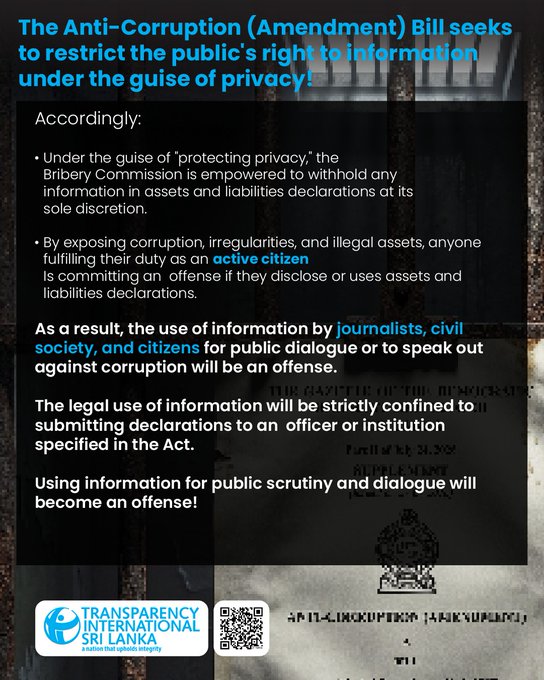
Most concerningly, the Bill seeks to police how citizens use information expressly made available to the public. By limiting the use of an asset declaration to submission to an institution or officer specified in the Act, it effectively strips public access of its wider purpose as a tool for public scrutiny, accountability and informed discussion. Criminalising the use of information lawfully made available to the public is a serious infringement of the right of access to information and freedom of expression. It would also discourage the very scrutiny that can expose hidden wealth, conflicts of interest and possible abuses of office.
The Bill would also give the Central Authority broader discretion to redact any information that it considers would violate privacy, without establishing any clear criteria. This creates the serious risk that information necessary for meaningful public scrutiny will be withheld. Public access is of little value when declarations are so heavily redacted that the public cannot reasonably assess the financial interests of those exercising public power.
The Bill removes the requirement to disclose the assets and liabilities of a person who has lived with the declarant for at least six months. Assets can be held in the name of a cohabiting partner or another person within a shared household while the public official continues to control, use or benefit from them. Removing this information would create an obvious route for concealing wealth and make it more difficult for authorities and the public to verify declarations, identify beneficial ownership and detect unexplained or disproportionate assets.
These amendments are especially troubling because the Government came to power on an explicit platform of fighting corruption and strengthening transparency and accountability. The mandate it received it to dismantle the systems of secrecy and impunity that allow corruption to flourish. Weakening the asset declaration framework directly contradicts that mandate. A Government elected on a promise of anti-corruption cannot now make it easier to conceal assets, harder to examine public officials’ wealth, and risk imprisonment for citizens who have the right to use publicly disclosed information.
TISL therefore calls on the Government to:
• Remove the proposed restrictions and criminal offence relating to the legitimate public-interest use of asset declarations.
• Retain the requirement to disclose information concerning persons who cohabit and share mutual rights and obligations with a declarant, while protecting their personal details from public disclosure; and
• Clearly and narrowly define in law the information that may be redacted, rather than granting the Central Authority broad discretion to determine what information should be withheld.
Those in public office are subject to a social contract, where they accept a higher level of scrutiny in return for holding power within the doctrine of public trust. As such, there is a clear, established rationale for subjecting public officials to public scrutiny.
Existing laws on defamation, harassment and related offences already provide avenues to address the misuse or abuse of information. There is, therefore, no justification for imposing broader restrictions on the legitimate use of information that has been lawfully made public. The right of access to information is constitutionally recognised, and therefore all laws and governance frameworks must give practical effect to that right, rather than weaken or restrict it.
The Government, Parliament, and relevant public institutions must protect the progress achieved under the Anti-Corruption Act in 2023 and ensure that any amendments strengthen, not dismantle, the public’s ability to hold those in power accountable. Asset declarations are effective only when they disclose meaningful information and when the public is free to scrutinise that information. Anything less reduces this hard-won accountability reform to an empty exercise.