
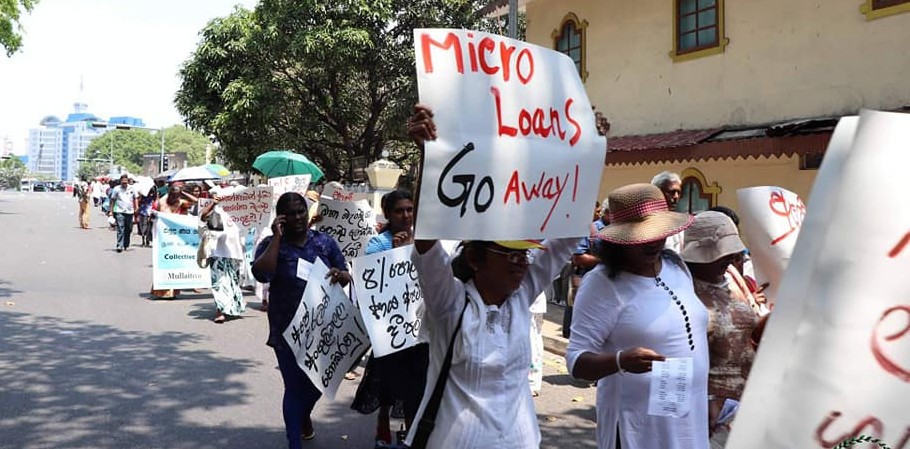

- Financial experts opine that the solution to the microfinance crisis lies in community credit lending practices
- NPP elections’ manifesto promises to ‘take measures to alleviate the burden of predatory microfinance loans on women’
- Large financial institutions at one point operated as a mafia and provided ‘quick and easy loans’ to people at high interest rates
The surge in unregulated and predatory microfinance practices has made many individuals at the grassroots level vulnerable to mounting debts. After the year 2000, large financial institutions with access to international financial markets entered the microfinance business. At one point it operated as a mafia, providing ‘quick and easy loans’ to people at high interest rates. However, after much protests and community interventions the new Microfinance and Credit Regulatory Authority Bill (gazetted in October 2023) and then amended due to protests and re-gazetted in November 2025 proposes to regulate community-controlled credit providers instead of big finance companies.
 We don’t provide loans based on requests from Central Bank or foreign loans. Previous governments have supported us and even certain projects such as United Nations. But nobody thought these organisations would expand and become a challenge to commercial banks and finance companies
Renuka Bhadrakanthi, Representative of the Integrated Community Development Women’s Federation in Weligepola, Balangoda
Concept of microcredit
In Sri Lanka, microcredit was practised as early as the 1900s by Credit Cooperatives. Many community groups, especially village women’s groups, provide microcredit loans to their members through savings built over the years. Governments back then facilitated Community-Based Women’s Organisations (CBOs) to engage in microcredit and savings schemes. This was initially done under the Janasaviya programme (1980s), later under Government-sponsored Rural Development programmes (1990s), and also with assistance from international organisations such as the UN.
As the agrarian crisis escalated, Death Donation and Welfare Societies (Maranadara Samithi) in villages, among other community initiatives founded on the principle of mutuality and mutual aid, started lending to their members using savings from membership fees. CBOs, Death Donation and Welfare Societies, and others provide lending services as a social good. Their services are provided at low interest rates, offered under flexible conditions (terms of payments) without profit-making motives.
However, according to community leaders the proposed Bill frames all microcredit providers registered as voluntary organisations or societies as moneylenders. The sustainability of grassroots organisations is threatened as they are labelled as moneylenders. They claim that it denies their autonomy as Community-Based Organisations and grassroots societies to appoint members to positions of management. It also affects determining interest rates, which are usually determined democratically through General Assembly Meetings of respective organisations.
Questionable clauses
Several unclear and questionable clauses have also been highlighted. For instance, Clause 5 (3) b of the Bill states that at least one woman would be represented in the Authority. But according to activists, this is inadequate as many consumers are women. Therefore, one of the demands is that at least half of the officials appointed to the Authority should be women.
Clause 72 of the Bill indicates expanding the Credit Information Bureau (CRIB) to the grassroots level. According to Political Economist Amali Wedagedara, the CRIB says that it is a database of borrowers. “But it harms low-income borrowers because the current financial system makes it difficult for them to be good, creditworthy debtors (servicing their debts regularly). The majority of low-income people are listed as bad debtors, as many of them have defaulted. CBSL and Treasury see them as willful defaulters (not as a problem of the financial system). Bad debtors are either denied new loans from banks, finance companies, or even Samurdhi. Or some finance companies lend them money at higher interest rates, transferring the risk of lending to the borrower,” she explained.
Therefore, according to Wedagedara, by expanding the CRIB to grassroots organisations, there is a risk of people being excluded and pushed into the hands of moneylenders.
A blow to community-controlled credit lending practices?
The NPP elections manifesto promises to ‘take measures to alleviate the burden of predatory microfinance loans with high interest rates on women’. Under the section on ‘Macroeconomic Stabilization’ the manifesto mentions providing relief to deprived parties after reviewing microfinance loans provided in violation of legal provisions and guidelines given. But according to Suneth Aruna Kumara, representing the National Collective of Community Savings and Credit Service Providers, the new Microfinance and Credit Regulatory Authority Bill doesn’t seem to favour victims of the microfinance crisis. He made these remarks during a recent media briefing held in Colombo.
In his comments, he said that the solution to the microfinance crisis lies in community credit lending practices. “While providing solutions to victims of the microfinance crisis we gave our suggestions to introduce a Bill to regulate Community-controlled credit lending practices. Even though these suggestions were obtained they never introduced these suggestions to the existing Bill. The Bill will be tabled in Parliament and there will be a second reading. But we urge this government to implement the Bill in a lawful manner. We see this as a Bill that would destroy community credit lending practices in rural villages. In the past many political parties became unpopular among the public. Therefore the government should discuss with victims of the microfinance crisis and incorporate their comments and suggestions,” he added.
An urgent call to hold community consultations first
Renuka Bhadrakanthi representing the Integrated Community Development Women’s Federation in Weligepola, Balangoda said that over the past 30 years they have been able to establish a fund from people’s contributions and that they disburse loans through that. “We don’t provide loans based on requests from Central Bank or foreign loans. Previous governments have supported us and even certain projects such as United Nations. But nobody thought these organisations would expand and become a challenge to commercial banks and finance companies. Now people try to obtain credit from a community-controlled credit lending organisation to purchase a vehicle without going for a lease. These organisations are registered under the Voluntary Social Services Organisations Act No. 31 of 1980 or Trade Union Ordinance No. 14 of 1935. Then there are others that haven’t been registered at all. The government should in fact provide facilities for us to conduct audits because it is a costly process when conducted through private entities,” she added.
Explaining the process with which these organizations provide credit to borrowers, Bhadrakanthi said that an individual should have minimum six month’s membership in order to be eligible to apply for credit. “We check every project and provide credit only for deserving people. We initially started with Rs. 3000 and now our starting amount is Rs. 5000 and going up to a maximum of Rs. 500,000,” she added. She further said that the new Bill hasn’t defined what microfinance is and what community-controlled credit is. “Community-controlled credit lending practices persist at rural level and our request is to avoid regulating these organizations similarly to how they are planning to regulate microfinance companies. Community-controlled credit organizations are diverse and their role is different and their main task is not provide loans. Lending money is just a small part of our work. We don’t oppose the regulation of credit lending organizations, but they shouldn’t regulate grassroots organizations through this Bill. In fact they should add a new chapter on regulating community-controlled credit lending organizations. Or else they should introduce a fresh draft after holding discussions with victims of microfinance crisis and community credit organizations,” she underscored.
Consequences of a draconian Bill
Further explaining the objective behind the Praja Shakthi Organization, S. M. Leela from Badulla said that the concept of Praja Shakthi Organization was born in August 1978. “I joined in 1994 and for the past 48 years these organizations have been operating independently. There were hundreds and thousands of members from across the country. There are eight organizations in Badulla district alone and they provide many services to people. The government is also leading a national programme by the name Praja Shakthi, but this rural level initiative works closely with people. The existing Bill had been drafted sans proper consultations with our organizations. This would disrupt our initiatives. The government should thank us for our services and for resolving issues faced by people. They shouldn’t challenge us with draconian Bills of this nature,” she added.
A recent development with regards to the microfinance crisis has been the mounting number of court cases filed by big microfinance companies in order to obtain money from victims. People have been receiving letters of demand, but they are unable to settle loans at exorbitant interest rates. Therefore community leaders and civil society representatives urge the government to safeguard victims of the microfinance crisis from being pushed towards vulnerabilities.