
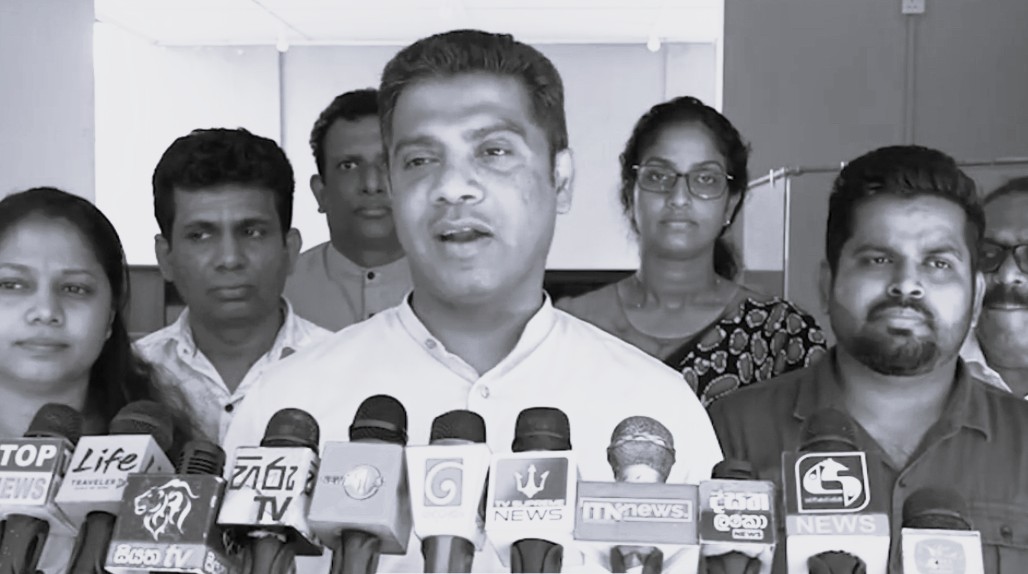

(Sri Lanka Brief) Media Minister Nalinda Jayatissa has rejected allegations that the government is seeking to suppress media freedom, stating that Sri Lanka remains committed to democratic principles while taking necessary action against the spread of fake news and disinformation.
Addressing recent criticism, Jayatissa said that social, electronic and print media were free to criticise the government and highlight its shortcomings. However, he stressed that the government was duty-bound to act when media platforms engage in what he described as deliberate disinformation campaigns that threaten public trust and national stability.
“With the existing laws, the government is duty-bound to take action,” the Minister said, a remark that has sparked concern among media rights advocates about potential government overreach.
His comments have been widely interpreted as a signal that the government may review the broadcasting licence of a popular private television and radio network, ABC, which operates Hiru TV and Hiru FM. The network has been critical of the current administration, prompting speculation that regulatory action could be taken against outlets perceived as unfriendly to the government.
Jayatissa dismissed claims of media suppression, reiterating that criticism alone would not invite punitive measures. “These are not mere criticisms,” he said, referring to what he termed organised disinformation efforts. “They are calculated attempts to create public distrust and destabilise society.”
The Minister also framed the government’s stance as a response to public pressure. “People are accusing us of not taking action. They have given us a mandate, and there is a strong public call for the government to act against fake news and false reporting,” he said.
Sri Lanka’s debate mirrors a global challenge faced by governments as misinformation spreads rapidly through digital platforms and social media. From election interference in Western democracies to public health misinformation during the COVID-19 pandemic, fake news has been shown to undermine institutions, deepen social divisions and, in some cases, endanger lives.
International organisations, including UNESCO, have warned that efforts to combat disinformation must be carefully balanced to avoid censorship. They advocate transparent regulation, independent fact-checking mechanisms and media literacy initiatives rather than sweeping legal restrictions.
Media freedom groups in Sri Lanka have cautioned that any move to penalise broadcasters must be guided by due process and independent oversight. They argue that vague definitions of “fake news” could be used to silence dissenting voices, weakening democratic accountability.
As the government signals a tougher stance on misinformation, observers say the key challenge will be ensuring that action against disinformation does not erode press freedom—long regarded as a cornerstone of Sri Lanka’s democratic framework.