
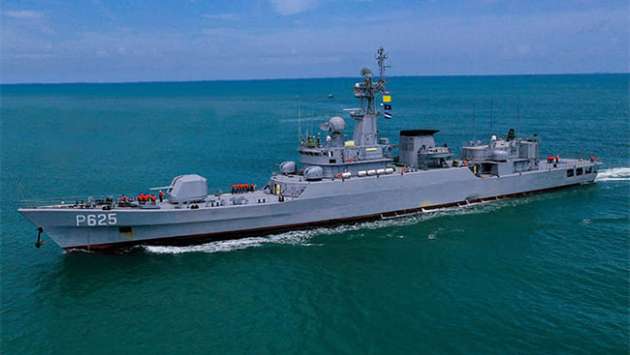

Sri Lanka’s foreign exchange earnings from onboard maritime security operations have seen a marked increase since the Sri Lanka Navy assumed full control of the service, ending years of reliance on private-sector intermediaries, official figures show.
The provision of Onboard Security Team (OBST) services was first introduced by the Sri Lanka Navy in 2009 to safeguard international merchant vessels transiting high-risk waters. While the Navy initially operated the service directly, it was later placed under various administrative arrangements. In 2012, the service was transferred to a joint venture between Rakna Arakshaka Lanka Ltd (RALL) and Avant Guard Maritime Services (AGMS), significantly altering the revenue structure.
Under the joint venture model, the bulk of earnings flowed to the private partner. Of the total revenue generated, Avant Guard Maritime Services received 80.75 percent, while Rakna Arakshaka Lanka Ltd was allocated 4.25 percent. The Sri Lanka Navy, despite providing operational expertise and personnel, received only a 15 percent share, paid in Sri Lankan Rupees, limiting the direct foreign exchange benefit to the state.
Although the service was briefly returned to Navy control in 2015, it was once again handed back to a private joint venture in 2021. This arrangement continued until August 10, 2025, when the government took a decisive policy turn. Through an extraordinary gazette notification, full authority and responsibility for providing onboard maritime security services were reassigned exclusively to the Sri Lanka Navy, placing the operation under direct government control.
Since the change, all revenue earned from international shipping companies has been credited directly to the Government’s Consolidated Fund in US Dollars, eliminating intermediaries and increasing transparency. According to official data, the Navy’s independently managed operations generated USD 598,250 in foreign exchange in less than four months, from October 3, 2025, to February 8, 2026.
By contrast, the previous RALL–AGMS joint venture generated approximately USD 14.12 million over a period of nearly four years, from September 2021 to July 2025. Despite the higher gross earnings during that period, the government’s direct financial benefit remained limited due to the revenue-sharing structure.
Further concerns have emerged over outstanding payments from the private operator. Authorities have revealed that Avant Guard Maritime Services has failed to remit LKR 782 million owed to the Sri Lanka Navy for the period between December 1, 2014, and November 13, 2015, raising questions about accountability under the earlier private-sector model.
Officials say the return of OBST operations to direct Navy control not only maximizes foreign exchange inflows but also strengthens Sri Lanka’s credibility in the international maritime sector. By removing private intermediaries, the government retains full oversight of security operations, revenue collection, and diplomatic engagement with foreign shipping entities.
The Navy’s direct involvement is also expected to enhance national security standards while ensuring that earnings from maritime security—an area closely linked to sovereign responsibility—fully accrue to the state.