
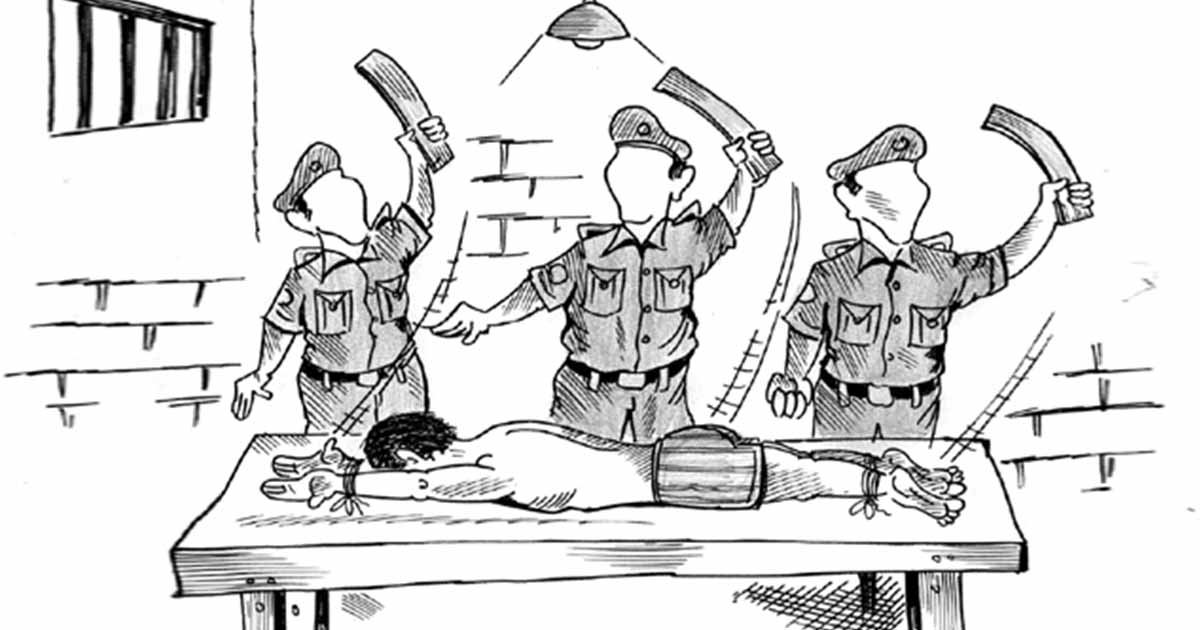

The police service in Sri Lanka is once again under intense public scrutiny following the death of 29-year-old Ishara Harsha Kumara, a resident of Kiriwaththuduwa and a father of one, while held in police custody. The incident triggered widespread public outrage and a high-level investigation, leading to the arrest of the former Officer-in-Charge (OIC) of the Homagama Police Crimes Division by the Western Province South Divisional Crimes Division, while three officers were suspended and an open verdict was delivered in the post-mortem examination. This tragic incident underscores a terrifying reality: custodial violence in Sri Lanka is not an isolated phenomenon, but an ongoing, unaddressed epidemic.
Custodial violence in Sri Lanka
Custodial violence, arbitrary deaths, and the extrajudicial killing of suspects and prisoners under heavy police guard have long plagued the Sri Lanka Police Service. According to the Human Rights Commission of Sri Lanka (HRCSL), between January 2020 and March 31, 2025, alone, there were 49 reported deaths in police custody and 30 deaths resulting from confrontations with the police following arrest.
A list of Custodial Deaths
Over the decades, a grim pattern of fatal encounters in custody has emerged across the island, demonstrating that these events are not isolated anomalies but structural failures. Notable historical and recent cases include human rights lawyer Wijedasa Liyanarachchi, who died in 1988 from severe internal trauma following police torture while representing political detainees; Gerald Mervin Perera, a dock worker arrested in a case of mistaken identity who suffered acute renal failure due to torture in 2002 and was later assassinated in 2004 days before testifying against the responsible officers; Chadrik Sriyantha De Silva, who died in 2005 following severe assault at the Peliyagoda Police Station over an alleged telephone theft; Dinesh Tharanga Fernando and Dhanushka Udayakantha Aponso, who were abducted, assaulted, and shot to death while in the custody of Angulana Police in 2009; high-profile suspects Samarasinghe Arachchige Madush Lakshitha (“Makandure Madush”) in 2020 and Dharmakeerthi Tharaka Perera Wijesekera (“Kosgoda Tharaka”) in 2021, both shot dead during alleged weapons recovery operations; Nagarasa Alex, a 26-year-old youth who died following severe torture in Vaddukoddai Police custody in 2023; Sathsara Nimesh, a 26-year-old who died in police custody in Colombo in April 2025, and Rajendran Kapilan, a 34-year-old man who died while in Pesale Police custody in Mannar in October 2025.
Prolonged Impunity
While many custodial incidents result in prolonged impunity, the Sri Lankan judiciary has on several notable occasions handed down stern convictions and severe punishments to officers involved in custodial killings. In the 2009 Angulana double murder of Dinesh Tharanga Fernando and Dhanushka Udayakantha Aponso, a High Court Trial-at-Bar sentenced four officers, including OIC Newton and three constables, to death, a ruling subsequently affirmed by the Supreme Court. In the 2005 Chadrik Sriyantha De Silva case, the Colombo High Court sentenced a Sub-Inspector and a Police Constable to death in March 2024 and ordered them to pay compensation to the victim’s family. In the 2014 Sandun Malinga case, involving a 17-year-old tortured to death at the Kandaketiya Police Station, the Badulla High Court sentenced six police officers to 20 years of rigorous imprisonment each. In the 2002 Wisidagamage Gerard Perera case, the High Court convicted the responsible officers under the Convention Against Torture (CAT) Act, sentencing them to 10 years of rigorous imprisonment. In the 2008 Sugath Nishantha Fernando case, where the victim was shot dead while his torture complaint was ongoing, the High Court handed down death sentences to the primary accused police officers and their accomplices.
Judicial Precedents and Failure of the Police
Despite these landmark judicial precedents, institutional reform remains elusive, and senior police leadership has frequently faced accusations of condoning, ignoring, or directly participating in custodial abuse. High-ranking figures have been repeatedly implicated in constitutional violations, such as in Supreme Court Fundamental Rights case SC/FR/107/2011, where former Inspector General of Police (IGP) Deshabandu Tennakoon – who was Superintendent of Police at the time material – and fellow officers were found personally responsible for torturing a detainee, including forcing him to apply Siddhalepa ointment to his genitalia during interrogation. In another telling judgment delivered on April 2, 2026, the Supreme Court ordered current Police Media Spokesman ASP F. U. Wootler (Udayakumara Wootler) to personally pay compensation to an Attorney-at-Law for violating his fundamental rights during an interrogation incident at the Negombo Police Station.
These two cases serve as glaring examples of institutional rot that runs from top to bottom. It is a dark irony that the very Police Spokesman found by the Supreme Court to have personally violated fundamental rights remains the official voice of the police service—issuing press statements and providing public assurances on investigations into custodial deaths like the Homagama incident. When institutional leaders and official spokespersons face formal judicial condemnation for constitutional violations yet retain their posts, institutional authority, and public podiums, the message conveyed to subordinate officers is one of systemic tolerance for lawlessness. Lower-ranking personnel predictably view abuse and summary violence not as criminal offenses, but as standard operational procedures endorsed from above. Following HRCSL General Guidelines No. 1 of 2025 on Preventing Custodial and Encounter Deaths, the Inspector General of Police (IGP) issued a formal circular on June 20, 2025, to operationalize these standards and train personnel. Yet, as recent custodial deaths prove, the police force repeatedly demonstrates a complete disregard for even its own IGP’s directives and institutional guidelines.
Existential Threat to the Democratic Framework
The occurrence of custodial deaths represents a grave, existential threat to the democratic framework and social contract of a nation. The police service functions as the most direct, visible, and frequent interface through which the state interacts with ordinary citizens. Under fundamental legal philosophy, a democratic government derives its legitimate authority from a social convention in which free individuals surrender certain private freedoms to the state in exchange for collective security, order, and the defence of human dignity. The police are explicitly commissioned to exercise state power and authority for the sole purpose of protecting individual rights, preserving order, and safeguarding civil liberties. This protective obligation is especially sacred when it comes to the weak, the underprivileged, the impoverished, and the helpless—the very populations who lack economic influence or social privilege and possess only state law enforcement as their shield against insecurity, extortion, and physical threats.
Furthermore, when an individual is taken into police custody, their liberty is stripped away, making them completely vulnerable and dependent on the state. Consequently, the state and its law enforcement officers assume an absolute legal and moral guardianship over every person held under restraint. This fiduciary duty of protection applies universally and unconditionally to any human being under state control, regardless of whether they are an innocent bystander, a falsely accused civilian, a petty offender, or a hardened criminal. When officers mistreat, assault, or kill a person in their custody, they commit a fundamental betrayal of state trust. If citizens cannot rely on law enforcement for protection, the fundamental justification for state authority dissolves, leaving society exposed to arbitrariness and systemic terror.
Public Apathy and Endorsement of Police Brutality
Despite the severe constitutional implications of custodial violence, public apathy and even endorsement of police brutality remain alarmingly widespread. Society is frequently manipulated by official narratives into believing that anyone who dies in police custody must inherently be a dangerous criminal, a murderer, or a drug trafficker whose death is a benefit to public safety. This narrative fosters the dangerous misconception that righteous, law-abiding citizens never face police violence, and that custodial deaths happen only to those who deserve them. Driven by frustration with an overburdened judicial system, soaring legal costs, prolonged trials, and public security anxieties, many people rationalize custodial killings as a quick, efficient, and cost-effective shortcut to justice.
A Dangerous Delusion
Promoting or tolerating this form of “instant justice” is a dangerous delusion that directly destabilizes the security of every citizen. When extrajudicial killings are normalized or applauded, the nation edges toward a lawless state where law enforcement officers operate without accountability, effectively assuming the role of investigator, prosecutor, judge, jury, and executioner simultaneously. When police officers are empowered to decide who lives and who dies behind locked doors, procedural safeguards disappear. Under such a regime, any citizen can fall victim to police violence over a personal grudge, a financial dispute, or a refusal to pay a bribe, because an officer need only kill the individual and subsequently claim they were a dangerous drug dealer or an armed suspect.
This grave risk is not hypothetical, as illustrated by a damning judgment delivered by Gampaha Magistrate Bandula Gunaratne. The Magistrate ordered three police officers from the Gampaha Anti-Vice Squad to personally pay Rs 200,000 in compensation to a citizen after uncovering that the officers had initiated frivolous and oppressive prosecutions against him by filing two separate cases on the very same day to artificially inflate case counts. Society needs no starker reminder of how easily police authority can be weaponized than the conviction of former DIG Vass Gunawardena, his son Ravindu, and four fellow officers, currently on death row for the May 2013 abduction and contract murder of Colombo businessman Mohamed Shiyam for Rs. 10 million. When law enforcement units actively fabricate evidence, frame citizens on bogus narcotics charges to hit administrative targets, or engage in contract killings, trusting the police to unilaterally execute summary justice without trial invites total tyranny—a danger that would only intensify if unchecked police powers are further expanded under proposed legislation like Sri Lanka’s Protection of the State from Terrorism Act (PSTA).
Moreover, allowing suspects to die in police custody undermines the broader administration of justice by destroying essential evidence and protecting high-level criminal networks. Suspects held in custody often possess critical information regarding masterminds, corrupt public officials, organized crime syndicates, and complex illegal operations. When a suspect is killed under the guise of an escape attempt or a weapons recovery operation, their silence ensures that the larger infrastructure of crime remains untouched. Extrajudicial killings do not eradicate crime; they cover up corruption, silence potential state witnesses, and allow powerful accomplices to evade accountability permanently.
The Way to Safeguard the Rule of Law
The judicial process exists for a vital reason: to establish factual truth through rigorous evidentiary standards, cross-examination, and impartial adjudication. Every individual, regardless of the severity of the allegations against them, possesses an absolute right to present a defence and be judged according to the law. The constitutional duty of the police is strictly limited to investigating crimes, gathering evidence, and presenting suspects before a court of law. Sanctioning custodial violence under the illusion of convenience dismantles the legal protections that keep all citizens safe; condemning custodial abuse and holding every officer accountable is the only way to safeguard the rule of law.