


Recommendations flagged in successive audit and performance reports go unheeded
By Namini Wijedasa/ Sunday Times.
Sri Lanka’s lead agency for disaster management suffers from crippling staff shortages, an analysis of documents from 2011 to 2023 shows.
As at the end of last year, only 269 employees of the Disaster Management Centre’s (DMC) approved cadre of 447 were in service, the latest report of the National Audit Office states.
This left 178 vacancies—or 40 per cent of the approved cadre—unfilled, amounting to just under half the required staff positions.
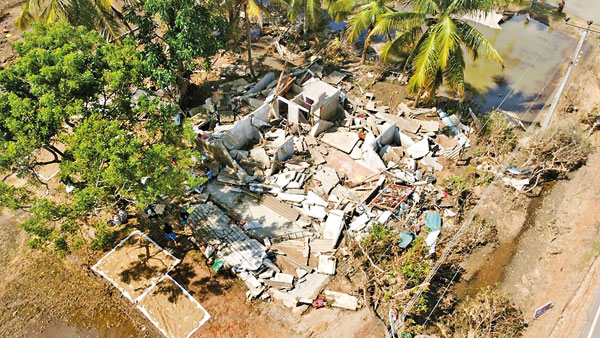
Karuwalagaswewa Ditwah disaster: DMC’s handicap exposed but not acted upon. Pic by Hiran Priyankara
No development officers
Separately, the DMC’s latest Annual Performance Report, presented to Parliament this year, states that as at the end of 2023, there were 169 vacancies of the approved cadre of 447. This signifies that 38 percent of positions were unfilled and that the number of vacancies increased by two percent last year.
The vast majority of openings—101 of them—were for development officers. These are key personnel whose telephone numbers are stored in the DMC’s call centre database (alongside those of grama niladharis and relief service officers) for disaster-related communication and information dissemination. Their positions have not been filled for many years.
The “inability to fill those vacancies is currently a great obstacle and a challenge to perform the responsibility and duties efficiently and effectively,” the 2023 APR states, with regard to total staff shortages. Many positions are technical, requiring specialised skills for tasks such as risk reduction, training, emergency response and research.
There is also a specific need for staff who can handle the Tamil language in the 24×7 emergency operation room and 117 call centre, the 2023 report flagged. This was also highlighted in the 2022 report. While operations are meant to be trilingual (English, Sinhala and Tamil), the lack of communication in the Tamil language raised significant concern before and after Cyclone Ditwah.
This serious shortfall is also identified in several other APRs. For instance, in 2017, it was noted that, “Only a limited number of employees are there who can use the Tamil language, and therefore there are difficulties in providing service to the Tamil-speaking persons, and it also affects the State language policy.”
Data collection impacted
Employee shortages have also affected the DMC’s www.desinventar.lk database, which contains past disaster-related information, including deaths, affected people and damaged property in each district. The system was updated every 15 days, depending on data collection, etc. Information from police reports is also incorporated.
“This data system has been actively updated up to 31.09.2023, but due to the lack of necessary staff for the same, it has not been possible to update,” the APR says.
The need to carry out a “school disaster risk assessment” in the education sector at the national level was highlighted on many occasions as an urgent need. After conducting preliminary discussions with the Education Ministry, education zonal directors and principals were notified, and the necessary information was collected in the main data system in 2023.
“However, the future work of preparing this risk index has not been able to be implemented due to the lack of relevant staff and lack of provisions,” it is revealed.
The DMC has notified the NAO that vacancies arose after the suspension of public sector recruitments in August 2021. However, all APRs from 2011 to 2023 have listed staffing deficiencies as an impediment to the effective functioning of the agency.
Long-standing issues
Alarmingly, the latest APR also highlights that the DMC lacks the financial provisions to conduct simulation exercises to educate about and prepare communities and other stakeholders for disaster situations, particularly at the district level.
Simulation exercises help gear communities and allow for stress testing plans and systems for effective response. Systems, emergency procedures, contingency plans, response mechanisms, and equipment are tested in these exercises.
Meanwhile, there is the need for an emergency fund—this existed before but no longer does—to provide emergency financial provisions for search and rescue teams. This is emphasised in several APRs, including in 2019, where it is held that cash-in-hand is essential to carry out certain duties, such as transporting rescue groups, fuel expenses for certain equipment or machinery, and buying spare parts. “However, this facility is not available at present,” it points out.
Equipment for the communication network is needed to carry out essential coordination with other agencies, while money is also required for a technical upgrade of the 117 call centre. Local authorities must actively engage with disaster management units at the district level, and there was a “lack of proper allocation of resources at the district level for efficient implementation of emergency response systems”.
Will history repeat?
The 2021 APR reveals that the agency faced problems in resettling disaster victims owing to the lack of alternative lands in high-risk areas such as Badulla, Nuwara Eliya, Kegalle, Matale, Kandy and Kurunegala—all regions which were severely impacted by Cyclone Ditwah and where there were hundreds of landslides. This is defined as “a major concern”.
Further difficulties included the inability to acquire identified lands and the failure to update the approved limit of allocations to acquire lands and construct houses. There was also a notable lack of proper laws regarding the eviction of families from their homes before permanent housing was assigned for resettlement.
“Large amounts of money utilised to provide relief in disaster situations could be saved by providing immediate resettlement after proper and systematic removal of houses that are facing risks,” the report maintains. “Flats or apartments are more suitable for resettlement in highly populated areas such as Colombo.” It also envisages introducing flats or apartments to families who reject resettlement “due to different reasons and concerns”.
“It is more appropriate to obtain lands closer to estates in areas like Kandy, Nuwara Eliya and Badulla to construct houses,” it states.
Good, on paper
The 2021 APR notes that a long discussion was held in a Parliament committee room on actions to be taken regarding floods and landslides that took place in November that year. It was chaired by the then Prime Minister, Mahinda Rajapaksa, and attended by 13 ministers from the National Council for Disaster Management, eight state ministers, 21 parliamentarians, secretaries of several ministries, and 22 representatives of departments and government institutions with direct involvement in disaster management.
There were “decisions taken to minimise the existing disaster situations”. Among these was to accelerate the land acquisition process after discussions with divisional secretaries and owners of plantation companies. Another was to take immediate action to set up a consolidated mechanism—together with the Department of Irrigation, Land Development Corporation, Coast Conservation Department, Road Development Authority and the Sri Lanka Land Reclamation Corporation—to prevent floods.
“As there is a possibility of future disasters happening due to the islands of sand near the Mahaweli River in Getambe, Gannoruwa, it is appropriate to remove the sand for proper development activities, subject to obtaining prior approval of the Geological Survey and Mines Bureau,” it was agreed, referring to an area of Kandy among the worst affected in recent floods.
Whither implementation?
The thirteen APRs analysed by the Sunday Times showed that there was no shortage of recommendations. Risks have been identified, and solutions visualised repeatedly.
For instance, the 2020 APR proposes that disaster risk mitigation be included in the development mainstream; that disaster management be identified as an essential service; that a multi-hazard warning system be established; and that the existing communication network be repaired and upgraded.
It decries the “lack of active involvement” of local authorities with district-level disaster management units; the absence of an emergency financial provision for speedy rehabilitation and recovery; the failure to set up search-and-rescue teams at the district level; and, again, the lack of an emergency fund to provide emergency financial assistance to search-and-rescue teams during emergency response.
When district risk profiles are prepared, it takes time to collect quality data from the grassroots and to computerise the data and to convey that information to the national headquarters, the 2018 APR explains, pointing to “various practical difficulties”.
“DMC works with minimum human and physical resources at the national and district level, and it creates various challenges in project planning, implementation, and monitoring/evaluation,” it says.
The report also reveals that disaster mitigation programmes identified at the district level sometimes cannot be implemented due to public protests.
In other reports, the need is emphasised for an efficient communication system to provide information to the grassroots in an emergency. In 2018, it was stated that the present communication system of the DMC “cannot cover all the people that can be affected by a disaster”.